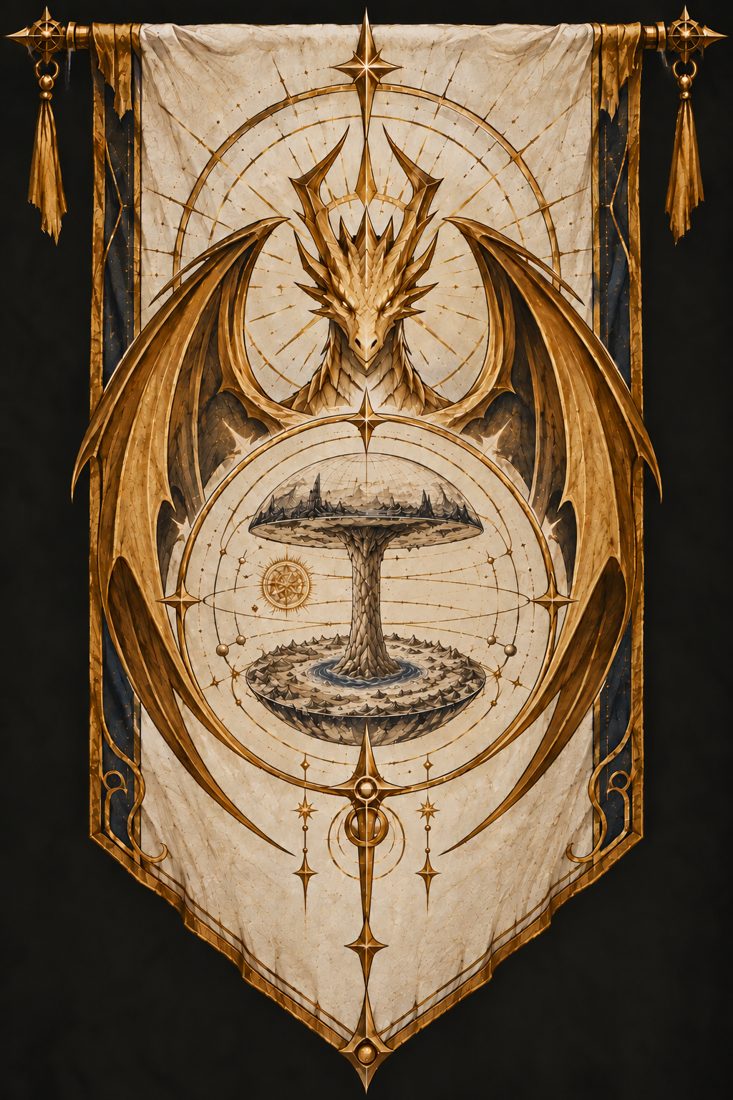
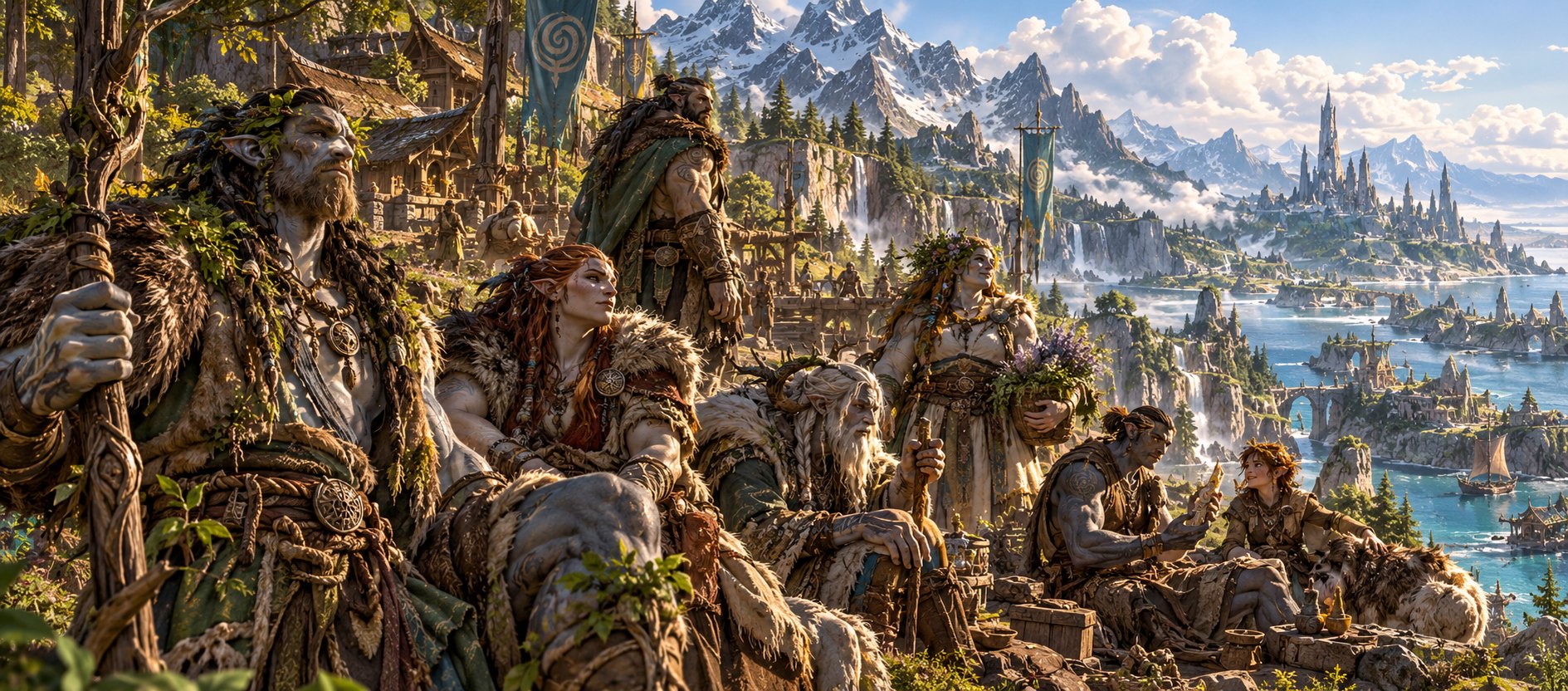
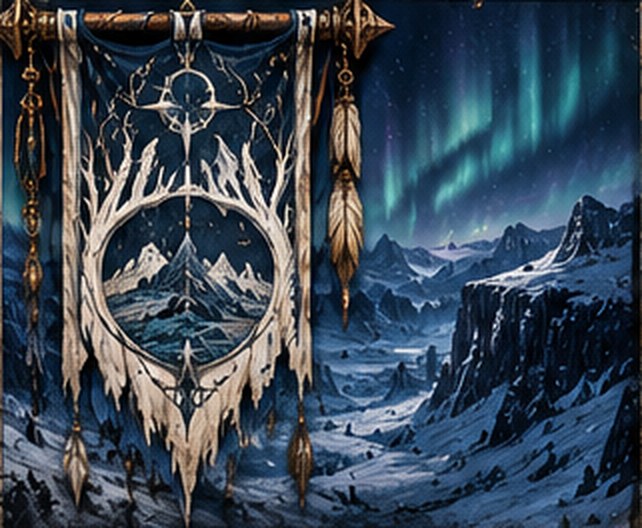
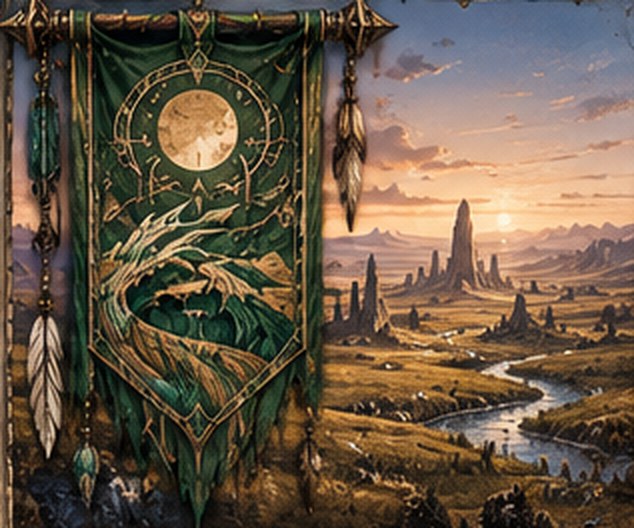
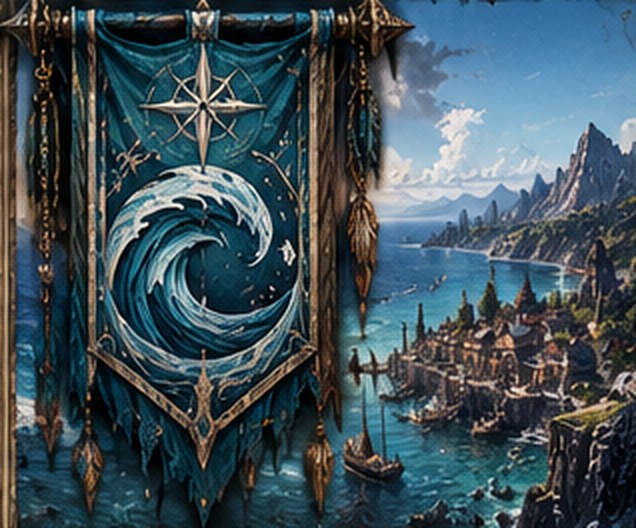
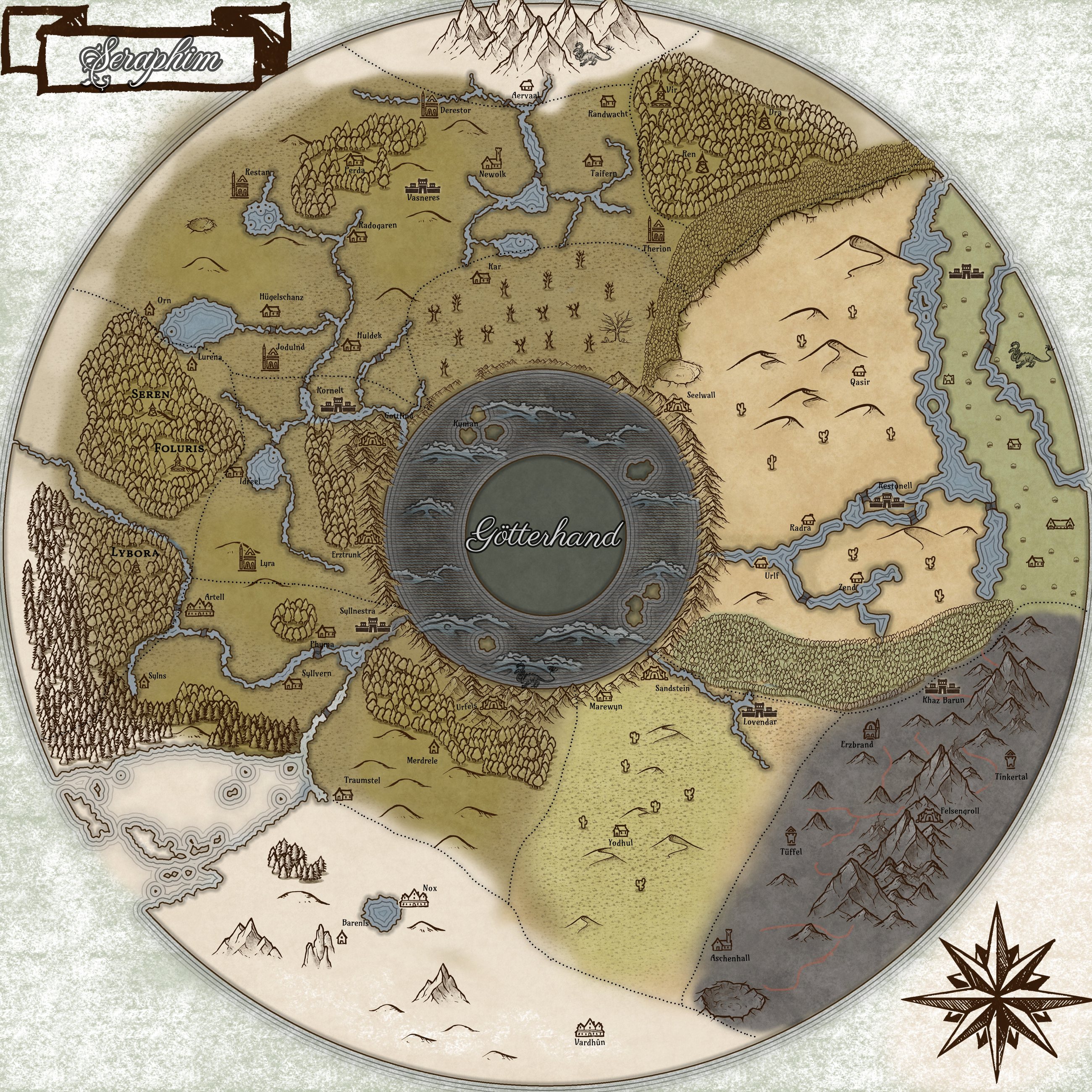
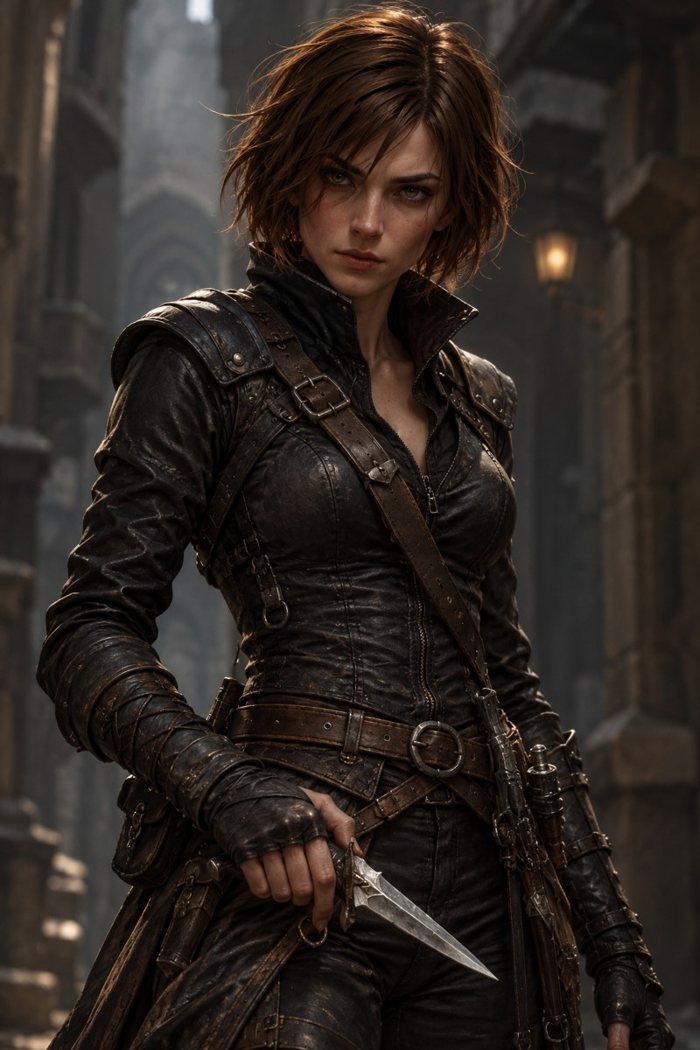
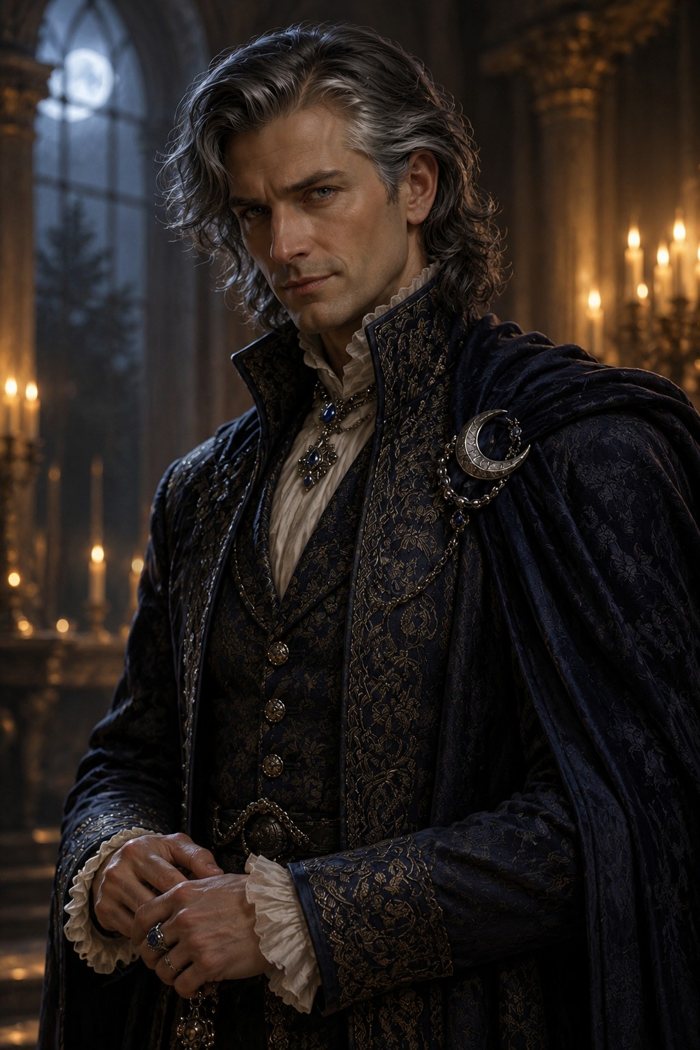
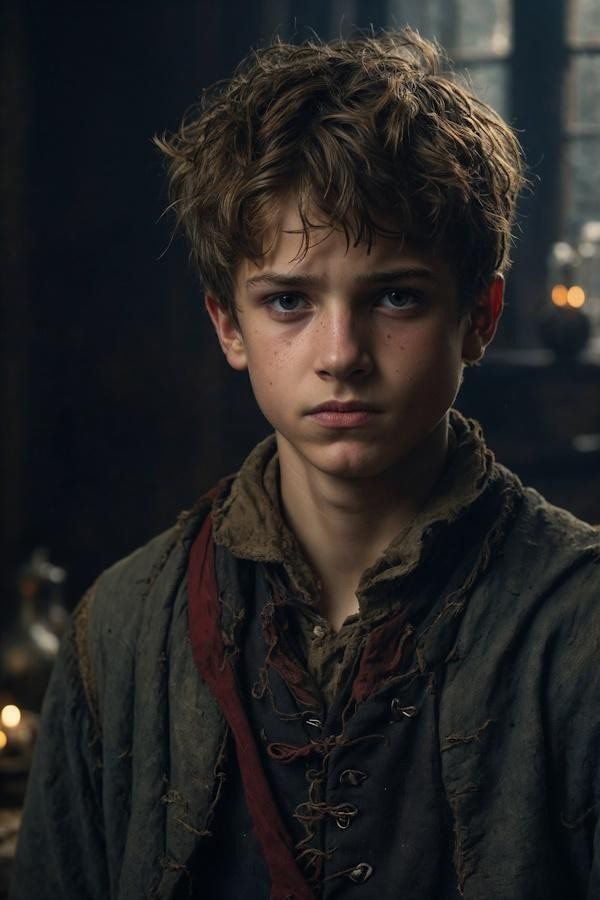
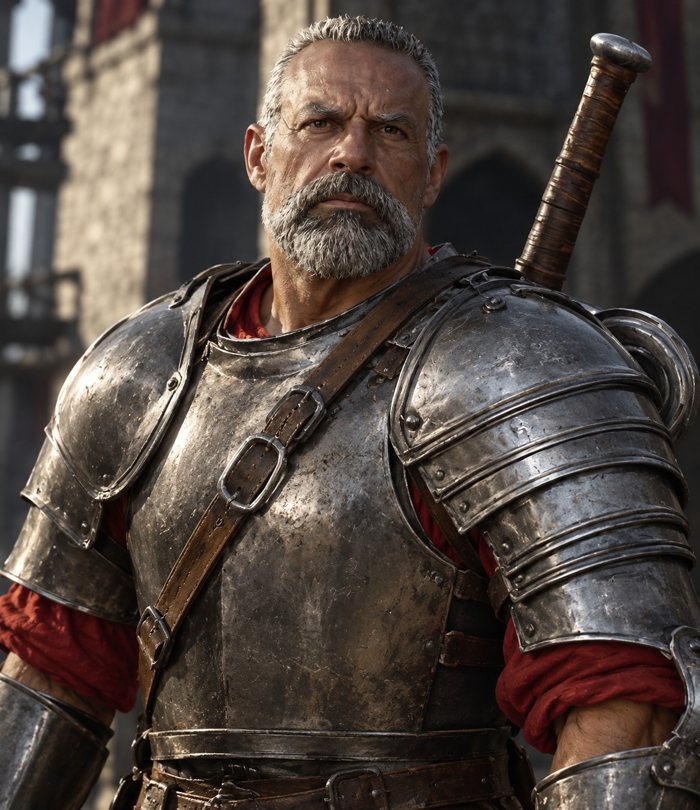
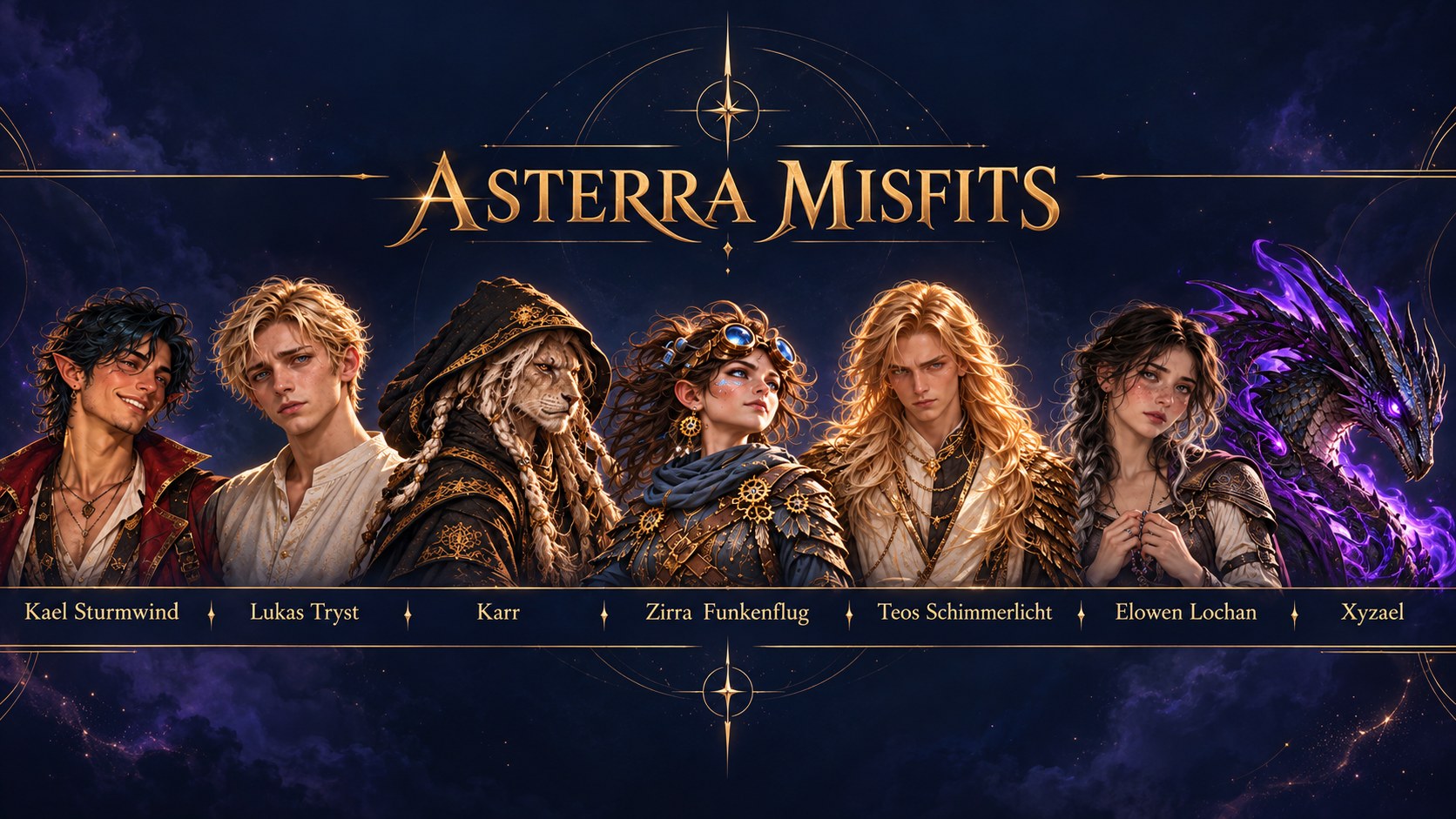
We are a roleplaying group exploring the world of Asterra together. Our heroines and heroes walk the disc of Seraphim, beneath a sky that knows no infinity, in the shadow of a pillar that is slowly breaking apart.
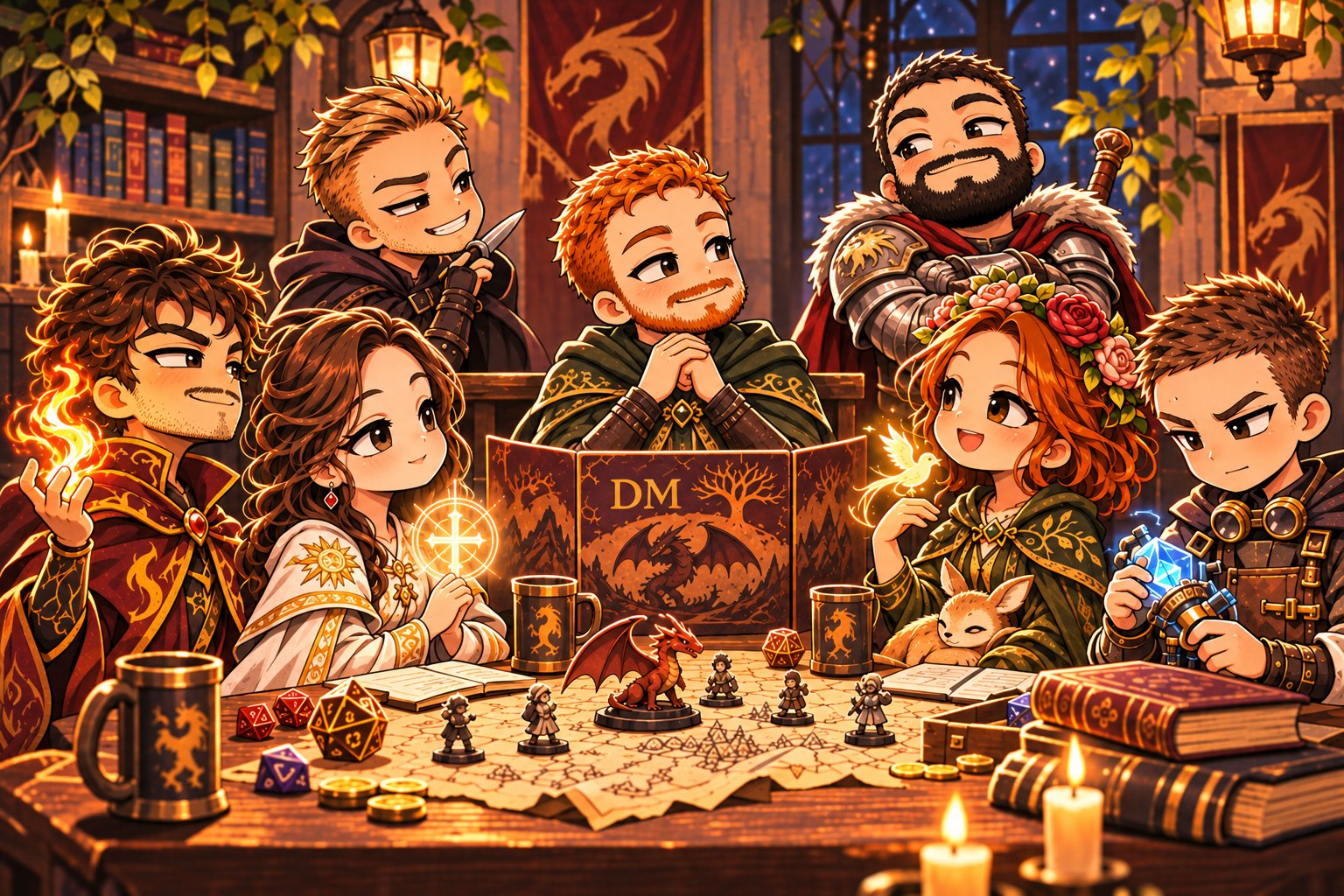
We play online on Discord and Roll20, using the D&D 2024 rules. Our campaign is streamed, and at times the viewers vote on the path ahead as the “7th player”.
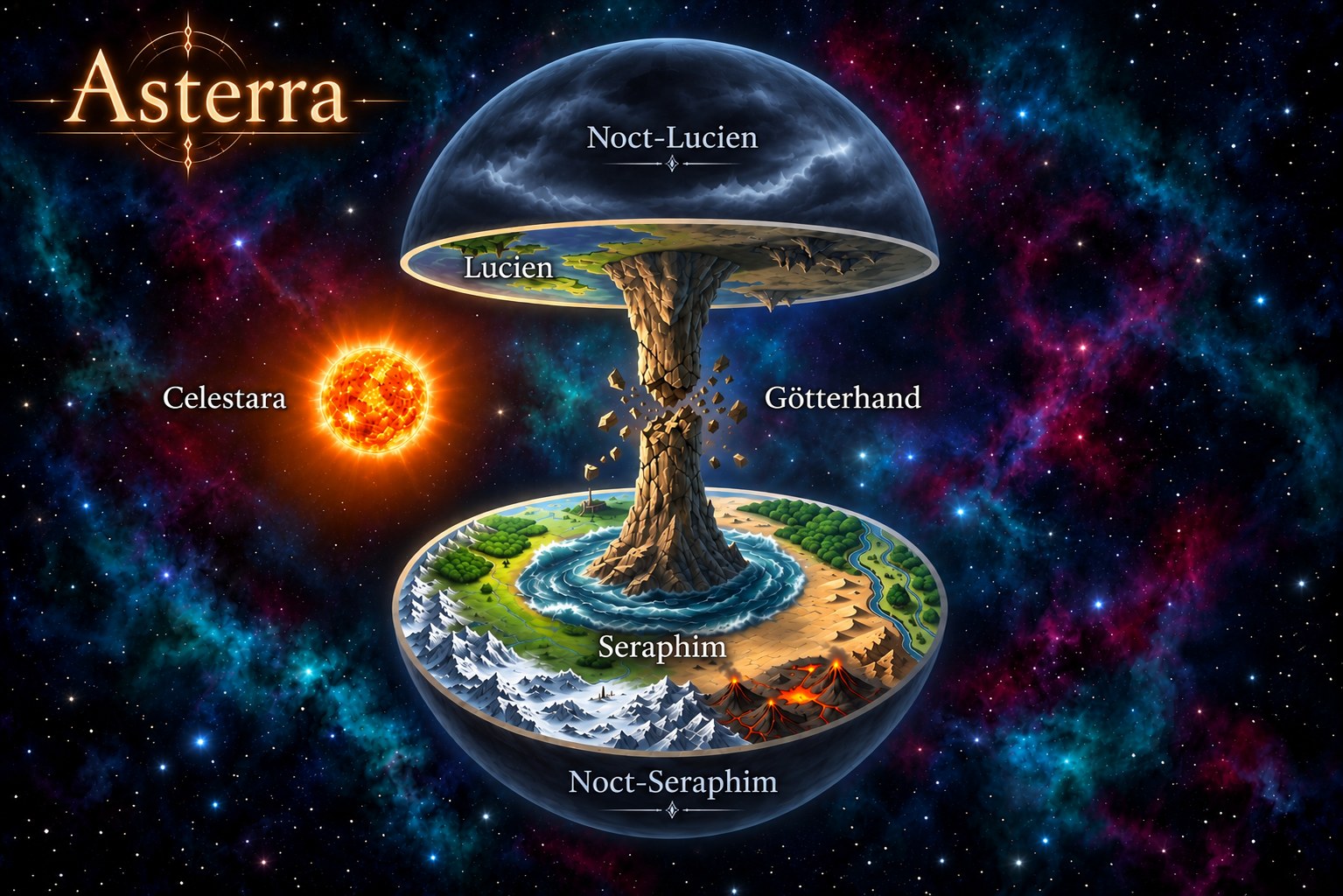
In an existence that mocks every law of nature, two titanic hemispheres rise up – fragments of a world that ought to have shattered long ago. In the midst of this impossibility, the Götterhand, a stone pillar of unimaginable power, braces itself against the chaos.
It alone keeps the fabric of the world from ruin and forces even the most doubting scholars and astronomers to their knees before the realisation: no chance was at work here, but the will of the Eternal Ones.
the order of the cosmos
Light within, silence without
They sit enthroned in eternal strife: Lucien and Seraphim, two world discs facing one another like grim colossi, caught in a rigid stare of rock and ice. Yet amid this deafening silence, Celestara keeps watch.
As a blazing astral body, she traces her orbit around the stone heart of the Götterhand. Her light is the holy breath that quickens the flesh of the earth; without her eternal dance there would be only dead rock, but through her blessing flora and fauna flourish in the shadow of the impossible.
Here, on the vast disc of Seraphim, our heroes walk beneath a sky that knows no infinity but has a face. High above them looms the distant sister Lucien, an unreachable firmament of stone and far-off lights.
The Götterhand rises into the zenith as an incomprehensible monument, a pillar without tangible history, whose origin was lost in the mists of primeval times. What truly stirs over there, in the shadow of the opposite world disc, remains a whisper in the textbooks.
inner side · above
Lucien
The distant sister. To the heroes, a firmament of stone and far-off lights – unreachable.
inner side · below
Seraphim
The heroes’ disc. Grassland, desert, ice and embers around a roaring sea.
outer sides
Noct-Lucien & Noct-Seraphim
The outer shells, turned towards the yawning void of the cosmos. Unknown.
the echo of doom
The backbone of creation is bursting
The impossible demands its tribute. The Götterhand, that eternal foundation which has endured for aeons, is beginning to tremble under the unbearable weight of two worlds. What was once dismissed as a distant flood or a rumbling quake now reveals its true, terrible face.
With every splinter that breaks from the sacred rock, Lucien and Seraphim draw closer to one another – a slow, unstoppable fall into the final abyss. Does Asterra face its last sunset, or can those who defy fate halt the looming world-fire?
World-fire
the world · the cosmos
Time in Asterra
A year of six god-months, a day of 25 hours and a night that can turn completely black.
360days in a year
6months of 60 days each
25hours per day
~2hours of Perfect Night
The Calendar
The year counts 360 days and is divided into six months of 60 days each. Each month bears the name of one of the six great deities and thus stands symbolically under their influence. The deities alternate in their order between female and male.
Together the six months form a complete Götterkreis (circle of the gods). One Götterkreis is thus equal to a full year and comprises 360 days.
Dates are given by the day, the month and the current Götterkreis. After the 60th day of a month, the next month begins immediately. After the 60th day of Terminos, the Götterkreis ends and a new one begins with the first day of Idrenel.
“The 48th day of Syllona, in the 327th Götterkreis.”This is how a date reads in Asterra
Date calculator
Which day of the Götterkreis is this?
The Skies of Asterra
At the centre of Asterra stands the mighty Götterhand. This gigantic pillar construct connects and holds together the two halves of the world, Seraphim and Lucien. Around the Götterhand, Celestara, the sun-like celestial body, travels her eternal orbit.
Celestara’s motion is influenced by the gravitational forces of the two world halves. As a result she does not move on a perfectly even circular path but follows a wave-shaped orbit. Along her course she approaches the two world halves to varying degrees and then moves away from them again.
This interplay gives rise to Asterra’s distinctive day and night cycles as well as its different weather zones.
One complete orbit of Celestara around the Götterhand takes 25 hours. This period forms one complete day-night cycle.
The side of a world half that faces Celestara is lit by her light and experiences day. The opposite side meanwhile lies in night.
Ordinary night, however, is not completely dark. Even on the side turned away from Celestara, faint, indirect light still reaches the surface. Together with the light of the stars, this creates a natural darkness in which the world remains faintly visible.
With her 25-hour orbit, Celestara’s light wanders continuously across the two world halves. Day and night thus move steadily across Asterra.
DayNightPerf. NightNight
0 h25 h
Schematic: the length of day and ordinary night is simplified here. Only the total cycle of 25 hours and the roughly two hours of Perfect Night are fixed.
light · occluding object · shadow
The Perfect Night
A special phenomenon arises from the interplay of Celestara, the Götterhand and the shadow that the Götterhand casts.
When Celestara stands behind the Götterhand on her orbit, the mighty pillar construct lies between the light source and the opposite world half. The Götterhand obscures Celestara and casts its shadow onto the surface. Where this shadow meets the world, the Perfect Night arises.
The Perfect Night is not a supernatural phenomenon. It follows the natural laws of light, occluding object and shadow. Since the Götterhand can completely obscure Celestara, no direct light of hers reaches the surface in this area.
The Perfect Night therefore wanders across the world together with Celestara. Celestara’s light and the Perfect Night are always on opposite sides of each other.
In a 25-hour cycle, the Perfect Night lasts roughly two hours. Before and after it, ordinary night prevails.
The Weather Zones
Asterra has no fixed seasons. The temperatures and climatic conditions of a place do not change regularly over the course of a year. Instead, the different distances to Celestara determine the permanent weather zones of the world.
close to CelestaraScorching deserts
The closer a region is to Celestara, the more warmth and energy it receives. Here warm and dry landscapes arise, up to the scorching deserts of Asterra.
in betweenGrasslands
Between the extremes lie temperate regions, fertile plains, dense forests and lush grasslands.
far from CelestaraTundras & eternal ice
In the regions that lie especially far from Celestara, icy temperatures reign, and the landscape gives way to tundras and eternal ice fields.
The weather zones are thus a permanent part of the world. A region does not experience alternating seasons; owing to its position within the world it has a constant climatic zone.
the world · creatures
Bestiary
The creatures and monsters of Seraphim: what lurks in forests, deserts, ice and embers. Choose a creature to learn more.
Water djinn are ancient elemental spirits who command water in all its forms. They are found at oases and hidden springs, in underground watercourses and rivers, and on the coasts of the Tosendes Meer. Their arrival is often heralded by inexplicable currents, suddenly rising mist or unnaturally stirring water.
They are regarded as mighty spellcasters of their element: intelligent, vengeful and unyielding. Water djinn are often accompanied by lesser water elementals. They usually attack intruders without warning and use their surroundings to drown, wash away or otherwise subdue their opponents.
Water djinn regard mortals as intruders in their domain. Whoever enters their waters does so at their own risk: for a water djinni, any foreign life can become the plaything of an oceanic fate that it can shape, wash away or extinguish at will.
Traits
Mighty spellcasters of their element
Intelligent, vengeful and unyielding
At home at oases, springs, coasts and watering places
Usually accompanied by lesser water elementals
Attack intruders without warning
Use their surroundings to drown, wash away or control enemies
Magical abilities
Control over water in all its forms
Creation of powerful water jets and whirlpools
Creation of water out of nothing
Mist and ice spells
Manipulation of currents and waves
Healing magic they cast on themselves
Deforming and shattering matter by means of water
Engulfing and drowning opponents
“Water does not forget, and it does not forgive.”
Show stats (D&D 2024)
Water djinn
Large elemental (genie), neutral
Armor Class
17
Hit Points
218 (19d10 + 114)
Speed
30 ft, swim 60 ft
Initiative
+2 (12)
Challenge
CR 11 · 7,200 XP · PB +4
Size / Reach
Large / 5 ft
STR
DEX
CON
INT
WIS
CHA
21 (+5)ST +5
15 (+2)ST +2
22 (+6)ST +6
15 (+2)ST +2
16 (+3)ST +7
20 (+5)ST +5
Damage Immunities
Cold, poison, water
Damage Resistances
Acid; slashing, piercing and bludgeoning damage from nonmagical attacks
Condition Immunities
Poisoned, Exhaustion
Senses
Darkvision 120 ft; Passive Perception 13
Languages
Primordial (Aquan)
Elemental nature
Doesn’t need to breathe; can move freely underwater
Elemental plane
Water
Movement
Swim 60 ft; water is not difficult terrain
Traits
Elemental Regeneration. If the water djinni dies outside the Elemental Plane of Water, its body dissolves into watery mist. After 1d4 days it gains a new body on the Elemental Plane of Water and returns with all its hit points.
Magic Resistance. The water djinni has advantage on saving throws against spells and other magical effects.
Water Walker. The water djinni can move through water without being hindered by difficult terrain. It doesn’t need to breathe and can see and act normally underwater.
Wishes. The water djinni has a 30% chance of knowing the Wish spell. If it knows it, it can cast the spell for a non-genie creature that can communicate with it in a way it understands. After casting it three times, it can’t do so again for 365 days.
Actions
Multiattack. The water djinni makes three attacks, using Water Whip or Pressure Wave in any combination.
Water Whip. Melee attack: +9 to hit, reach 5 ft, one target. Hit: 12 (2d6 + 5) slashing damage plus 7 (2d6) cold damage. The target must succeed on a DC 17 Strength saving throw or be pushed 10 ft away.
Pressure Wave. Ranged attack: +9 to hit, range 120 ft, one target. Hit: 13 (3d8) bludgeoning damage. If the target is Large or smaller, it must succeed on a DC 17 Strength saving throw or be pushed 10 ft away.
Create Whirlpool. The water djinni conjures a whirlpool at a point it can see within 120 ft. The whirlpool fills a cylinder with a 20-ft radius that is 60 ft high. It lasts until the water djinni’s concentration ends. At the start of each of its turns, the water djinni can move the whirlpool up to 20 ft. When the whirlpool enters a creature’s space or a creature enters the whirlpool, it must make a DC 17 Strength saving throw. On a failure, it is restrained and moves with the whirlpool. At the start of each of its turns, it takes 21 (6d6) bludgeoning damage. At the end of each of its turns, it repeats the saving throw, ending the effect on a success.
Spellcasting
Spellcasting ability
Charisma (spell save DC 17, +9 to hit with spell attacks), no material components
At will
Detect evil and good, detect magic
2/day each
Create food and water, tongues, water walk
1/day each
Creation, gaseous form, invisibility, major image, plane shift
Water-specific
Water walk, create water, shape water
Concentration
Create Whirlpool requires concentration
Elemental magic
Water, mist and current effects
About the djinn in general
Djinn are elemental beings that have been found in and around the desert regions of Seraphim since the most ancient times. They are inseparably bound to the mighty natural forces of their homeland and appear above all where the elements are especially pronounced. Some have dwelt in remote regions for centuries, while others roam the deserts and change their territories again and again.
Their form and powers differ according to their elemental nature. Best known are the water and fire djinn, found at the oases, watering places and coasts of the Tosendes Meer and in the hot sand dunes and rocky areas of the Sengende Wüste respectively.
Djinn are no ordinary elementals. They possess intellect, a will of their own and a pronounced mastery of the arcane powers of their element. A djinni can not only control water, fire, sand or other manifestations of its element, but shape them as part of its magic and turn them against its enemies. Even experienced spellcasters should not underestimate an encounter with a djinni.
Most djinn regard the desert as their ancestral realm and react with extreme hostility to intruders. Travellers who enter their territories may be attacked without warning. Djinn are also often surrounded by lesser elementals of their own element, who follow them and serve as guards or retainers.
Although water and fire produce their most obvious representatives, the scholars of Seraphim also tell of djinn said to be bound to sand, storm, smoke or other elemental forces. Whether these are separate kinds or merely rare variants of known djinn remains unresolved to this day.
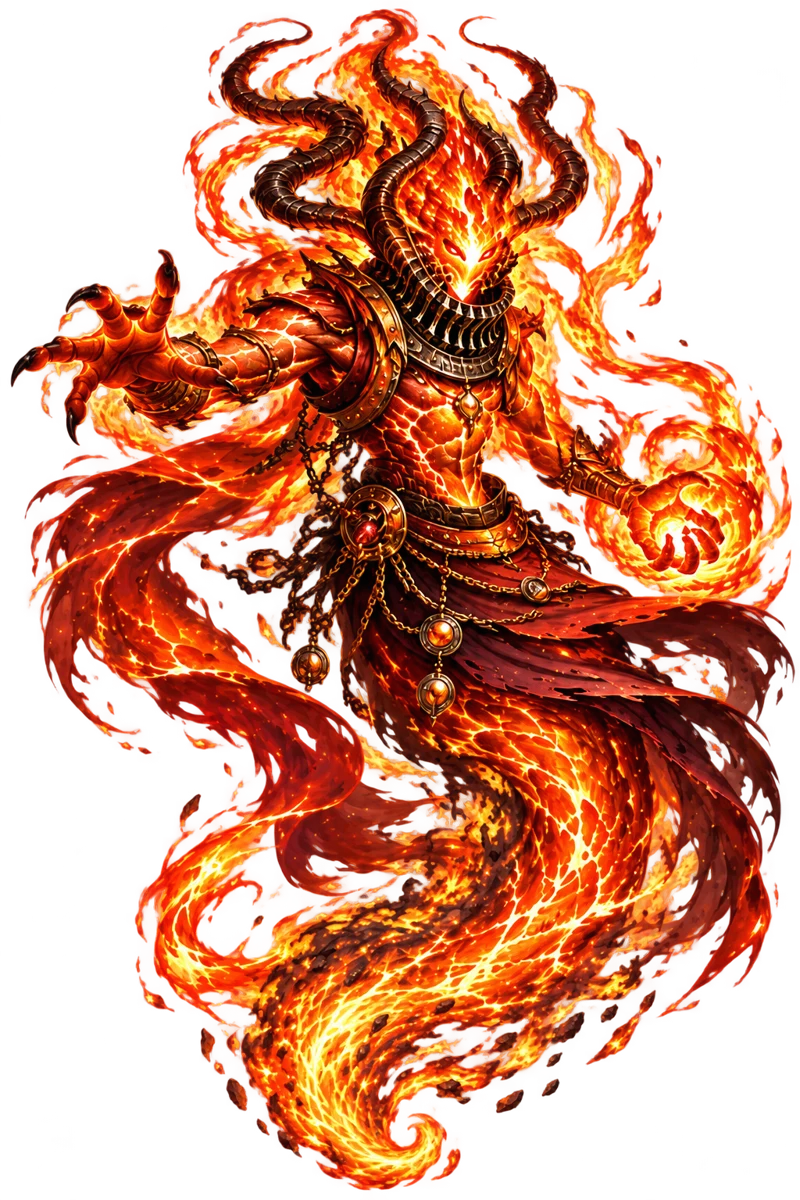
Fire djinn are ancient elemental spirits who roam the hottest regions of the desert. They inhabit glowing sand dunes and scorching rock plateaus – wherever the heat still shimmers even at night. To them the desert is a realm, and all mortal beings are intruders who are only tolerated for a while. Whoever sets foot on their dunes enters their hunting ground.
Fire djinn are proud, ruthless and merciless. They regard mortals as intruders and can turn them to ash in an instant. They are usually accompanied by lesser fire elementals. In battle they attack without warning and turn heat, fire, sand and their surroundings into weapons.
Traits
Mighty spellcasters of their element
Proud, vengeful and unpredictable
Live in the hottest dunes and on glowing rock plateaus
Usually accompanied by lesser fire elementals
Attack intruders without warning
Use heat, fire, sand and their surroundings as weapons
Magical abilities
Creation of fireballs and fire lances
Creation of walls and storms of flame
Heating metal, sand and rock
Igniting objects from afar
Manipulation of smoke and ash
Transforming their own body into fire
Creation and shaping of rock and metal
Drawing off heat and oxygen
“In every flame burns a will, and that will knows no mercy.”
Show stats (D&D 2024)
Fire djinn
Large elemental (genie), neutral
Armor Class
17
Hit Points
218 (19d10 + 114)
Speed
30 ft, fly 60 ft (hover)
Initiative
+2 (12)
Challenge
CR 11 · 7,200 XP · PB +4
Size / Reach
Large / 5 ft
STR
DEX
CON
INT
WIS
CHA
21 (+5)ST +5
15 (+2)ST +2
22 (+6)ST +6
15 (+2)ST +2
16 (+3)ST +7
20 (+5)ST +5
Damage Immunities
Fire, poison
Damage Resistances
Slashing, piercing and bludgeoning damage from nonmagical attacks
Condition Immunities
Poisoned, Exhaustion
Senses
Darkvision 120 ft; Passive Perception 13
Languages
Primordial (Ignan)
Elemental nature
Doesn’t need to breathe; can move through flames and smoke
Elemental plane
Fire
Movement
Fly 60 ft (hover); fire and heat are not difficult terrain
Traits
Elemental Regeneration. If the fire djinni dies outside the Elemental Plane of Fire, its body dissolves into sparks, smoke and ash. After 1d4 days it gains a new body on the Elemental Plane of Fire and returns with all its hit points.
Magic Resistance. The fire djinni has advantage on saving throws against spells and other magical effects.
Fire Walker. The fire djinni can move through fire, smoke and extreme heat without taking damage or suffering movement restrictions from these surroundings. It can move through flames as if they were open space.
Flame Form. The fire djinni can ignite or extinguish small flames near it. Flammable nonmagical objects it deliberately touches can catch fire.
Wishes. The fire djinni has a 30% chance of knowing the Wish spell. If it knows it, it can cast the spell for a non-genie creature that can communicate with it in a way it understands. After casting it three times, it can’t do so again for 365 days.
Actions
Multiattack. The fire djinni makes three attacks, using Flame Blade or Fire Bolt in any combination.
Flame Blade. Melee attack: +9 to hit, reach 5 ft, one target. Hit: 12 (2d6 + 5) slashing damage plus 7 (2d6) fire damage. The target can’t voluntarily become invisible until the start of the fire djinni’s next turn; flammable objects on the target can catch fire.
Fire Bolt. Ranged attack: +9 to hit, range 120 ft, one target. Hit: 13 (3d8) fire damage. If the target is Large or smaller, it must succeed on a DC 17 Dexterity saving throw or catch fire. A burning target takes 7 (2d6) fire damage at the start of its next turn; it can extinguish the flames as an action.
Create Fire Whirl. The fire djinni conjures a whirling column of fire at a point it can see within 120 ft. The whirl fills a cylinder with a 20-ft radius that is 60 ft high. It lasts until the fire djinni’s concentration ends. At the start of each of its turns, the fire djinni can move the whirl up to 20 ft. When the whirl enters a creature’s space or a creature enters the whirl, it must make a DC 17 Dexterity saving throw. On a failure, it is caught by the flames and moves with the whirl. At the start of each of its turns, it takes 21 (6d6) fire damage. At the end of each of its turns, it repeats the saving throw, ending the effect on a success.
Spellcasting
Spellcasting ability
Charisma (spell save DC 17, +9 to hit with spell attacks), no material components
At will
Detect evil and good, detect magic
2/day each
Create food and water, tongues, fly
1/day each
Creation, gaseous form, invisibility, major image, plane shift
Fire-specific
Fireball, flame strike
Concentration
Create Fire Whirl requires concentration
Elemental magic
Fire, smoke, heat and ember effects
About the djinn in general
Djinn are elemental beings that have been found in and around the desert regions of Seraphim since the most ancient times. They are inseparably bound to the mighty natural forces of their homeland and appear above all where the elements are especially pronounced. Some have dwelt in remote regions for centuries, while others roam the deserts and change their territories again and again.
Their form and powers differ according to their elemental nature. Best known are the water and fire djinn, found at the oases, watering places and coasts of the Tosendes Meer and in the hot sand dunes and rocky areas of the Sengende Wüste respectively.
Djinn are no ordinary elementals. They possess intellect, a will of their own and a pronounced mastery of the arcane powers of their element. A djinni can not only control water, fire, sand or other manifestations of its element, but shape them as part of its magic and turn them against its enemies. Even experienced spellcasters should not underestimate an encounter with a djinni.
Most djinn regard the desert as their ancestral realm and react with extreme hostility to intruders. Travellers who enter their territories may be attacked without warning. Djinn are also often surrounded by lesser elementals of their own element, who follow them and serve as guards or retainers.
Although water and fire produce their most obvious representatives, the scholars of Seraphim also tell of djinn said to be bound to sand, storm, smoke or other elemental forces. Whether these are separate kinds or merely rare variants of known djinn remains unresolved to this day.
Habitat: rocky coasts & rock crevicesMostly in groupsCalls for reinforcements
Traits of the Cliff Hopper
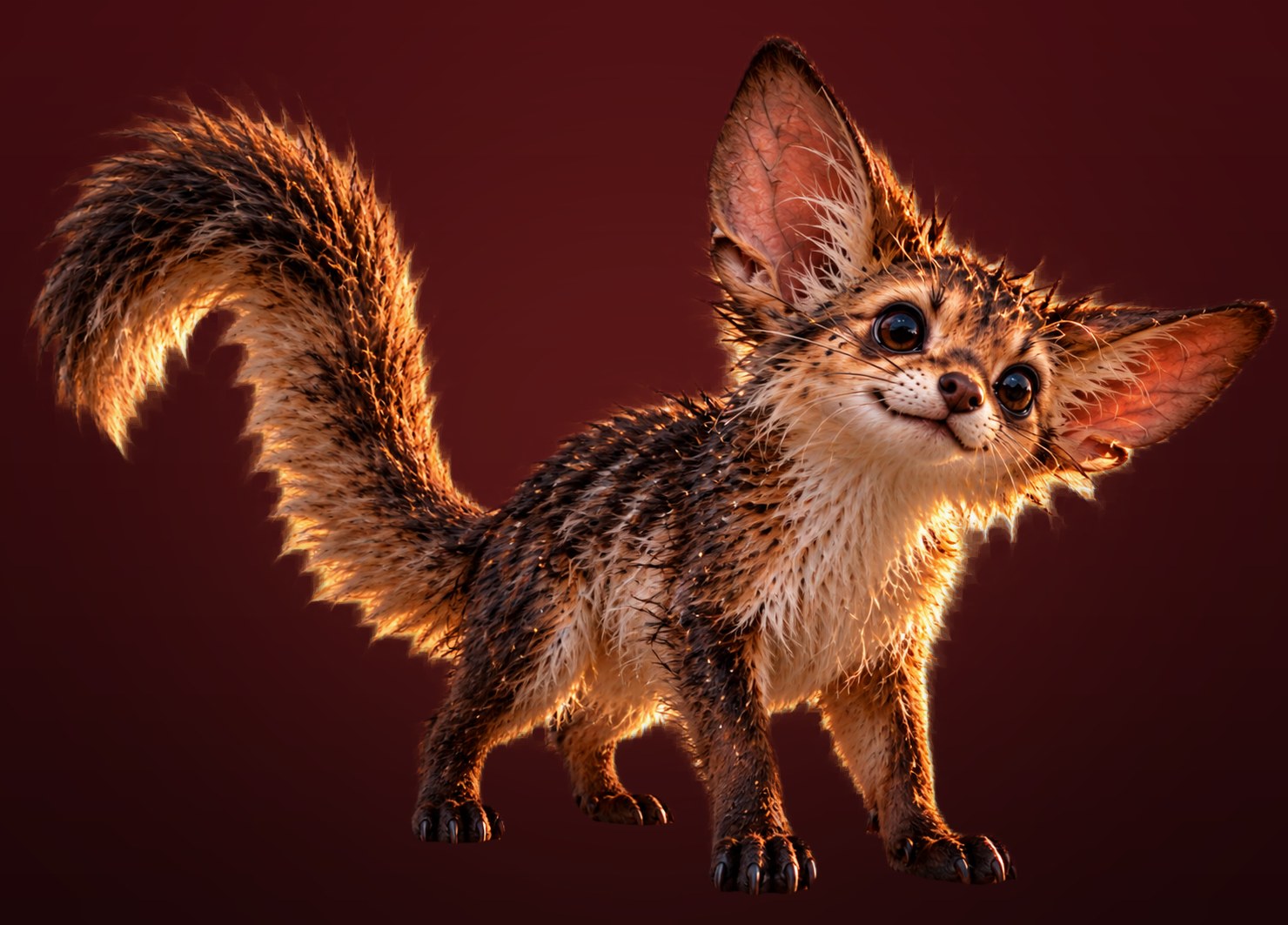
Appearance: A small cross between an otter and a fox, with oversized ears, a long bushy tail and shaggy fur.
Habitat: It lives on rocky coasts and moves nimbly over cliffs and through rock crevices.
Behaviour: Cliff Hoppers are curious and cheeky. They are particularly interested in shiny trinkets and like to make off with unattended loot.
Senses: Their keen hearing and fine sense of smell help them find their way around their territory.
Occurrence: They are mostly out and about in groups. A single Cliff Hopper seems quick and shy; together they can harry a threat surprisingly hard.
When in danger: If one is threatened, it lets out a shrill call. More Cliff Hoppers may then come rushing out of the rock crevices.
Fighting style: They climb and leap over rocks, distract opponents and prefer to attack together. They are more pesky and crafty than tough or strong.
Show stats (D&D 5e)
Cliff Hoppers
Tiny beast, neutral
Armor Class
13 (natural armor)
Hit Points
7 (2d4 + 2)
Speed
9 m, climb 9 m
Initiative
+3
Challenge
1/8 (25 XP) · PB +2
Size / Reach
Tiny / 1.5 m
STR
DEX
CON
INT
WIS
CHA
8 (−1)
16 (+3)
12 (+1)
5 (−3)
14 (+2)
8 (−1)
Senses
Darkvision 18 m, passive Perception 14
Skills
Perception +4
Languages
—
Equipment
None; occasionally collects shiny trinkets
Traits
Cliff Climber. The Cliff Hopper has a climbing speed of 9 m and can move up steep surfaces and upside down on natural rock without making an ability check.
Keen Senses. The Cliff Hopper has advantage on Wisdom (Perception) checks that rely on hearing or smell.
Pack Tactics. The Cliff Hopper has advantage on attack rolls against a creature if at least one of the Cliff Hopper's allies is within 1.5 m of the creature and the ally isn't incapacitated.
Shiny Loot. The Cliff Hopper has advantage on Wisdom (Perception) checks to spot small shiny objects.
Actions
Bite.Melee attack: +5, reach 1.5 m, one target. Hit: 5 (1d4 + 3) piercing damage.
Crevice Call (1/Day). When the Cliff Hopper is threatened, it lets out a shrill call. Within 1d4 rounds, 1d4 Cliff Hoppers emerge from rock crevices no more than 18 m away. In their territory, up to 20 Cliff Hoppers may come rushing instead.
Bonus Actions
Snatch Loot. Picks up a small, unsecured object within 1.5 m that isn't being worn or carried.
Curious, cheeky and mostly out and about in groups. When in danger, it calls for reinforcements from the rock crevices. · Homebrew creature
Round coastal animal about 30 cm tall with thick fur
Big, dark eyes, small ears and short legs
Eats mussels and likes to rest curled up on warm stones
Mostly peaceful and shy
When frightened, raises its fur and hurls hair-fine barbs
The barbs' poison causes pain and temporary muscle stiffness
“Look at puffel. Don’t cuddle puffel.”What coastal children learn early
Show stats (D&D 5e)
Puffel
Tiny beast, neutral
Armor Class
13 (Spiny Coat)
Hit Points
7 (2d4 + 2)
Speed
6 m, swim 6 m
Initiative
+2
Challenge
1/8 (25 XP) · PB +2
Size / Reach
Tiny / 1.5 m
STR
DEX
CON
INT
WIS
CHA
4 (−3)
14 (+2)
12 (+1)
2 (−4)
12 (+1)
5 (−3)
Senses
Passive Perception 11
Languages
—
Special Resources
Poisonous barbs; after a shot they recharge (5–6)
Traits
Spiny Coat. When a creature hits the Puffel with a melee attack while within 1.5 m of it, the creature takes 1 piercing damage.
Paralysing Poison. A target hit by a spine must make a DC 11 Constitution saving throw. On a failure, its speed drops to 0 until the end of its next turn.
Shy. The Puffel is not aggressive. Unless it is threatened or cornered, it would rather flee than attack.
Coast Dweller. The Puffel lives on rocky coasts, eats mussels and likes to rest curled up on warm stones.
Actions
Spine Shot (Recharge 5–6).Ranged attack: +4, range 6/18 m, one target. Hit: 1 piercing damage. The target must also make a DC 11 Constitution saving throw. On a failure, its speed drops to 0 until the end of its next turn.
Bonus Actions
Curl Up. The Puffel curls up into a ball; its AC increases by 2 until the start of its next turn, and its speed is 0.
Reactions
Spiny Coat. See trait.
Round coastal animal about 30 cm tall with thick fur, big dark eyes and short legs. Mostly peaceful; when frightened, it raises its fur and hurls hair-fine barbs. · Homebrew creature
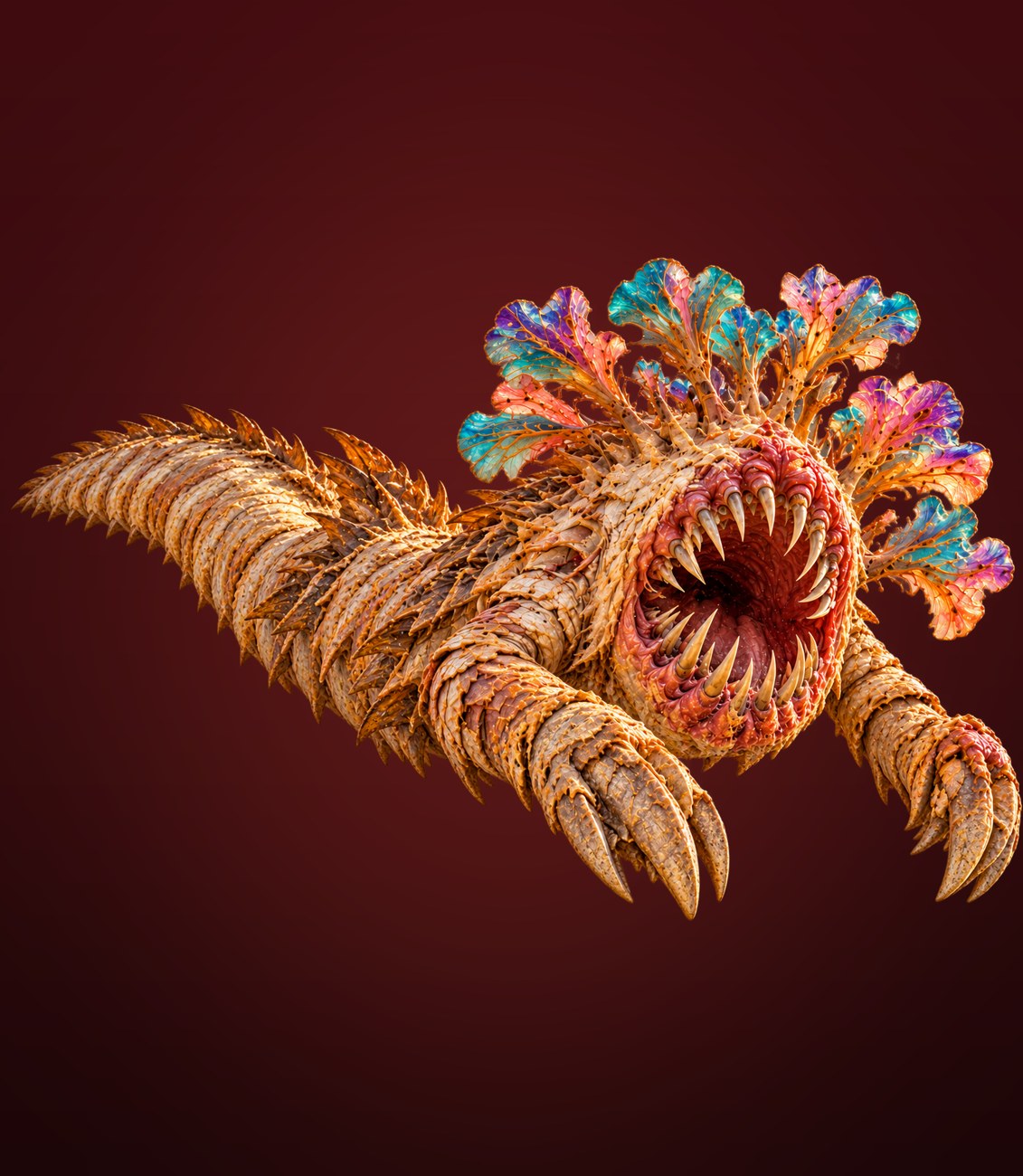
Size: About 5–6 m long, with a powerful, flat body and shovel-like forelimbs.
Appearance: Sand-coloured and covered in scales, so that it barely stands out among the dunes.
Blossom sensory organs: Brightly coloured blossoms in turquoise, violet, coral red and gold grow on its head. They jut out of the sand and look like scattered desert flowers.
Sweet luring scent: The blossoms give off a sweetish scent that spreads across the dunes. It is reminiscent of nectar or an oasis and awakens the curiosity of thirsty travellers.
Senses: The blossom organs perceive vibrations, warmth, air movements and chemical traces. This lets the Sandmaw locate movement in the sand and nearby prey.
Hunting behaviour: It buries itself beneath a dune, leaving only its colourful blossoms visible. When prey approaches, it suddenly bursts out of the sand.
Attack: With its enormous maw it seizes its victim and drags it beneath the surface of the sand. In doing so, it tries to tear the group apart.
Habitat: The hot deserts of eastern Seraphim, especially vast dune fields.
Occurrence: It mostly stays hidden. A conspicuous blossom in the middle of an otherwise flowerless sandscape can be a sign of its presence.
Tracks: Its movements leave hollows beneath the surface. After an attack, a sunken patch of sand and drag marks are often left behind.
Show stats (D&D 5e)
Sandmaw
Large monstrosity, neutral
Armor Class
17 (natural armor)
Hit Points
94 (9d10 + 45)
Speed
9 m, burrow 12 m (sand and loose earth)
Initiative
+0
Challenge
5 (1,800 XP) · PB +3
Size / Reach
Large / 1.5 m
STR
DEX
CON
INT
WIS
CHA
19 (+4)ST +4
11 (+0)ST +0
21 (+5)ST +5
2 (−4)ST −4
10 (+0)ST +0
5 (−3)ST −3
Senses
Darkvision 18 m, tremorsense 18 m, passive Perception 16
Skills
Perception +6
Languages
—
Special Resources
Luring blossoms; their scent carries on the wind across the dunes.
Traits
Sand Camouflage. The Sandmaw can burrow through sand and loose earth without leaving an open tunnel. In sandy terrain, it has advantage on Dexterity (Stealth) checks.
Blossom Sensory Organs. The colourful blossoms perceive vibrations, warmth and air movements. As long as the Sandmaw is touching sand, it can use its tremorsense to locate creatures within 18 m.
Sweet Luring Scent. A creature that can smell the scent within 18 m must succeed on a DC 14 Wisdom saving throw. On a failure, it has disadvantage on Perception checks to detect the Sandmaw and feels tempted to approach the blossoms. The effect ends as soon as it takes damage or can no longer smell the scent.
Heat Adapted. The Sandmaw has advantage on Constitution saving throws against exhaustion from extreme environmental heat. This trait grants no resistance to fire damage.
Actions
Multiattack. The Sandmaw makes two bite attacks.
Bite.Melee attack: +7, reach 1.5 m, one target. Hit: 17 (2d12 + 4) piercing damage. If the target is Large or smaller, it must make a DC 15 Strength saving throw. On a failure, it is grappled (escape DC 15). The Sandmaw can have only one creature grappled at a time.
Sand Eruption (Recharge 5–6). The Sandmaw bursts out of the sand and leaps up to 4.5 m into a space containing one or more creatures of size Large or smaller. Each creature in that space must make a DC 15 Dexterity saving throw. On a failure, it takes 10 (3d6) bludgeoning damage and 7 (2d6) fire damage and is knocked prone. On a success, it takes half damage and stays on its feet.
Bonus Actions
Leap. The Sandmaw leaps up to 9 m by spending 3 m of its movement.
Desert variant of the Whitemaw. Lurks beneath a dune, letting its colourful blossoms jut out of the sand. When prey approaches, it bursts out, seizes it and drags it down into the depths. · Basis: Bulette (Monster Manual), adapted
Length: 5–6 mHabitat: tundra & snowLurks beneath the snow
Traits and Occurrence
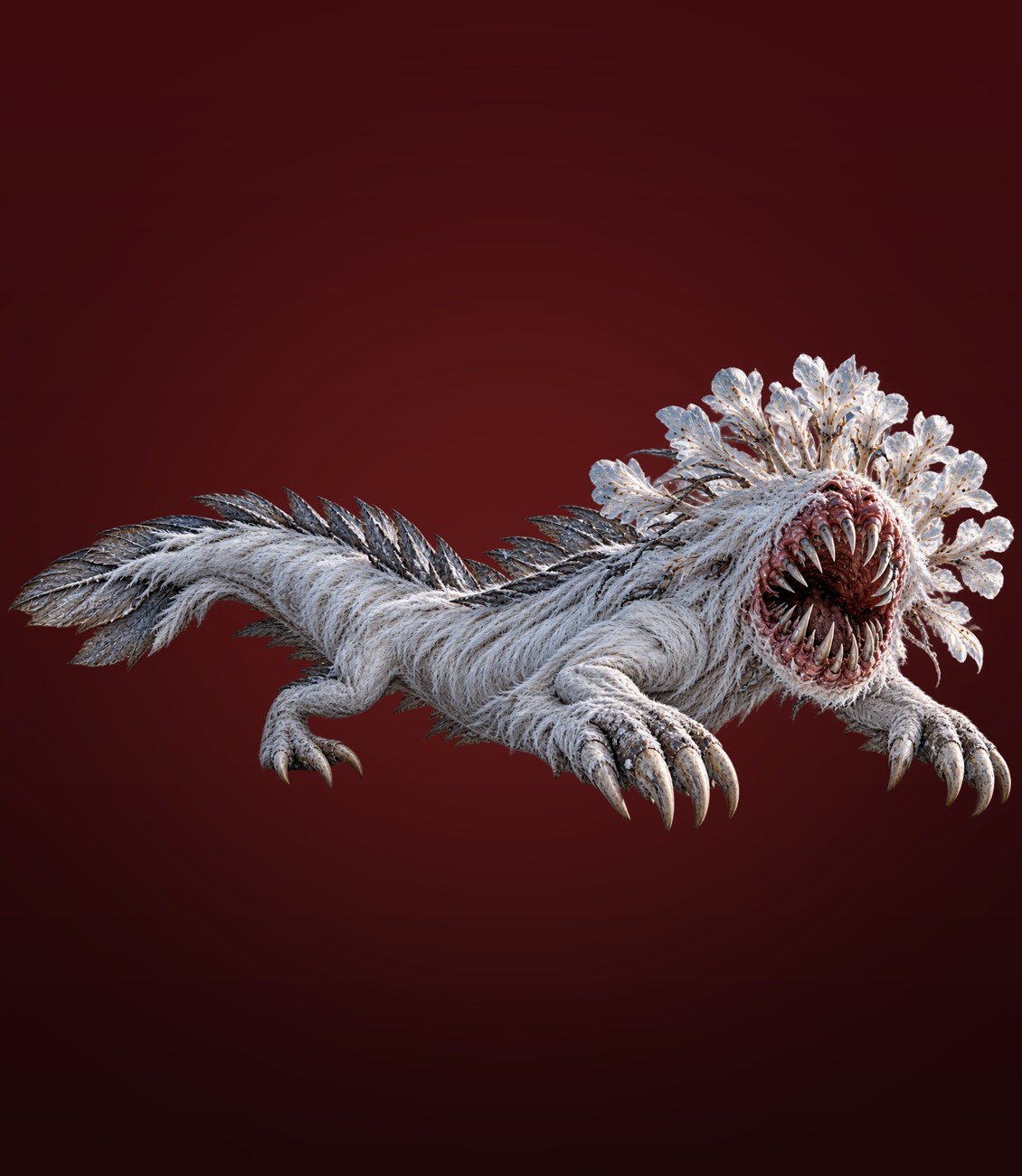
Size: About 5–6 m long; a powerful, flat body that moves easily through snow and loose ground.
Appearance: Its white-grey, scaly and shaggy exterior camouflages it in the tundra. On its head it bears striking, blossom-like sensory organs.
Maw: An enormous gullet with inward-pointing teeth, with which it seizes prey and drags it down into the depths.
Senses: The “blossoms” react to vibrations, warmth, air movements and chemical stimuli. They help it track down prey beneath the surface of the snow.
Habitat: Tundra and snow-covered plains, where it lies hidden just beneath the surface.
Hunting behaviour: The Whitemaw lurks motionless beneath the snow. As soon as it senses vibrations or warmth, it locates its prey and bursts out explosively.
Attack: It snaps with its great maw and drags its victim down into the snow, making full use of the element of surprise.
Occurrence: It mostly stays hidden. Often only its blossom-like sensory organs are visible, and they are easily mistaken for white flowers.
Tracks: After an attack, often only irregular collapsed patches and drag marks are left behind.
Danger: Its camouflage makes it hard to detect. Anyone who walks towards the supposed “blossoms” or moves carelessly across the snow can walk straight into its ambush.
Show stats (D&D 5e)
Whitemaw
Large monstrosity, neutral
Armor Class
17 (natural armor)
Hit Points
94 (9d10 + 45)
Speed
9 m, burrow 9 m (snow and loose earth)
Initiative
+0
Challenge
5 (1,800 XP) · PB +3
Size / Reach
Large / 1.5 m
STR
DEX
CON
INT
WIS
CHA
19 (+4)ST +4
11 (+0)ST +0
21 (+5)ST +5
2 (−4)ST −4
10 (+0)ST +0
5 (−3)ST −3
Senses
Darkvision 18 m, tremorsense 18 m, passive Perception 16
Skills
Perception +6
Languages
—
Traits
Snow Camouflage. In snow or beneath a thin layer of snow, the Whitemaw has advantage on Dexterity (Stealth) checks. If it starts a combat hidden, it has advantage on initiative.
Blossom Sensory Organs. The blossom-like organs perceive vibrations and air movements. As long as the Whitemaw is touching the ground, it can use its tremorsense to locate creatures within 18 m.
Tunneller. The Whitemaw burrows through snow and loose earth at its burrowing speed. It leaves no open tunnel behind. It cannot burrow through solid rock.
Prey to the Depths. While burrowing, the Whitemaw can move at half speed while carrying a Medium or smaller creature it has grappled. The creature remains grappled and can free itself with an action as usual.
Actions
Multiattack. The Whitemaw makes two bite attacks.
Bite.Melee attack: +7, reach 1.5 m, one target. Hit: 17 (2d12 + 4) piercing damage. If the target is Large or smaller, it must make a DC 15 Strength saving throw. On a failure, it is grappled (escape DC 15). The Whitemaw can have only one creature grappled at a time.
Snow Burst (Recharge 5–6). The Whitemaw bursts out of the snow and leaps to a point it can see within 4.5 m. Each creature in its target space must make a DC 15 Dexterity saving throw. On a failure, it takes 19 (3d12) bludgeoning damage and is knocked prone. On a success, it takes half damage and stays on its feet.
Bonus Actions
Leap. The Whitemaw leaps up to 9 m by spending 3 m of its movement.
Tactics: lurk hidden beneath the snow, open with Snow Burst, then grapple and drag prey beneath the surface. Two or three Whitemaws at once are considerably more dangerous for a group. · Basis: Bulette (Monster Manual), adapted
the world · the first ones
The First Ones
The dragons, the oldest and most enigmatic beings of Seraphim.
“Before the first kings raised their halls, before the oldest peoples carved their names in stone, the shadow of a wing is said to have already passed over the world.”--- From the Fragments of Adventurion, author unknown
The dragons are among the oldest and at the same time most enigmatic beings of Seraphim. Their history is lost in the world’s oldest traditions, in an age from which hardly any reliable records survive. Many peoples claim that dragons ruled the world long before the first civilisations arose.
Whether this is true cannot be said with certainty.
Countless legends tell of the so-called primordial dragons – mighty beings of almost godlike power who are said to have ruled not only the elements but the fundamental forces of the world itself. Some stories claim that mountains rose beneath their steps and seas were parted by the beat of their wings. Others see in them the first children of magic, or even the creators of today’s dragons.
So far, however, no conclusive proof of the existence of these primordial dragons has been found.
Their traces are found only in ancient ruins, enigmatic artefacts and the stories of the dragons themselves. Whether these testimonies are genuine memories of a bygone age or merely myths passed down over millennia remains the subject of countless scholarly debates.
What is certain, however, is that today’s dragons are an exceptionally diverse species.
The known variety ranges from mighty, ancient specimens whose power even the greatest mages fear, down to small lizard dragons that grow scarcely larger than a full-grown dog. Between these extremes exist countless kinds, lines and offshoots, some of whose origins are unexplained.
Of particular importance are the three great dragon clans of Seraphim.
The three great dragon clans
Although dragons can be found in almost every region of Seraphim, over the millennia three great lines have emerged whose influence reaches far beyond their respective territories.
dragon clan
Zul’Varis
The World Wardens
TerritoryFar East, far to the east of Restonell
The clan of the Zul’Varis, also called the World Wardens, is considered one of the oldest known dragon clans of Seraphim.
Far in the east, beyond the known realms of Restonell, their nests and sanctuaries are said to lie. Only a few travellers have actually reached these lands, and even fewer have returned with credible accounts.
The Zul’Varis see themselves less as rulers of the world than as its keepers. Old traditions ascribe to them the task of watching over natural and magical balances. Where other dragons amass riches, territories or power, the World Wardens are said to strive above all to preserve the balance between the great forces of Seraphim.
Whether this is truly the clan’s guiding principle or merely the image other peoples have of them is uncertain.
In legends the Zul’Varis are often associated with ancient stars, the sky and the great cycles of the world. Some scholars therefore suspect that their bloodline could be particularly closely tied to the fabled primordial dragons.
There is no proof of this.
dragon clan
Zyl’Gar
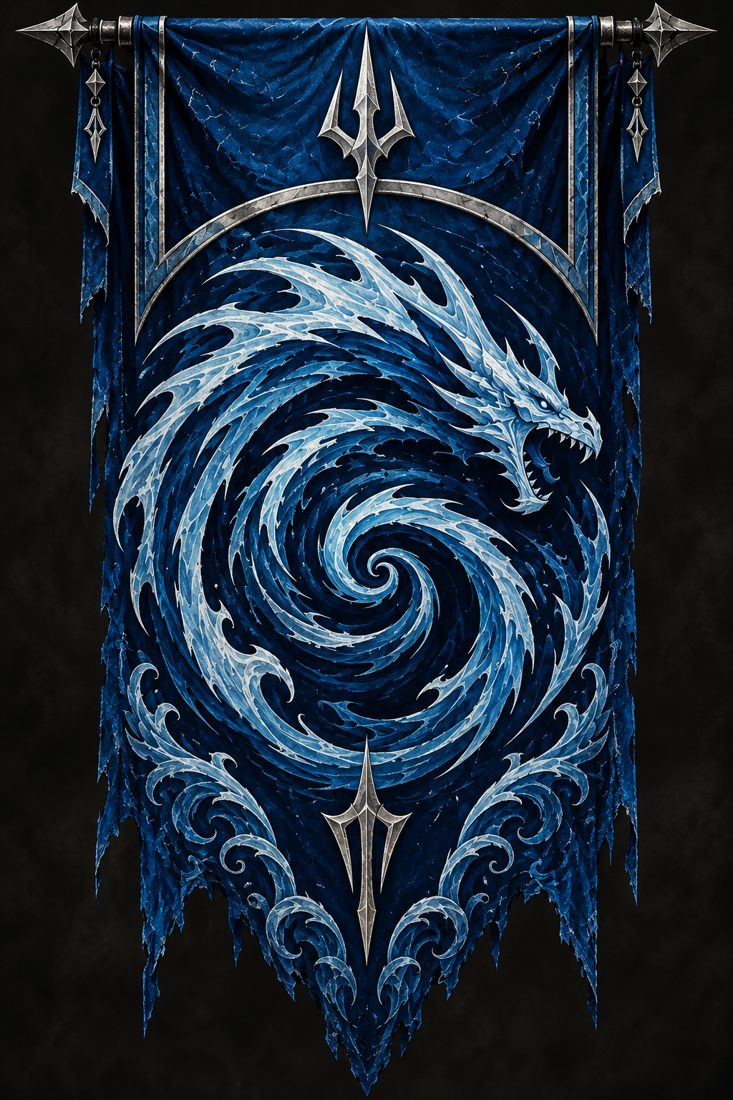
The Eternal Maelstrom
TerritorySouthern ring of the Tosendes Meer
Where the waters of the Tosendes Meer never come to rest, the realm of the Zyl’Gar clan is said to lie.
The Zyl’Gar bear the epithet “The Eternal Maelstrom”, a name whose origin is as unexplained as much else about the clan. Their domain lies in the southern ring of the Tosendes Meer, a region considered almost impassable even by experienced seafarers.
The dragons of this clan are often associated with storm, sea and destructive forces of nature. Sailors’ tales speak of gigantic shadows beneath the waves and of dragons that rise from the sea during the fiercest storms.
Some of these stories may be exaggerations.
Others might not be.
Among the three great clans, the Zyl’Gar are considered especially territorial. Foreign ships that venture too deep into their waters are said to sometimes never return. At the same time, a few travellers report that the dragons of the Eternal Maelstrom have warned certain seafarers of storms or rescued them from distress at sea.
Whether this is a contradiction or whether the Zyl’Gar simply follow their own rules, no one knows.
dragon clan
Zar’Gath
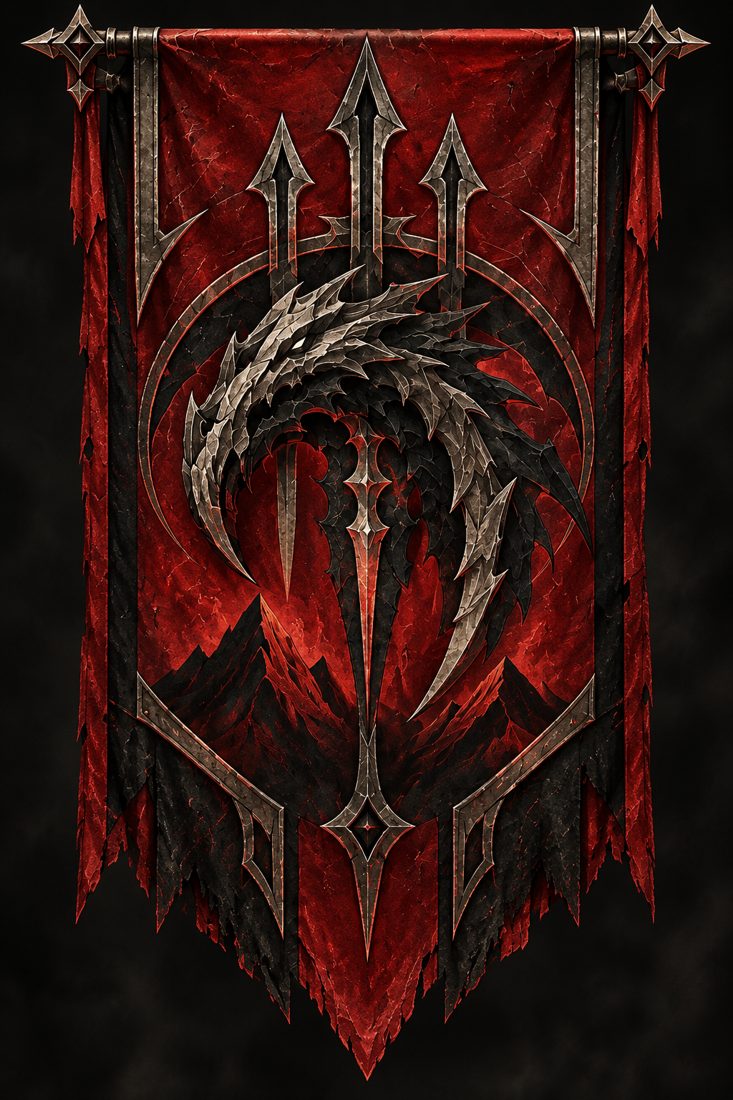
The Unbreakable Claw
TerritoryNorth of Seraphim, near the Kronengipfel
In the harsh north of Seraphim, where the mighty Kronengipfel rise into the sky, lies the territory of the Zar’Gath clan.
The Unbreakable Claw, as they are called, are known for their extraordinary strength and their pronounced territoriality. Their nests are said to be hidden deep in the mountains, some of them in cave systems that existed before the first peoples settled the region.
Of all the great dragon clans, the Zar’Gath are considered the ones who preserve their old traditions most strictly.
Their stories deal with bloodlines, honour and the preservation of their own heritage. While other dragons seek their origins in myths and legends, the Zar’Gath are said to place great value on passing down their lineage. Some even claim that their halls hold records of generations of dragons reaching back to the earliest known ages.
Should these records truly exist, they could be among the most valuable sources on the early history of Seraphim.
So far, however, no outsider has seen them.
The question of the primordial dragons
Among the scholars of Seraphim, hardly any question has sparked more debate than that of the existence of the primordial dragons.
Some claim that the three great dragon clans are merely distant descendants of these first dragons. Others believe the primordial dragons were never more than a collection of myths that merged with one another over the millennia.
The dragons themselves contribute little to settling this question.
Some speak of their ancestors with reverence. Others treat the stories as children’s fairy tales. Still others respond to questions about the primordial dragons with a silence that has caused more unease among scholars than any answer.
Perhaps the primordial dragons really are extinct.
Perhaps they sleep.
Perhaps their descendants still walk the world unrecognised.
Or perhaps they were never more than a legend.
As long as no conclusive proof is found, the truth about the first dragons remains one of the oldest unsolved mysteries of Seraphim.
War and Truce
The Dragon War
The clans’ territories stretch across regions of the world far apart from one another. Their cultures, traditions and ideas about the nature of dragons differ considerably.
Nevertheless, the three clans share a common and bloody history.
Today the three great clans are in a state of truce. To speak of peace, however, would be misleading.
Between the Zul’Varis, Zyl’Gar and Zar’Gath there is an old rivalry whose origins are lost in the mists of history. What was once the reason for the first clashes, not even the dragons know for certain any more. Traditions speak of disputes over territories, ancient artefacts, the lineage of the dragons and even over the question of which clan preserves the legacy of the primordial dragons most purely.
Over the centuries, these conflicts gave rise to open wars again and again.
When the dragons fought out their struggles, these were no ordinary battles.
Armies were not needed when single beings were capable of razing entire fortresses to the ground. Forests burned, rivers changed their course and mountains were shaken by mighty magical discharges. Where dragons fought each other, they left behind not battlefields but altered landscapes.
And although the dragons largely avoided the great cities of the peoples, even these were not always spared.
Some ruins that are today attributed to long-forgotten kingdoms are said in truth to have been destroyed during a dragon war. Other regions of Seraphim still bear the traces of those conflicts: vitrified rocks, soil spoiled by magic, deep gorges with no natural origin and entire stretches of land where unusual magical phenomena can be observed to this day.
The humans, elves, dwarves and other peoples who witnessed these events were seldom more than spectators.
Or victims.
The Truce
Exactly how the present truce came about is as disputed as much else in the history of the dragons.
None of the known traditions names a clear victor of the last great war. Rather, each clan seems to tell the conflict from its own perspective.
What is certain, however, is that the three clans have not waged open war against one another for several generations.
The truce has not, however, ended the old enmities.
Encounters between members of different clans are seldom free of mistrust. Border violations, vanished artefacts and disputes over old territories can still cause tensions. For most dragons, another clan is not an immediate enemy – but not a friend either.
Some scholars therefore more aptly call the present state the “peace of drawn claws”.
Each clan knows what the others are capable of.
And each remembers what happened when, once, the claws were not withdrawn.
The Scars of Seraphim
Perhaps the greatest witnesses of the dragon wars are neither books nor oral traditions.
It is the world itself.
In remote valleys there are mountains with huge craters whose formation cannot be explained by natural processes. On the coasts of the Tosendes Meer there are regions where the water forms dangerous currents even in complete calm. In the north, the inhabitants of the Kronengipfel tell of black rock faces that still hold warmth even after centuries.
Some of these places are avoided by the peoples of Seraphim.
Others became sanctuaries, places of research or warning signs of a bygone age.
For the dragons themselves, these places are something else.
Memories.
For while the peoples of Seraphim preserve their history in books and chronicles, the dragons carry theirs in bloodlines, tales and the scars of the world.
Perhaps this is precisely why the old conflicts have never fully disappeared.
For as long as the scars remain, the past is not forgotten either.
Full-blood dragons and dragonshifters
The great dragon clans of Seraphim each rule over their own domains. These realms differ in landscape, culture and the laws by which their dragons live. What they have in common, however, is that the limits of their rule seldom end where the visible borders of their territories lie.
For a dragon does not necessarily need a nest to exert influence.
Some rule over mountain ranges, seas or entire stretches of land. Others move unrecognised through the cities of the mortal peoples, deal with politicians, make pacts with trading houses or offer their services to those willing to pay a fitting price.
To understand these differences between the dragons, one must first consider their development.
Among the peoples of Seraphim, dragons are often regarded as uniform beings. For the dragons themselves, however, this distinction is far more significant.
Broadly speaking, the known dragons can be divided into two great forms of development:
Full-blood dragons and dragonshifters.
Both are true dragons. Both possess dragon blood and the natural magic of their species. The decisive difference lies not in their lineage but in their development.
Full-blood dragons
Full-blood dragons are those dragons that can never leave their original, draconic form.
Their body is an expression of their lineage. Scales, horns, claws, wings and the other features of their kind are not merely physical traits but an integral part of their being.
Full-blood dragons can reach enormous size and possess tremendous physical resilience. Their natural magic is deeply bound to their body and often manifests in the form of breath weapons, elemental powers or other draconic abilities.
The term “full-blood” does not necessarily mean that such a dragon is stronger or older.
A young dragon can be a full-blood dragon, while an ancient dragonshifter would not bear the same designation.
The term describes physical development, not age.
Among developed dragons, full-blood dragons are often considered more primal and closer to the nature of their ancestors. Many of them are more strongly shaped by instincts such as territoriality, dominance and the protection of their hoard.
This does not, however, mean that they are necessarily unintelligent or primitive.
A full-blood dragon can be learned, strategic and highly educated.
It nevertheless remains a dragon that cannot shed its form.
Dragonshifters
The dragonshifters represent a more highly developed form of dragon.
They possess the ability to change their original form and take on the appearance of other peoples of Seraphim.
This is not a simple illusion.
A dragonshifter can actually change its body. Its scales become skin, its claws become hands, and its wings vanish along with its other draconic features. It can also take on the physical traits of various peoples.
A dragonshifter can walk through a city as a human, sit at a royal table as an elf or live in an underground settlement as a dwarf.
Its true nature remains hidden.
At least as long as it does not reveal it itself.
This development was accompanied by a change in nature.
While full-blood dragons are more strongly governed by their instincts, dragonshifters are far better able to control their urges. They are more often cultivated, patient and politically adept. Many of them have observed the societies of the mortal peoples over centuries and understood that brute force is not always the most efficient way to achieve one’s goals.
For the peoples of Seraphim are far mightier than the dragons once thought possible.
A single dragon may be able to inflict great damage on a city. But a city has mages, soldiers, craftsmen, merchants, spies and, above all, something that even dragons can hardly replace:
Community.
The dragonshifters have learned that it is often wiser to make a potential enemy an ally than to create yet another enemy.
The Domains of the Clans
Although the dragonshifters enter the cities and realms of the peoples, the old domains of the great clans remain the heart of their society.
The Zul’Varis, the World Wardens, rule over their secluded lands far to the east of Restonell.
The Zyl’Gar, the Eternal Maelstrom, command parts of the southern ring of the Tosendes Meer, where even the largest ships seldom dare to cross their waters.
The Zar’Gath, the Unbreakable Claw, have their domain in the north of Seraphim near the Kronengipfel, deep in a landscape whose mountains and valleys have been shaped by the dragons for millennia.
These realms are the centres of their respective clans. But their influence reaches far beyond them.
A dragon need not sit on its own territory to wield power.
Sometimes a name is enough.
An old treaty.
A favour.
Or a claw that comes down on the right side at the right moment.
Relations with the Peoples
The relationship between dragons and the other peoples of Seraphim is far more complex than the old legends suggest.
The stories of fire-breathing beasts that burn down villages, steal treasure and lay waste to entire stretches of land are not entirely false. Particularly primitive dragons can pose a considerable danger, and dragonshifters are by no means peaceable by nature either.
But the times when dragons had to prove their strength through violence alone are over for many of them.
The ability to shapeshift brought with it a profound cultural development among the dragons. Over long periods, dragonshifters have observed and come to know the societies of mortals. They speak their languages, understand their customs and can move within their societies. In doing so, many of them have learned that not every conflict has to be resolved with violence.
Trade. Diplomacy. Deception. Pacts. Favours.
To a dragonshifter, these are tools just as much as claws and fire.
The developed dragons have recognised that trade, diplomacy and mutual dependence often open up far greater possibilities than destruction.
A dragon can annihilate an enemy.
An ally, on the other hand, can open a hundred doors for it.
For this reason, dragons are by no means as rare in the cities of Seraphim as one might suppose. Behind strange faces, members of the great clans move through markets, noble courts, academies and port cities. Some stay only a few days; others lead a life under an assumed identity for decades.
Some become merchants.
Others scholars.
Some become advisers to princes or join adventuring parties.
Still others deliberately seek out those places where things can be found that a dragon cannot simply take by force.
Information. Artefacts. Access. Contacts.
Among dragons a simple principle applies, one that is also widespread among the mortal peoples:
“One hand washes the other.”
A dragon may help an adventurer with a difficult matter and demand a service in return. A trading house could profit from a dragon’s protection while the dragon gains access to rare goods. A ruler could enter into an old pact with a dragon clan, while the clan in return offers influence, information or protection.
Not every one of these agreements is between equals.
And not every dragon keeps its word.
Yet among dragonshifters a promise given is considered a valuable currency. For whoever walks among mortals for centuries quickly learns that trust can sometimes be worth more than gold, and that a well-tended contact opens more doors than the threat of fire.
Perhaps this is precisely one of the greatest differences between a dragonshifter and a full-blood dragon.
While the full-blood dragon can openly display its power, the dragonshifter has learned that true power need not always be visible.
A dragon can destroy a city.
A dragonshifter can make sure the city opens its gates to it of its own accord.
Dragon Children
“To some they are border-walkers. To others they are bastards of the scales.”
Few beings in Seraphim are as controversial as the so-called dragon children.
In rare cases, the union between a dragonshifter and a member of a mortal people is said to have produced offspring. These children carry the blood of both worlds within them, and yet never fully belong to either.
They are children of mortals.
And children of dragons.
Among the peoples of Seraphim they are usually called border-walkers. Among the dragons, by contrast, far less flattering names circulate.
Their mere existence poses an uncomfortable question for many:
What happens when the blood of a dragon and that of a mortal merge?
The answer is as varied as the border-walkers themselves.
Between Two Worlds
A border-walker grows up between two worlds.
They can understand the form and society of mortals and at the same time possess a connection to the world of dragons that remains incomprehensible to ordinary peoples. Some border-walkers spend their entire lives among humans and learn of their lineage only late. Others are initiated into the secrets of the dragons by their parents or their clan while still children.
But regardless of how they grow up, their origin often remains part of their identity.
Among the peoples there are those who see them as protectors. For these people, border-walkers are living proof that dragons and mortals need not necessarily be enemies.
They are revered, feared or even sought out as mediators between the two worlds.
Others, by contrast, see them as an abnormality.
To them, dragon children are a mistake of nature – beings that should never have come into existence and whose existence violates the natural order.
This rejection is not found only among mortals.
The dragons themselves also often regard border-walkers with mistrust or contempt.
Bastards of the Scales
For many dragons, the idea of a half-breed is hard to accept.
A border-walker does not possess the physical might of a full-blooded dragon. They cannot lay claim to the centuries-old tradition of a dragon line and must work hard to earn their place in a clan.
In the eyes of many dragons, precisely this makes them weak.
Some regard border-walkers as diluted descendants of their own species. Others see in them nothing more than mortals with unusual blood.
The expression “bastards of the scales” is therefore used as an insult among some dragons.
But there are also dragons who reject this view.
Some scholars of the clans suspect that the union between dragons and mortals might represent not a weakening but a special form of evolution.
For although a border-walker never physically attains the size and resilience of a full-blooded dragon, they carry something within them that matters even to dragons:
Dragon magic.
The Blood of the Dragon
A border-walker’s magic flows through their blood.
It is no learned craft and no gift bestowed from outside. It is part of their being.
In some border-walkers this magic shows only faintly. Their eyes change when they grow angry. Their bodies are unusually resilient. Heat, cold or other natural dangers harm them less than ordinary mortals.
In others the connection is far stronger.
Then the magic can manifest in the form of destructive powers.
Fire, ice, storm, shadow or other forces can break forth from a border-walker, depending on their lineage and the nature of the dragon whose blood flows through their veins.
But this power has its price.
For a dragon’s magic is not made to rest within a mortal body.
The Inner Dragon
Many border-walkers describe their powers not as something they possess, but as something that lives within them.
Among them, the term “inner dragon” has therefore become established.
The inner dragon stands for those primal instincts and powers that can awaken with the dragon blood. Rage, greed, territoriality, pride and the urge for dominance can grow stronger when a border-walker unleashes their powers.
Whoever cannot control these instincts risks being overwhelmed by their own power.
Some lose control of their powers in such moments.
Others are driven by their instincts.
And some, in the frenzy of their power, wreak devastation they can barely remember afterwards.
But there are those who learn to tame their inner dragon, to master it.
A border-walker who succeeds in this can unleash powers that may become dangerous even to a dragon.
When the Bastard Conquers the Claw
Only a few records tell of border-walkers who achieved such mastery.
Most of these writings are considered legends or have been heavily embellished over the centuries.
Yet some accounts are astonishingly detailed.
They tell of border-walkers who stood against full-blooded dragons and brought them to their knees.
It was not cunning or superior numbers, but the power of their own dragon blood.
Whether these stories are true cannot be established beyond doubt.
The dragons themselves are reluctant to speak of it.
Perhaps therein lies the reason why border-walkers are so feared and despised among them.
For if the stories are true, then these children are no proof of the weakness of dragon blood.
Perhaps they are its hitherto unknown potential.
And perhaps a border-walker who fully masters their inner dragon is something that even the great clans must fear.
For a full-blooded dragon knows its nature.
A border-walker, on the other hand, must learn to master two natures at once.
the world · nature
Flora & Fauna
Plants and animals that make the land flourish under Celestara’s light.
Work in progress
Entries on plants, herbs and animals from the regions of Seraphim are being created here. Feel free to send us texts and pictures for them.
the world · familiar faces
NPCs
The people and beings our heroes meet on their travels, sorted by the place where they can be found.
Far away from her Asrani homeland, Merinda has created a forum for adventurers in Idreel: the Tanzwut tavern. Among tankards, stories and new jobs awaits her greatest pride – a small fighting arena where adventurers can measure their strength without mortally wounding one another.
While the fighters prove themselves, the guests cheer them on and bet their coins on the favourites. Merinda makes sure the contest stays hard but fair. Whoever enters the Tanzwut may find a companion, a challenge – or a reason to stay in Idreel a little while longer.
Together, Andre and Oleg make sure that adventurers at the Tanzwut tavern in Idreel are supplied with their favourite drinks. Between tankards, orders and the general bustle, the two always have a friendly word for their guests.
Adventurers are especially welcome: Andre and Oleg are always glad to listen to their stories, worries and plans.
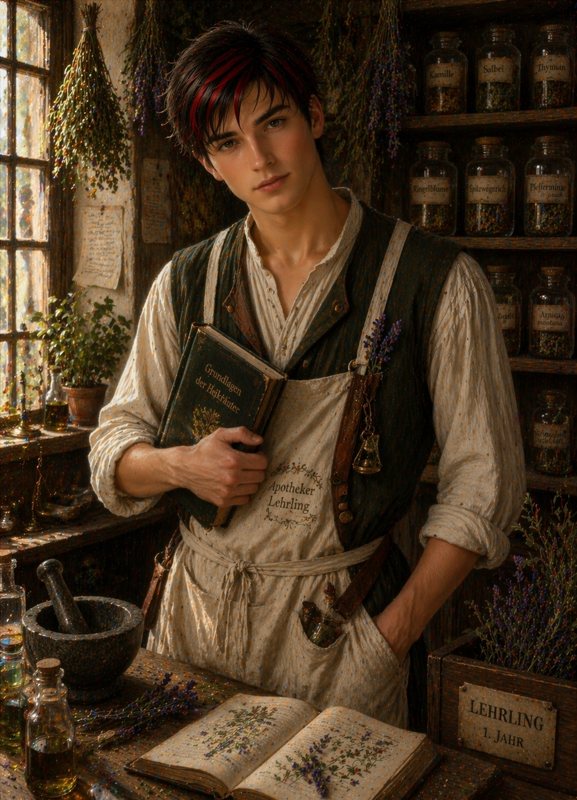
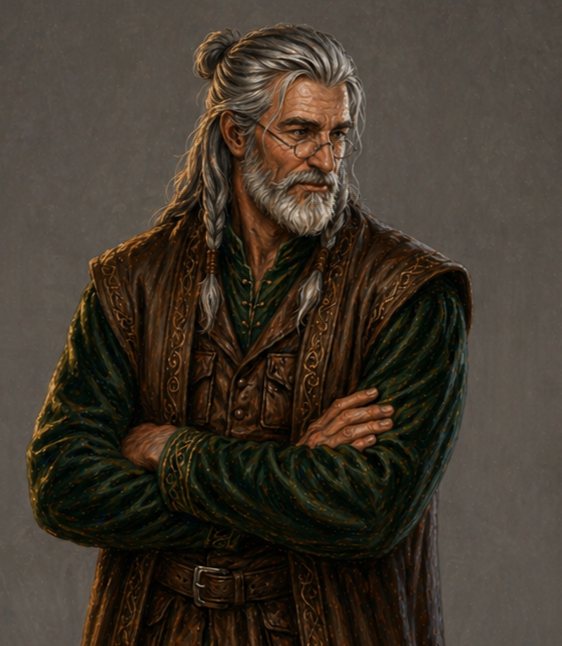
Tiberius is the foster father and master of Noble Rose. In Artell he runs a renowned apothecary whose high-quality wares are prized far beyond the city.
Many years ago, Tiberius found Noble as a little boy in the desert of Restonell. He took him in, gave him a home and trained him as an apothecary.
Their bond is still very close to this day: whenever Noble gets into trouble, Tiberius does everything he can to protect his foster son and help him wherever possible – even if he does it with a shake of his head.
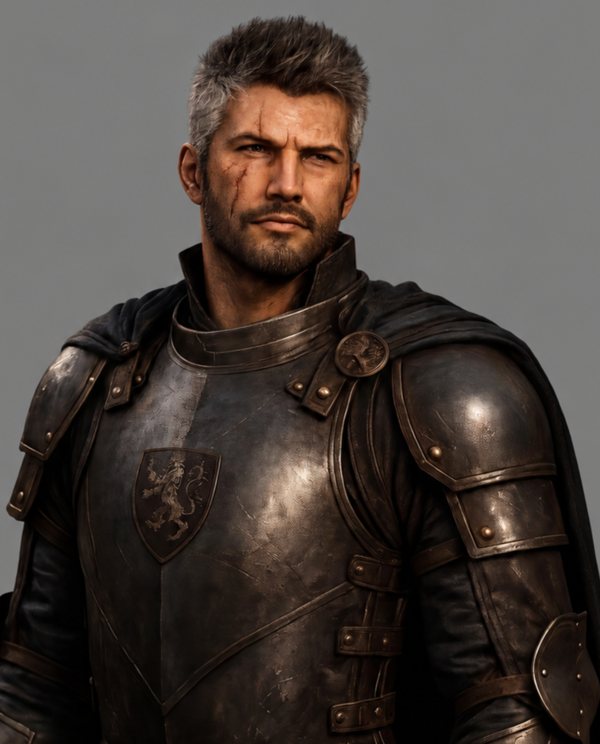
Myrodin is the right hand of the Mayor of Artell. When an important matter comes up, the townsfolk often send for him – and he is also present at great festivals and other special occasions.
His cold, distant manner, however, makes it hard to get close to him. Nothing is known about his family; whether he has any friends remains just as unclear.
After a gruelling warrior training under Barvur, which he completed as the best of his year, Myrodin came to Artell. What brought him there, and what he would reveal about his past, remains an open question.
the world · peoples
The Peoples
The peoples of Asterra from which our heroines and heroes may hail. Choose a people to learn more about their origins, peculiarities and history.
“An Eldrake need not be large to hold its place in the world. But whoever underestimates its stinger has already lost their caution.”
Nature and Origin
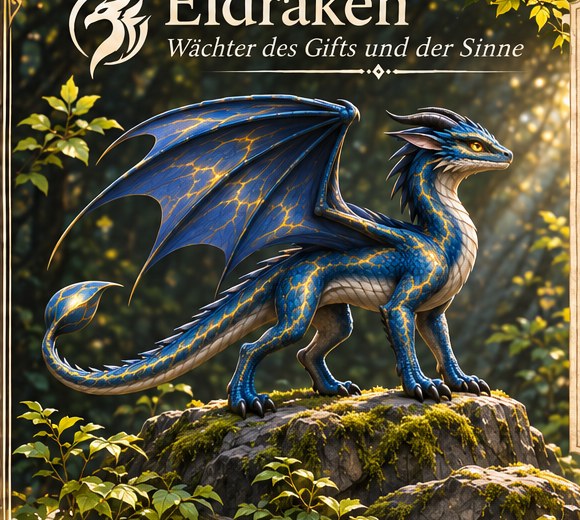
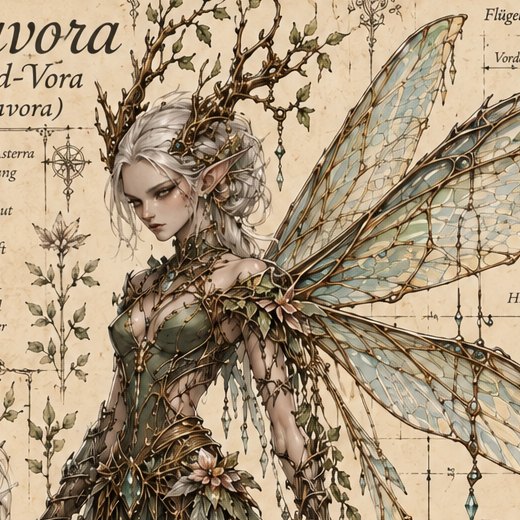
The Eldraken are a distinct, small-statured dragon kind that emerged from draconic ancestors over a long natural evolution. They are not an artificial creation. Their appearance recalls pseudodragons: four legs, two wings, a long flexible tail and small, mobile ears shape their form. Unlike many great dragons, Eldraken do not live as solitary rulers or lone terrors, but mostly in close-knit nest communities.
Together with the closely related Vodraken, the Eldraken form one society. Both kinds live in mixed families and enjoy the same rights. A young dragon is always either an Eldrake or a Vodrake; no third, mixed kind arises. Their shared ancestry and life together have made the boundaries between the two kinds largely meaningless in society.
Homeland
Eldraken live in hidden nest communities whose location depends on the landscape, history and size of each community. Nests may lie in forests, caves, mountains, cliff faces or old ruins. Natural structures are often carefully extended rather than building entirely new settlements.
Their architecture combines sheltered flight entrances and raised landing platforms with paths on the ground. Hidden trails, camouflage and guards protect the settlements; supporting magic may be used, but it is neither present everywhere nor a requirement for a nest. The locations are, as a rule, kept secret from outsiders.
Character and Society
An Eldrake cannot be reduced to a single temperament. As with any people, personalities, interests and paths in life vary greatly. Their society’s self-image, however, is strongly shaped by community, freedom, protection, responsibility, knowledge and personal bonds. The nests combine mutual care with the right to one’s own decisions and private retreat.
Eldraken value craftsmanship, honest research and well-passed-on knowledge. Collecting, play and discovering things together remain common even in adulthood. Their society is not built around a mandatory religion. Political and social standing derive neither from kind nor from colour, physical condition or individual talent.
Their lifespan is extraordinarily long: many Eldraken live for centuries, possibly even millennia. Still, they are not immortal. They reach physical and mental adulthood at around 25; visible ageing often sets in only very late and differs from one individual to the next.
Combat and Abilities
The Eldraken’s natural traits are their pseudodragon-like bite, the venomous stinger on their tail and special natural powers of perception. The long tail aids balance and body language but is not prehensile. The forepaws have two forward-facing toes and a third, more lateral and especially mobile toe, which let them grasp and steady small, suitable objects.
The stinger is a natural weapon, but not a fully functional danger from birth: at hatching it is soft and harmless. Its structure hardens over the first years of life; full natural venom develops roughly between the fifth and tenth year. Young Eldraken therefore receive age-appropriate instruction in tail control and safe handling.
Flying is an important part of their independence and wellbeing. It serves not only for travel but also for experiencing nature, play, relaxation and social life. How an individual Eldrake fights depends on training, personality and chosen class.
Relations with Other Peoples
Eldraken meet the outside world with a mix of caution and openness. Contact, trade and voluntary journeys are possible; individual dragons may do business on their own or travel on behalf of their nest community. Keeping the nest locations secret remains an important principle of protection.
The nests organise basic supplies, healing and important stores communally, but allow personal property, private workshops and private business. In contact with other peoples, Eldraken may therefore appear as travellers and traders as well as craftspeople, scholars or scouts. There is no fixed blanket attitude towards strangers.
At a Glance
Origin
Distinct, naturally evolved small-statured dragon kind; similar to pseudodragons.
Homeland
Hidden nest communities in forests, caves, mountains, cliff faces or ruins.
Appearance
Four legs, two wings, a long flexible tail, small mobile ears and scales.
Lifespan
Many centuries, possibly millennia; no fixed maximum age known.
Coming of age
Physical and mental adulthood at around 25.
Traits
Individually different; socially shaped by freedom, community, responsibility and knowledge.
Natural abilities
Pseudodragon-like bite, venomous stinger and special natural powers of perception.
Movement
Four-legged movement and active flight; flying has great personal and cultural importance.
Language
Draconic as everyday language; Common is taught in basic education.
Reputation among the peoples
Cautious contact; trade and journeys are possible, nest locations stay secret.
Playable Species (D&D 2024)
Playable Species · V6.2 · Rules basis V5.3
Two kinds. One community.
Eldraken are intelligent, four-legged dragons with their own wings, special senses and a venomous stinger. They live as equals with the magically gifted Vodraken in hidden nest communities.
Their homeland stays secret, but travel, trade, friendship and the search for knowledge are part of their lives. Eldraken descend from a natural draconic line; the Vodraken arose through ancient magical influences.
Scope of the rules
These rules cover only the playable Eldraken. Vodraken need their own species rules. The venom mechanic remains a DM test version. All listed abilities apply regardless of the chosen class.
Basic stats
Creature typeDragon
SizeTiny
Speed20 / 30 ftWalk 6 m / Fly 9 m
Senses
Darkvision60 ft18 m
Blindsight10 ft3 m
Telepathy100 ft30 m
Build & Dimensions
Shoulder height30–40 cm
Tailapprox. 30 cm
Wingspanapprox. 1 m
Weight3–6 kg
Eldraken dimensions
Traits
Flight and Movement
You can walk 20 ft (6 m) and fly 30 ft (9 m). Taking off costs no additional action. The two speeds are not added together. Without hover, the normal falling rules apply.
Senses
Darkvision 60 ft (18 m): you see in dim light as if it were bright light, and in darkness as if it were dim light. Blindsight 10 ft (3 m): you perceive your surroundings within this range even without sight.
Telepathy
Within 100 ft (30 m), you can send simple images, feelings and short impulses of thought to a creature that understands at least one language. Each message reaches a single target; short messages take no action and are unlimited. No mind reading and no full mental conversation.
Natural Weapons
Bite and venom stinger are proficient, non-magical finesse attacks. Each deals 1d4 + Dexterity modifier piercing damage on a hit. The stinger can also inject a dosed venom (see below). The species grants no extra attacks.
Forepaws
Two forward-facing toes and one mobile side toe let you operate suitable objects and tools. No extra combat attack. You can don or doff adapted light armour yourself in 1 minute each.
Languages and Abilities
Languages: Common and Draconic (speak, understand, read). Abilities: no innate bonuses or penalties; increases follow your background.
Venom Stinger & Extra Rule
Dosed venom based on rules V5.3 · renewed DM approval required
Venom pool2 × proficiency bonusvenom charges, regained after a long rest
Save DC8 + prof. + CONthe target’s Constitution saving throw
Scaling by character level
Character level
Proficiency bonus
Venom charges
Venom DC*
1–4
+2
4
12
5–8
+3
6
13
9–12
+4
8
14
13–16
+5
10
15
17–20
+6
12
16
* Example with Constitution 14 (+2). With a higher CON modifier the DC rises further. Increases follow total character level; all charges are regained after a long rest.
Dosing after a stinger hit
First the normal piercing damage is resolved. Then you decide whether and how much venom to inject. Charges are spent before the saving throw.
0
Dry sting
Piercing damage only, no saving throw against venom.
1
Small dose
CON saving throw. Failure: poisoned until the end of your next turn. Success: no effect.
2
Full dose
CON saving throw. Failure: unconscious for up to 1 minute. Success: incapacitated until the start of the target’s next turn.
Use and Limits
At most one venom injection per turn. Venom effects do not stack and deal no extra poison damage. Creatures immune to the poisoned condition are immune to both doses.
Ending Unconsciousness
The target repeats the CON saving throw at the end of each of its turns. A success, damage taken later, or an action by a creature within 5 ft (1.5 m) to wake it ends the condition. The triggering piercing damage does not end it immediately.
Distinction from the Vodraken
Illusions and invisibility are fey-dragon talents of the Vodraken and are not part of the Eldraken’s traits. Vodraken use their own species rules.
Sources: Eldraken & Vodraken – Cultural Compendium, book version 0.7 · Eldraken – Playable Species V6.2 (venom scaling)
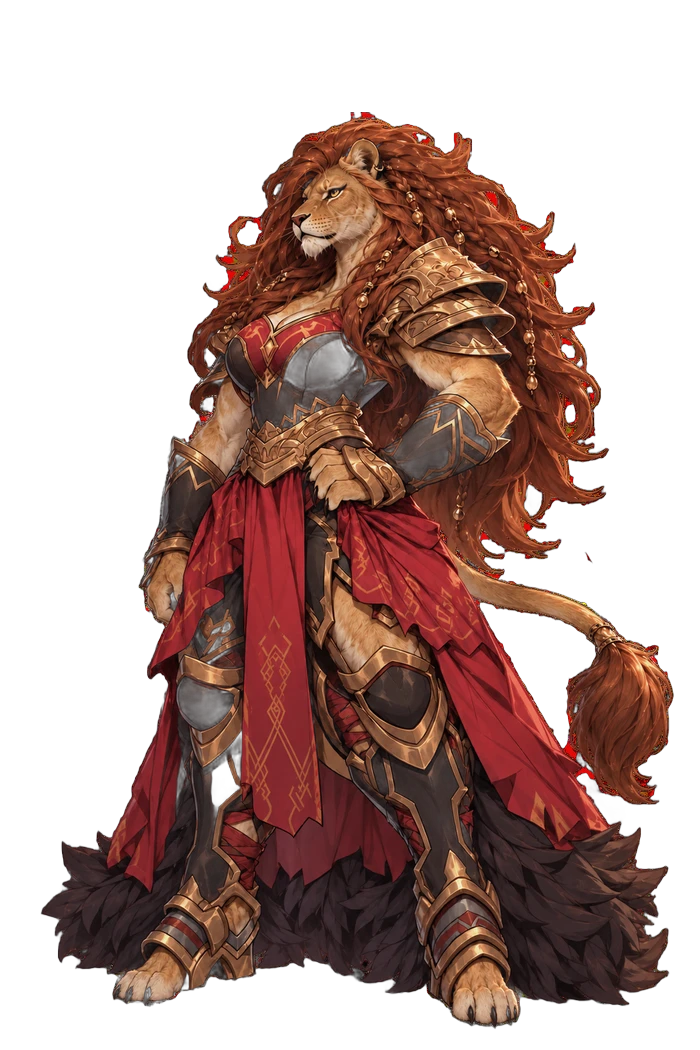
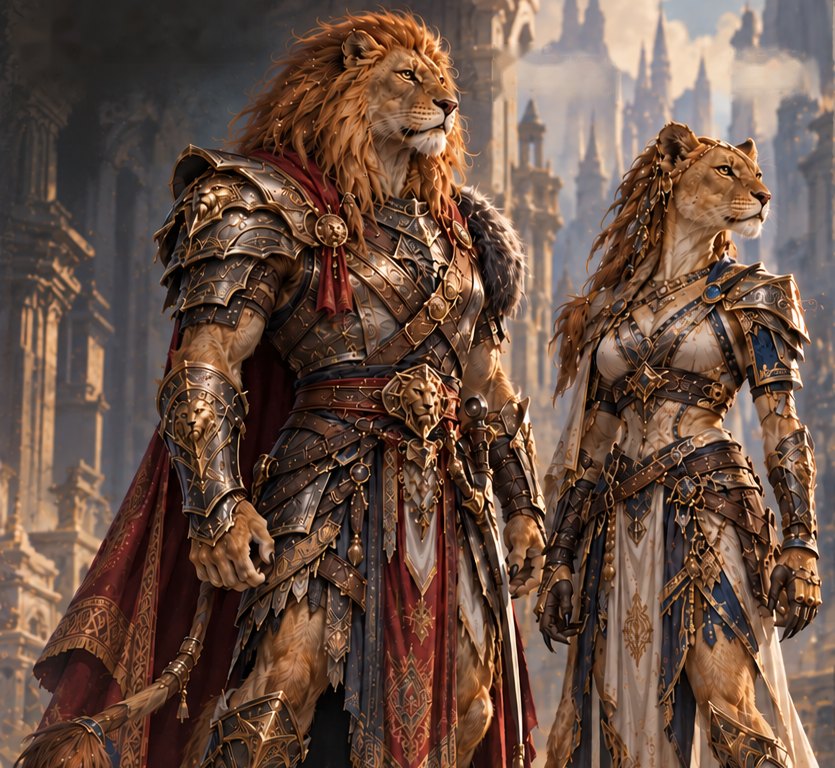
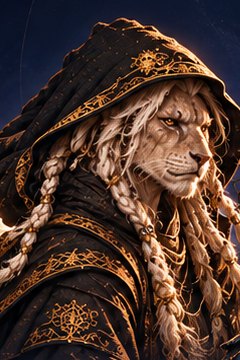
Tall lion folk from the northeast: reserved towards strangers, loyal to their allies and feared in close combat.
Home: Newolk
In the northeast, where broad river branches run through the land and lakes lie between wooded shores, lies Newolk – the ancestral home of the Asrani. Their city and the fortress at its heart watch over fords, harbours and important trade routes. Water connects the widely scattered settlements, yet belonging to one of the great houses often determines whom an Asrani trusts.
Appearance
The Asrani are tall, powerfully built lion folk. Their broad stature, upright bearing and thick manes give them an imposing appearance. Men and women alike wear their manes with pride; elaborate braids, ribbons and jewellery can reveal personal tastes or allegiance to a house. Even away from the battlefield, the Asrani are known for their dignified robes in red, blue and white.
Dealing with Strangers
The Asrani first meet strangers neutrally and with reserved courtesy. Trust must be earned: they watch attentively, weigh words against deeds and reveal little of themselves until they can size up the person before them. Yet whoever proves reliable and wins their respect may find mighty allies in them. A promise once given weighs heavily, and together with their allies the Asrani stand resolutely against those they regard as a threat.
Houses and Rivalries
They are particularly wary of the houses with which their own clan is at odds. Old rivalries and open clan feuds determine who is granted hospitality and who is met with suspicion or open hostility. Belonging to a house can open doors – or close them irrevocably.
Combat and Community
In battle, the Asrani are feared close-quarters fighters. Their highly ornate plate armour of gold and bronze and their noble cloaks make them recognisable from afar. With strength and endurance they hold their lines, protect their own and rarely give ground. But the Asrani are more than warriors: among them are scholars, guardians, rangers and travellers too. What unites them is their pride in Newolk, loyalty to their own people and the conviction that honour is proven through deeds.
People's emblem of the Asrani
Species Traits (D&D 2024)
Basic Stats
Creature type
Humanoid
Size
Medium
Speed
10.5 m
Darkvision
18 m
Languages
Common and one other suitable language
Traits
Darkvision
You can see in dim light within 18 m as if it were bright light, and in darkness within that range as if it were dim light. You discern colours in darkness only as shades of grey.
Natural Claws
Your claws are natural weapons, which you can use to make Unarmed Strikes. When you hit with them, you deal slashing damage equal to 1d4 + your Strength modifier instead of the normal damage of an Unarmed Strike.
Hunter's Instinct
You gain proficiency in one of the following skills of your choice: Athletics, Intimidation, Perception or Survival.
Fearsome Roar
1 × per Long Rest
As an action, you let out a mighty roar. Each creature of your choice within 3 m that can hear you must succeed on a Wisdom saving throw against a DC of 8 + your Proficiency Bonus + your Constitution modifier. On a failure, the creature has the Frightened condition until the end of your next turn.
Under the D&D 2024 rules, ability scores are determined by the character’s background, not by their species.
At a Glance
Home
Newolk in the northeast, between river branches and lakes
The Firbolgs are an ancient people bound closely to nature and deeply rooted in the history of Asterra. Having emerged from the untamed expanses of the south, they carry a magical spark within them from birth and sense the world in a way that often remains hidden to others.
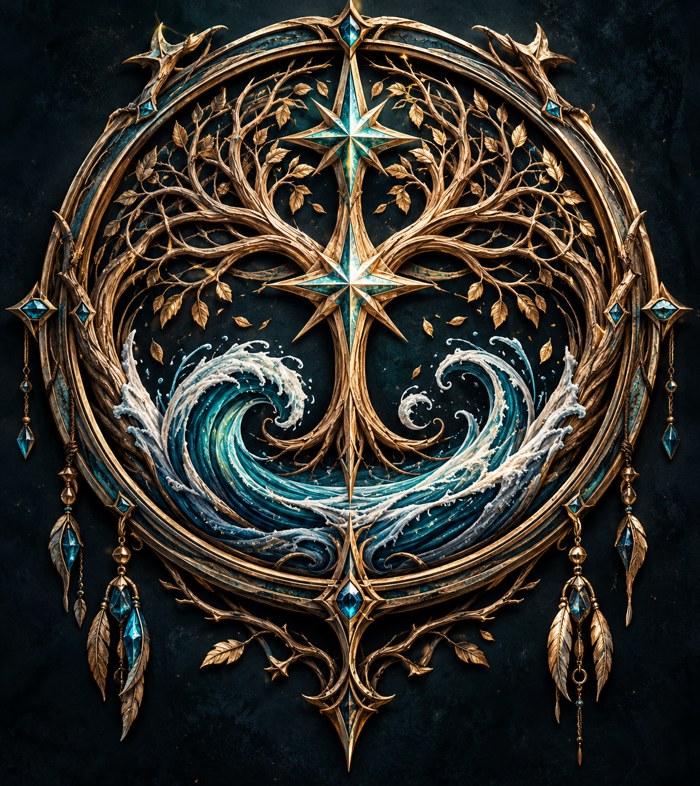
The sign of the Firbolgs unites earth, water, wind and the cycle of life. It stands for their deep bond with nature, their origins and the diversity of their paths.
The Tree
Life, connection, community
The Circle
Cycle, change, balance
The Star
Guidance, memory, future
The Waves
Adaptation, movement, all paths
The Roots
Origin, memory, constancy
Their History
The Firbolgs are no young newcomers but an ancient people who have been part of Asterra for a very long time. Their exact origins lie in the darkness of the early ages, yet their history is closely interwoven with nature, the changing of the world and the great powers of Asterra.
Primeval Times
In an age when the magical forces of the world were still untamed, the Firbolgs arose from the interplay of life, land and the primordial natural forces of Asterra.
The First Kin Groups
In the deep south the first communities formed. The Firbolgs lived in harmony with the wild landscapes, shaping them just as they were shaped by them.
Age of Change
Over generations, groups of Firbolgs spread out, first into the steppes and later along the coasts. In the process, new cultures, traditions and ways of life emerged.
Encounter and Exchange
With growing contact with other peoples, the life of the Firbolgs changed as well. Trade, new influences and different surroundings gave rise to regional branches.
Today
The Firbolgs are firmly rooted in the southern regions, while in the rest of Asterra they are considered rare. Despite all the changes, their bond with nature remains the heart of their people.
Their Cities
The Firbolgs' beginnings lie in Vardhûn. From there they wandered further north, first towards Yodhul and on as far as Marewyn. In the far north, Aervaal is no more than an outpost. The further the road leads, the sparser their population becomes. Each of these places is home to one of the four branches: the Tundra Firbolgs in Vardhûn, the Steppe Firbolgs in Yodhul, the Coastal Firbolgs in Marewyn and the Firbolgs of the northern regions in Aervaal.
You can cast Detect Magic and Disguise Self. You can cast each of these spells once per long rest through this trait without a spell slot. If you have spell slots, you can also cast them using those. When you create your character, you choose Intelligence, Wisdom or Charisma as your spellcasting ability for these spells. With Disguise Self, you can also appear up to 3 feet (about 1 m) taller or shorter.
Hidden Step
Proficiency bonus × per long rest
As a bonus action, you can magically turn invisible. The invisibility lasts until the start of your next turn and ends early if you attack, deal damage or force another creature to make a saving throw. You can use this ability a number of times equal to your proficiency bonus, and you regain all expended uses when you finish a long rest.
Powerful Build
You count as one size larger when determining your carrying capacity and the weight you can push, drag or lift.
Speech of Beast and Leaf
You can communicate in a limited way with animals, plants and vegetation. They can understand the meaning of your words. You have advantage on Charisma checks you make to influence animals or plants.
Under the D&D 2024 rules, ability score increases are determined by the character’s background, not by their species.
“We are not merely a part of the world. We remember what it once was.”
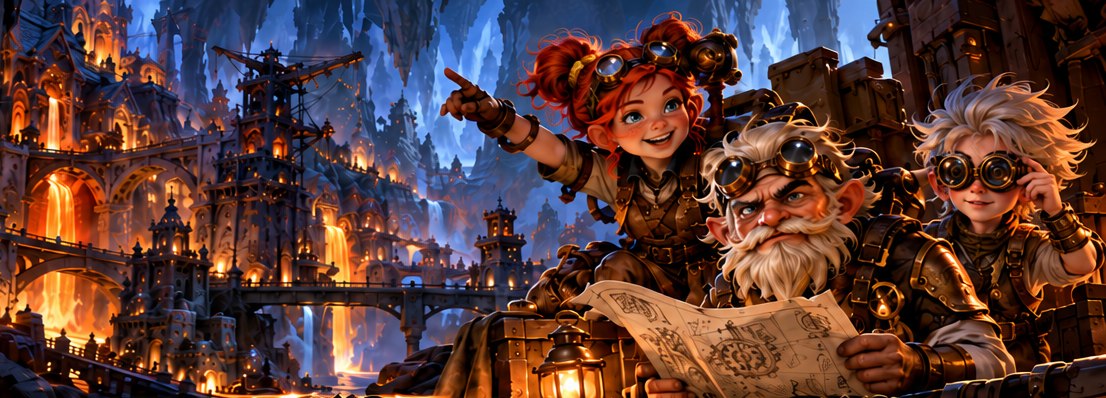
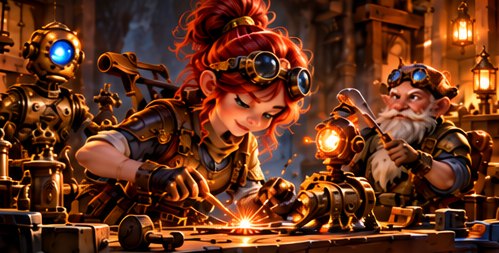
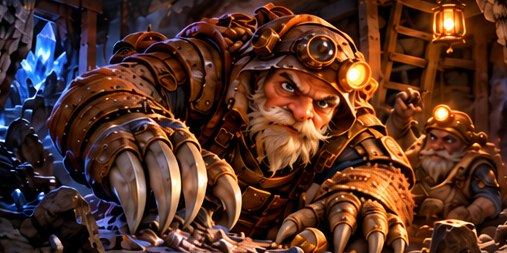
Deep in the mountains, where fire, steam and ore form the heart of ancient halls, lives one of the most inventive peoples of Asterra. Gnomes are small in stature, yet great in curiosity, courage and ideas. From a common origin, three paths emerged: the tinker gnomes, the deep gnomes and the sky gnomes.
“Small bodies. Big ideas.”
The People of the Gnomes
Gnomes are a resourceful, curious and energetic people. They do not regard the world as something finished, but as a structure that can be understood, improved and occasionally taken apart completely. Where others stop in front of a locked door, gnomes want to know who built it, how the lock works and whether a better entrance could be made through the wall.
Their oldest settlements lie deep in the mountains. There they connect natural caves with workshops, shafts, lifts and bridges. Fire and steam drive machines, while crystals light the lowest levels. Above the mountains, launch towers and air docks rise into the sky. A great gnome city therefore grows not only outwards, but downwards and upwards at the same time.
Despite their differences, all three groups see themselves as one people. Families may include members of several paths, and a young gnome is not obliged to take up their parents' trade. What matters is not which workshop someone was born into, but where curiosity and talent lead them.
“A good idea belongs to whoever tries it out. A safe idea belongs to whoever thinks first.”
Origin
the oldest tradition
The First Spark Chamber
According to the oldest tradition, the first gnomes lived in an enormous natural cave which they called the Spark Chamber. An underground stream of lava flowed through its centre. Above it lay veins of ore, crystal caves and shafts from which hot steam rose. For other peoples this place would have been uninhabitable. The gnomes saw it as a workshop that simply had not been fully fitted out yet.
They built channels for the heat, wheels for the steam and platforms above the depths. Within a few generations Funkenheim arose, the first great city of their people. Tools became more precise, tunnels longer, and the first simple gliders carried messengers from one mountain peak to the next.
the turning point
The Night of the Burst Boiler
Funkenheim's prosperity awakened ambition. A group of respected engineers built a gigantic pressure boiler meant to harness the power of several steam vents. It was to supply lifts, forges and lighting all at once. The calculations were bold, the warnings numerous and the first trial run far too successful.
The following night, deep beneath the city, a pipe burst. The pressure rose, tunnels collapsed and scalding vapours forced their way through the living halls. No single craft could save the city.
The mechanics dismantled the controls and kept the boiler in check with makeshift valves.
Diggers and ore prospectors used their broad, shovel-like hands and reinforced claw tools to hew new escape tunnels into the mountain.
The glider pilots rose through smoke and sparks, opened the upper steam shafts and carried children, the injured and important blueprints to safety over the peaks.
When the sun rose, part of Funkenheim lay in ruins, but the people lived. From the three tasks of that night, the three paths emerged. Not as a separation, but as a promise: no path should ever again believe that it alone was enough for the survival of all.
The Three Paths
Tinker Gnomes
Inventors · Mechanics · Artisans
The tinker gnomes are inventors, mechanics and artisans. Their workshops usually lie in the middle levels of the cities, where ore, fuel and trade routes come together. There they create tools, automatons, pumps, measuring instruments and those contraptions whose purpose even their builders only fully understand after several attempts.
For tinker gnomes, failure is not a disproof but a measurement. An explosion is not automatically considered a failure, as long as it is clearer afterwards which component needs reinforcing. This attitude makes them extraordinary inventors – and exhausting neighbours.
HomeMiddle levels
Typical tasks
Mechanical engineering, automatons and precision tools
The deep gnomes, often called mole gnomes, live in the lowest levels of the mountains. Their bodies are more sturdily built than those of many other gnomes. Most striking are their broad, shovel-like hands, which they reinforce with custom-made claw gloves. With these they can move earth and loose rock astonishingly quickly.
They search for veins of ore, tend crystal chambers and build safe tunnels through areas where ordinary tools fail. Deep gnomes learn early to read the mountain: fine cracks, shifting draughts and the echo of a hammer blow tell them whether a passage will hold or will soon collapse.
Outsiders occasionally take them for coarse or taciturn. In truth they often communicate tersely because in dangerous shafts every word must be unambiguous. Among themselves they have a dry sense of humour and a strong sense of community. No one is left behind in an unsafe tunnel.
HomeLower levels
Typical tasks
Ore mining, crystal prospecting and assaying raw materials
Tunnel building and securing underground settlements
Rescue teams for cave-ins and deep quakes
Mapping unknown caves and old ruins
Ore Mining & Raw MaterialsTunnelling & Underground SettlementsMole hands (special tools)Life in the depths, stable & safe
Sky Gnomes
Flight Pioneers · Navigators · Aircraft Builders
The sky gnomes live on the highest slopes and towers. They build gliders, airships and light flying machines with which they cross mountain valleys and reach distant places. Their workshops consist of open platforms, rope bridges and hangars in which the wind almost never falls silent.
They combine engineering with navigation, cartography and careful weather observation. A sky gnome learns to read clouds, air currents and the behaviour of birds as carefully as a deep gnome reads the rock.
Of the three paths, they are considered the most daring. Tinker gnomes claim that their flying machines only work because nobody has time to count all the faults during take-off. The sky gnomes usually reply that a machine on the ground can never prove that it flies anyway.
TopWindmills, observation towers and the air docks of the sky gnomes
MiddleResidential quarters, markets, forges, laboratories and the workshops of the tinker gnomes
BottomMines, crystal caves, storehouses and the halls of the deep gnomes
Between these levels run lifts, rail systems and cargo platforms. Some of them are centuries old and are constantly being repaired, improved and fitted with additional functions. Not every gnome still knows what all the levers are for. Most agree, however, that one should never pull an unknown red lever without witnesses.
The largest and most important city of the gnomes. The capital was hewn deep into a vast mountain massif and unites all three paths: in its lower halls deep gnomes mine ore and crystals, in the middle levels the workshops of the tinker gnomes are at work, and above the peaks lie the air docks of the sky gnomes. The constant rumble of hammers, machines and heavy lifts gave the city its name. This is also where the Council of the Three Paths convenes.
Tinktertal lies in a sheltered high valley dominated by workshops, testing grounds and smaller marketplaces. Many inventions are tried out here for the first time before they make their way to Felsengroll or other parts of Asterra. Visitors usually recognise Tinktertal from afar by its whistling, hissing and occasional bang.
An old mountain town on a widely branching cave system. A particularly large number of deep gnomes live there, tending the ore tunnels, crystal chambers and mushroom gardens beneath the town. Tüffel is smaller and quieter than Felsengroll, but has a reputation for finding a safe way even through difficult rock. A tall signal tower connects the town to the flight routes of the sky gnomes.
Council of the Three Paths
Important decisions are made by the Council of the Three Paths. Each path sends master craftswomen, master craftsmen and experienced specialists. A decision is only considered sound once its effects on workshops, deep levels and airways have been examined.
The council does not prevent disputes. Tinker gnomes demand room for experiments, deep gnomes insist on solid foundations and sky gnomes would like to turn every free tower into a launch platform. The procedure does, however, force them to listen to one another before a good idea turns into a city-wide catastrophe.
Family and Education
Gnome families are often large and closely knit. Children grow up among tools, maps, material samples and unfinished projects. From an early age they are allowed to watch and help, as long as an experienced person stays within reach and the emergency stop switch works.
As they grow older, young gnomes rotate between workshops, shafts and air docks. Only after that do they decide which path they wish to follow. Some switch again later or combine several fields. Those who can translate knowledge between the paths are held in especially high regard.
Names and Titles
Besides their family name, many gnomes bear an earned workshop name. This may be honourable, practical or unintentionally comical. Names such as Copperhand, Sparkflight, Tripleknot or Almost-Safe recall special achievements and, occasionally, particularly instructive accidents.
Customs and Way of Life
The First Spark
When a young gnome completes their first work of their own, it is presented to the family in the evening. It does not matter whether it works perfectly. What matters is that the builder can explain what they have learned and what they would change on the next attempt.
The Shared Meal
After larger projects, all the paths involved eat together. Deep gnomes bring mushrooms and root vegetables, tinker gnomes heated cooking devices with a questionable number of valves, and sky gnomes spices or fruit from distant regions. Whoever nearly made the project explode is usually expected to do the washing-up.
The Last Light
Deceased gnomes are not buried with their best tools. These are passed on to apprentices, friends or family members. Instead, the community lights a small light. For deep gnomes it stands in a crystal niche, for tinker gnomes in their former workshop and for sky gnomes in a lantern at the highest reachable point.
Trade with Other Peoples
Gnomes trade in tools, measuring instruments, pumps, maps, crystals and rare ores. From the forge dwarves they obtain high-quality metal and heavy components. Sun dwarves supply food, textiles, leather and brewed goods. In return, both dwarven cultures receive precision-engineered devices, mining equipment and fast message links via the airways.
Trade does not always run smoothly. Forge dwarves distrust devices with more joints than necessary. Gnomes, for their part, consider many dwarven constructions reliable but regrettably difficult to take apart. Nevertheless, their skills complement each other superbly.
Tensions between the Paths
The greatest conflicts arise from differing ideas of progress. Tinker gnomes want to try things out, deep gnomes want to secure them first and sky gnomes want to launch as quickly as possible. None of these attitudes is fundamentally wrong. It becomes dangerous when one of the paths believes it can do without the others.
Mining deep veins of ore also causes disputes. Some deposits lie beneath unstable or ancient parts of the mountains. Deep gnomes warn of cave-ins, while the workshops demand new raw materials. Sky gnomes point out that a ruined mountain also changes their launch sites and air currents.
Gnomes in Roleplay
Gnome characters do not have to be brilliant inventors. A tinker gnome can be a cautious repairer, a deep gnome a curious scholar and a sky gnome can suffer from a fear of heights. The chosen path describes the culture in which a character grew up, not their entire personality.
Possible character questions
Which of the three paths does the character feel connected to, and why?
Which invention, discovery or journey shaped their reputation?
Which mistake still haunts them to this day?
To whom do they owe their most important tool?
What do they think of the other two paths?
Which idea are they determined to realise, even though others advise against it?
Adventure hooks
The Old Pressure Boiler
Beneath Funkenheim, the boiler from the founding legend starts working again, even though no one has operated it for centuries.
The Lost Flight Route
An airship vanishes over a mountain range that appears on no known map.
Voices in the Crystal
Deep gnomes discover a crystal chamber from which knocking sounds emerge at regular intervals.
The Stolen Blueprint
The plans for a dangerous automaton are offered for sale at a foreign market.
The Fourth Path
A group of young gnomes claims that the three old paths are outdated and carries out experiments that endanger every level of the city.
The Mountain Breathes
Steam escapes from long-sealed shafts and alters the animals, plants and machines in the surrounding area.
Species Traits (D&D 2024)
Basic Stats
Creature type
Humanoid
Size
Small
Speed
9 m (30 ft)
Darkvision
18 m (60 ft)
Traits
Darkvision
You have Darkvision with a range of 60 feet (18 m).
Gnomish Cunning
You have advantage on Intelligence, Wisdom and Charisma saving throws.
Gnomish Lineage
You choose one of the following lineages. Intelligence, Wisdom or Charisma is your spellcasting ability for the spells you cast with this trait.
Forest Gnome
Proficiency bonus × per long rest
You know the Minor Illusion cantrip and always have Speak with Animals prepared. You can cast it without a spell slot a number of times equal to your proficiency bonus, and you regain all expended uses when you finish a long rest.
Rock Gnome
You know the Mending and Prestidigitation cantrips. In addition, you can use Prestidigitation to create a tiny clockwork device that performs one chosen effect of the cantrip.
Under the D&D 2024 rules, ability score increases are determined by the character’s background, not by their species.
Mighty turtle folk from the lakes of the northwest: deliberate, steadfast and almost impossible to move once they have taken up position.
Home: Restan
In the northwest, on the wide shores of the lake country, rises Restan: a city of stone whose mighty fortifications watch over harbours, lakeside paths and shallow waterways. Here House Steinschild rules over the Kapalith, a people of mighty turtle folk whose history is closely interwoven with the lakes and rivers of the region.
Appearance
The Kapalith are powerful and of a calm, deliberate nature. Their heavy shells protect them like natural armour; the patterns and colours on them differ from individual to individual and are often worn with pride. In everyday life they dress in elaborate tunics, adorned with pearls, shells and the jewellery that rivers and lakes provide. Shades of blue and green, careful embroidery and personal pieces of jewellery reflect their bond with the water.
Nature and Community
They meet strangers with considered reserve. The Kapalith are rarely hurried and do not give their trust lightly, but those who show patience and prove reliable will find loyal companions in them. They value constancy and hold fast to alliances. House Steinschild shapes their community and watches over Restan, yet the Kapalith are not only guardians and warriors: among them are scholars, seafarers, rangers and travellers as well.
Combat
When danger threatens, they advance with massive shell shields, staves and tridents. On open land as well as in shallow waters, they form a closed, armoured front. Their steps may seem slow, but once they have taken up position, they are almost impossible to move. Enemy attacks shatter against their wall of shield and shell – and whoever has the Kapalith at their side gains allies whose steadfastness can be relied upon.
People's emblem of the Kapalith
Species Traits (D&D 2024)
Basic Stats
Creature type
Humanoid
Size
Medium
Speed
9 m
Swimming speed
9 m
Languages
Common and one other language of your choice, for example Kapalith
Traits
Natural Armour
Your natural shell protects you from attacks. While you aren’t wearing armour, your base Armor Class is 17. You can use a Shield and still gain its bonus.
Your Dexterity modifier is not added to your natural Armor Class.
Shell Retreat
Bonus Action
As a Bonus Action, you withdraw into your shell. Until you end the retreat as a Bonus Action, the following rules apply:
You gain an additional +2 bonus to your AC.
Your Speed is 0.
You can’t take actions or Reactions.
You have advantage on Strength and Constitution saving throws.
You can end the retreat at any time as a Bonus Action.
Children of the Lakes and Rivers
You have a Swim Speed of 9 m and can hold your breath for up to one hour.
Unshakeable Steadfastness
You have advantage on saving throws you make to avoid being knocked prone or moved against your will.
Keeper of the Shores
You gain proficiency in the Survival skill. You are skilled at reading tracks, recognising changes in nature and finding your way around near lakes and rivers.
At a Glance
Home
Restan on the shores of the lake country in the northwest
“A Lupin might show you the way, save your life or lead you astray with a smile. The art lies in finding out in time which of these he intends.”
Nature and Origin
The Lupin are a fox-like, humanoid people who have settled primarily in the dense forests around Urfels in the Südliche Wieslande. Among ancient giant trees, winding paths and hidden clearings they have found a home that often seems impenetrable to outsiders. Whoever enters their forests enters a realm whose secrets are only rarely revealed in full.
Adult Lupin usually reach a height of around 1.60 to 1.75 metres. Their slender build, pointed ears, fox-like features and characteristic bushy tail give them an unmistakable appearance. Their movements are lithe, their senses keen and their reactions of a speed that can surprise even experienced fighters.
Yet it is not their physical make-up alone that sets them apart. Rather, it is their sharp mind, their ingenuity and their hard-to-read nature that have earned the Lupin their particular reputation.
Home of the Lupin
For generations, the dense forests around Urfels have formed the centre of Lupin life. Their settlements are said to lie hidden deep among the trees, connected by narrow paths, concealed crossings and trails that strangers easily overlook. Some settlements may look to a traveller like ordinary forest clearings, while others are skilfully embedded in the natural terrain.
The Lupin know the peculiarities of their homeland intimately. They know where the ground gives way beneath the leaves, which paths remain passable even in the rain and at which spots a sound carries through the undergrowth. Strangers who venture into the forest without a local guide can therefore quickly lose their bearings.
Whether the Lupin use this knowledge to help travellers, to protect their homeland or to keep unwelcome visitors at a distance depends on the situation at hand. The only certainty is that in their forests one is rarely as unobserved as one believes.
Character and Disposition
The Lupin are considered intelligent, quick-witted and exceptionally quick to learn. They observe their surroundings attentively, recognise connections quickly and know how to gain an advantage from seemingly insignificant details. Not infrequently they seem to know more than they care to reveal.
For members of other peoples, Lupin are therefore often hard to read. A friendly conversation may indeed be the beginning of a sincere friendship. But it may just as well serve to gather information, to fathom the intentions of the other person or to prepare an opportunity that only reveals itself later.
This uncertainty has earned them an ambivalent reputation. Lupin are generally regarded as neither dangerous nor hostile. They do not pick quarrels without reason and certainly meet strangers with openness. Even so, a simple rule persists among travellers, merchants and scholars:
“Trust a Lupin's smile – but don't forget to keep an eye on his hands.”
Whether this caution is justified or merely springs from the mistrust of other peoples can hardly be answered across the board. For their motives are as varied as their personalities.
Combat Skills and Abilities
The Lupin combine agility, dexterity and tactical thinking into a fighting technique that relies less on brute strength than on speed, precision and favourable opportunities. Their slender build and nimble movements allow them to evade attacks, close distances swiftly and put their opponents under pressure before they can reorganise their defence.
A Lupin warrior will rarely stay in one place for long if movement gives him an advantage. He uses cover, changes position and forces his opponent to respond to several possibilities at once. Where a heavily armoured fighter relies on resistance, a Lupin prefers to rely on timing, skill and a well-considered attack.
They are particularly feared opponents in wooded terrain. Among trunks, roots and dense undergrowth they can bring their agility fully to bear. They know how to incorporate their surroundings into their way of fighting and to exploit weaknesses that other fighters miss.
Their strength does not lie in attack alone. Retreat, distracting an opponent and deliberately avoiding a hopeless fight are also part of their repertoire. For many Lupin, a fight won is not necessarily the one in which the opponent falls, but the one from which they emerge with the result they wanted.
Relations with Other Peoples
The Lupin's relations with the other inhabitants of the Wieslande are marked by cautious curiosity. Merchants value their ingenuity and their ability to find unusual solutions. Travellers occasionally seek their help when they need safe routes through the forests. Others, in turn, meet them with mistrust, because they can never be sure whether a Lupin is revealing his true intentions.
Yet it would be wrong to place the entire people under a single suspicion. Many Lupin cultivate sincere friendships, keep the promises they give and stand loyally by their allies. Others are more reserved, more calculating or simply intent on protecting their own interests.
Anyone wishing to get to know a Lupin should therefore pay less attention to his words than to his deeds. Trust is not necessarily withheld – it is just rarely granted without being tested.
Species Traits (D&D 2024)
Basic Stats
Creature type
Humanoid
Size
Medium
Speed
9 m
Darkvision
18 m
Languages
Common and one other language of your choice
Traits
During character creation, you choose one of the two ways of life. Your choice cannot be changed later.
Darkvision
You can see in dim light within 18 m as if it were bright light, and in darkness as if it were dim light. In total darkness you discern colours only as shades of grey.
Lupin Way of Life: Hunter
Chosen at character creation
Hunters rely on stealth, cunning and the ability to deceive others with clever words.
Foxlike Stealth: You have advantage on Dexterity (Stealth) checks when you hide in suitable natural terrain such as forests, tall grass or dense undergrowth, or make use of such cover.
Cunning Deception: You have advantage on Charisma (Deception) checks.
Lupin Way of Life: Gatherer
Chosen at character creation
Gatherers know nature and how to find their way and provide for themselves in the wilderness.
Nature-Wise: You have advantage on Intelligence (Nature) checks.
Survivalist: You have advantage on Wisdom (Survival) checks.
Balance note: The Lupin specialise in two different roles. The Hunter is especially suited to situations that call for stealth and deception. The Gatherer is geared towards knowledge of nature and survival in the wilderness. The advantages are permanent, but each applies only to the chosen way of life. For the Hunter, the advantage on Stealth is additionally tied to suitable natural conditions.
At a Glance
Home
Dense forests around Urfels, Südliche Wieslande
Height
About 1.60–1.75 metres in adulthood
Traits
Intelligent, quick-witted, attentive and hard to read
Fighting style
Fast, agile, precise and tactical
Reputation among the peoples
Not fundamentally hostile, but always to be treated with a certain caution
“You can spend an evening by the fire with a Lupin, swap stories and say goodbye to him in the morning like an old friend. Only three days later will you wonder why he of all things asked about the name of the local captain, the state of the north bridge and the contents of your own saddlebag.”From the notes of a travelling scholar of the Wieslande
The largest and most widespread people of Seraphim, at home in tundras, grasslands and deserts.
The Largest People of Seraphim
Humans are the largest and most widespread people of Seraphim. They live in the most varied regions and have adapted to many ways of life and landscapes: from the tall, weather-beaten humans of the tundras and the inhabitants of the wide grasslands to the sun-kissed peoples of the eastern desert lands.
Build and Diversity
Humans usually reach a height of between 1.65 and 2 metres. As with every people, there are exceptions who exceed or fall short of this range. Their diversity shows not only in their appearance, but also in their customs, languages and ways of life.
Lifespan
On average they live to around 80 years of age. Naturally, illness, war, magic and the circumstances of their lives can shorten or lengthen this span.
At a Glance
Distribution
All of Seraphim: tundras, grasslands and the eastern desert lands
“Water is not our home. It reminds us how free we can be.”
The Mani · Three Peoples of the Sea
The Nymani are a subspecies of the Mani. The Mani are an ancient species whose origin is closely bound to the sea and the living power of water. Although Nymani, Kymani and Lymani belong to the same species, their ways of life have developed so differently over generations that today they seem almost like three separate peoples.
What all Mani share is their bond with water. But while some see it above all as freedom and pleasure, others regard it as their home and sovereign territory, and for the third it is a living part of themselves.
The Nymani
The Nymani are probably the most open and sociable people among the Mani. Their home lies along rivers, lakes and sheltered coasts, where splendid cities of pale stone, elegant bridges and artful waterways have arisen. Water runs through their settlements and is a natural part of daily life.
The Nymani place great value on aesthetics, beauty and social harmony. Art, clothing, architecture, jewellery and good food hold a high place in their culture. To a Nymani, a beautifully crafted object is not merely a possession – beauty is seen as an expression of joie de vivre and quality of life.
They are considered peaceful, open and full of zest for life. Towards strangers they are usually curious and friendly, though their openness does not always go hand in hand with real depth. Nymani can seem decidedly superficial and tend to judge people at first by their manner, their elegance or their social standing.
For the Nymani, the sea and great lakes mean above all freedom and relaxation. They swim, play in the water, go out in boats or spend whole days on the shores. Despite their great love of water, however, their true home lies on land.
For a Nymani, water is a place where one can leave the worries of everyday life behind – a place for laughing, celebrating, swimming and dreaming.
Typical traits
Aesthetic and cultured
Open and sociable
Peace-loving
Full of life and curious
Somewhat superficial and status-conscious
Strong connection to art, culture and social life
The Three Paths of the Mani
Although the Nymani, Kymani and Lymani belong to the same kind, they have developed three entirely different relationships with the sea.
However different their cultures may be, they are bound by something older than any of their cities and realms: the Mani – the living power of the sea.
The Sisters of the Mani
Since the oldest traditions of the Mani, the three peoples have been led by three sisters. Kadita, Vexana and Odetta are regarded not only as the rulers of their respective tribes, but also as embodiments of the three different paths the Mani have taken.
Although they are sisters, their natures could hardly be more different. Each of them carries a part of the ancient power of the Mani within her – and each watches over a different part of what the sea means.
Ruler of the Nymani
Kadita
The Voice of Radiance
Kadita is the ruler of the Nymani and the embodiment of their love of beauty, art and joy of life. In the cities of the rivers and lakes she is revered as the Voice of Radiance – the voice that reminds everyone that life need not consist only of duties and worries.
Kadita is considered charismatic, elegant and socially adept. She moves through splendid palaces with the same ease as through the bustling waterways of her cities. Under her rule, art, trade and social life became important pillars of Nymani culture.
Yet Kadita's radiance also has a darker side. She is aware of her people's superficiality and at times even encourages it. To her, beauty holds a power of its own – it can bring people together, open hearts and defuse conflicts. But whoever looks behind the radiance will recognise a ruler who knows very well how easily others can be swayed by beautiful things.
Title
The Voice of Radiance
People
Nymani
Domain
Rivers, lakes and coastal cities
Stands for
Beauty, joy of life, art and freedom
“What would life be worth if we forgot to enjoy it?”
Nymani as a Playable People
Unlike their sister tribes, the Nymani are the most friendly towards the land peoples and also the best adapted to life far from the high seas. They often accompany groups of adventurers to explore the vast expanses of Seraphim.
Basic Racial Traits
Creature type
Humanoid
Size
Medium
Speed
9 m on land
Swimming speed
12 m
Life expectancy
About 200–300 years
Maturity
At about 20 years of age
Languages
Common and Nymani
Disposition
Any
The Nymani are not water creatures that can exist only in a limited way on land. They are at home in both worlds and can in principle choose any class.
The Racial Traits in Detail
Shifting Fin
Core ability
The Nymani can switch between their land form and their water form.
On land: they have two ordinary legs and a walking speed of 9 m.
In water: their legs merge into a majestic fish tail. They gain a swimming speed of 12 m.
The transformation takes a moment and requires no action.
Clothing and equipment adapt naturally to the transformation.
Note: The transformation grants no additional Hit Points, armour or attacks.
Amphibious Nature
Nymani can breathe both air and water.
They can live and fight on land for just as long as other humanoids. Underwater they neither have to hold their breath nor surface regularly to breathe.
Note: This ability is very useful in underwater adventures, but on land it is not a direct combat bonus.
Eyes of the Deep
The eyes of the Nymani are adapted to the dim underwater world.
You have darkvision with a range of 18 m. In darkness, you see everything in shades of grey.
Note: This helps you in dark caves, sunken ruins and night-time surroundings.
Voice of the Sea
Nymani can exchange simple feelings, impressions and intentions with ordinary fish and other natural water creatures.
For example, they can find out whether a predator is nearby or whether a school of fish is fleeing from something.
Note: This ability grants no full understanding of language, no control over animals and no guarantee that the animals have helpful information.
Grace of the Nymani
The Nymani are known for their expressive appearance, their elegant body language and their melodious voices.
You gain proficiency in one skill of your choice: Performance or Persuasion.
Graceful eagle folk from the cliff faces of the north: unrivalled scouts who often spot danger before it reaches the ground.
Home: Derestor
In the far north, where the wide grassy plains meet the rugged mountain massif, Derestor nestles against the steep cliff faces. Towers, bridges and battlements jut out over chasms; from the highest ledges the view stretches far across the open landscape. Here live the Talon, a people of graceful eagle folk with powerful bodies, sharp talons and mighty brown-and-white wings. House Himmelskralle leads them and watches over their homeland.
Life at Altitude
The Talon are adapted to life at lofty heights. Their wings carry them over gorges and plains, while their keen sight picks out even distant movements on the horizon. On the open grassy plains, where natural cover is scarce, this makes them unrivalled scouts. They watch patiently, read wind and terrain and pass on important news swiftly.
Equipment and Combat
Their clothing and equipment are designed for agility. Light leather armour protects without hindering flight; elaborate feather ornaments and carefully crafted ribbons display personal tastes and allegiance to a house or retinue. Talon warriors favour bows and other weapons that can also be wielded from the air. In battle they make use of height and speed: they circle above the battlefield, loose well-aimed volleys of arrows and then swoop down on their foes with sharp talons.
Dealing with Strangers
The Talon meet strangers with watchful reserve. They value prudence, reliability and a clear eye – qualities as important in the mountains as in dealings with other peoples. Whoever wins their trust finds attentive allies who often spot danger before it reaches the ground. Their freedom and the safety of Derestor are especially close to their hearts; whoever threatens either must reckon with an answer from the clouds.
People's emblem of the Talon
Species Traits (D&D 2024)
Basic Stats
Creature type
Humanoid
Size
Medium
Ground Speed
9 m
Fly Speed
9 m
Darkvision
18 m
Languages
Common and one other suitable language
Traits
Mighty Wings
You have a Fly Speed of 9 m while you aren’t wearing armour or are wearing light armour.
While you wear medium or heavy armour, you can’t use your natural flight. From level 5 onwards, you can overcome this restriction through your Flight Mastery.
If your Fly Speed drops to 0 while you are in the air, you fall and take falling damage under the normal rules, unless you can break the fall in some other way.
Eagle Eyes
You gain proficiency in the Perception skill.
Your keen eyes help you spot movement in the distance, detect dangers early and watch vast landscapes attentively.
Darkvision
You can see in dim light within 18 m as if it were bright light, and in darkness within that range as if it were dim light. You discern colours in darkness only as shades of grey.
Cold Resistance
You have Resistance to Cold damage. When you take Cold damage, it is halved after other modifiers have been applied.
This resilience comes from life in the cold highlands of the north.
Controlled Descent
As long as you don’t have the Incapacitated condition and can use your wings, you can spread them while falling to break your fall and avoid falling damage.
This trait works regardless of the armour you are wearing.
Flight Endurance
If you fly actively and without interruption for longer than 10 minutes outside of combat, you must succeed on a DC 12 Constitution saving throw. On a failure, you gain 1 level of Exhaustion.
After a Short Rest on the ground, you can begin a new flight without having to make this saving throw again right away.
Flight Mastery
from level 5
From level 5 onwards, you learn the Fly spell. You can cast it once per Long Rest without a spell slot.
At character creation, choose Intelligence, Wisdom or Charisma as your spellcasting ability.
When you cast the spell this way, you can fly even while wearing medium or heavy armour. The spell otherwise follows its normal rules, including Concentration and duration.
Balancing note: Thanks to their natural ability to fly, the Talon have a considerable advantage in exploration, movement and ranged combat. The armour restriction keeps this advantage in balance, while Flight Mastery from level 5 gives heavily armoured characters a limited way to use their wings as well.
Under the D&D 2024 rules, ability scores are determined by the character’s background, not by their species.
At a Glance
Home
Derestor on the cliff faces of the northern mountain massif
All dwarves believe that their people were born of stone deep within the mountains. The first spark, however, split into two flames:
One flame grew hot enough to shape metal.
The other burned calmly enough to warm hearth and family.
From these arose the forge dwarves and the sun dwarves.
Forge Dwarves
Smithing · Runes · Mining
The forge dwarves live deep in the mountains, near underground veins of fire, great ore deposits and ancient magma chambers. Their cities consist of vast halls, bridges, mine shafts and forges that are never fully extinguished.
For them, smithing is no ordinary work. A well-made tool contains part of the essence of its maker. Weapons and armour are passed down through generations and often bear runes with the names of former owners.
place great importance on family, craft and the reputation of their clan
speak little about feelings
like to solve problems practically and directly
Sun Dwarves
Trade · Brewing · Agriculture
Sun dwarves live closer to the surface. Their settlements lie in green hills, small mountain ranges and fertile valleys. Their houses are built directly into hills and rock, but have large doors, windows, gardens and cosy communal rooms.
They are considered more sociable and open than the forge dwarves. While a forge dwarf finds his pride in a perfect axe, a sun dwarf measures his success rather by a full larder, a good meal and a table at which no one has to sit alone.
In search of more fertile land, the sun dwarves moved into the steppe and settled on the river Sar’Kesh. The river's name dates back to the time of the old desert peoples. But the steppe has grown ever greener and pushed the desert back. Today the sun dwarves farm the whole land from Lovendar towards Erzbrand.
Traits
sociable, curious and hospitable
skilled traders, brewers and craftsmen
excellent cooks and storytellers
less strictly bound to old traditions
grow fruit, hops, herbs and root vegetables
keep goats, sheep and hardy hill cattle
travel more often
Relations between the Two Groups
Each group considers the other somewhat odd:
Forge dwarves on sun dwarvesToo comfortable, talkative and lacking ambition.
Sun dwarves on forge dwarvesDogged. They would sooner marry their anvil than hold a sensible conversation.
Nevertheless, they depend on each other economically. They meet and trade in Erzbrand:
Trading cityErzbrand
Here forge dwarves and sun dwarves meet to exchange and trade their goods.
When threatened, they still regard themselves as one people. Their quarrels may be fierce, but no dwarf will tolerate an outsider speaking ill of the other kind of dwarf.
Differences in Appearance
The differences need not be biological, but can arise from their way of life:
Forge Dwarves
stronger and more broadly built
often sooty or weather-beaten skin
heavy clothing, metal and leather
elaborately braided beards with metal rings
burn marks or rune tattoos
Sun Dwarves
often somewhat shorter and rounder
more colourful clothing
wood, bone and glass jewellery
well-groomed, softer beard styles
often aprons, waistcoats and practical travelling clothes
Species Traits (D&D 2024)
Basic Stats
Creature type
Humanoid
Size
Medium
Speed
9 m (30 ft)
Darkvision
36 m (120 ft)
Traits
Darkvision
You have Darkvision with a range of 120 feet (36 m).
Dwarven Resilience
You have resistance to poison damage and advantage on saving throws you make to avoid or end the Poisoned condition.
Dwarven Toughness
Your hit point maximum increases by 1, and it increases by 1 again whenever you gain a level.
Stonecunning
Proficiency bonus × per long rest
As a bonus action, you gain Tremorsense with a range of 60 feet (18 m) for 10 minutes. You must be standing on or touching a stone surface. This works on both natural and worked stone. You can use this ability a number of times equal to your proficiency bonus, and you regain all expended uses when you finish a long rest.
These species traits apply equally to forge dwarves and sun dwarves. Under the D&D 2024 rules, ability score increases are determined by the character’s background, not by their species.
The Teravora belong to the Vora, whose emergence can be traced back to the magical influence of the mighty world tree Aevora.
Roughly 800 years ago, the first Vora developed in the vicinity of the tree. The Teravora are one of these peoples and have found their home high up in the sprawling treetops of Aevora.
Although they have a deep connection to nature, they are not bound to their place of origin. Teravora can leave Aevora and live permanently in other regions of Asterra or in human cities.
Appearance
Teravora are slender, humanoid beings with long, pointed ears and a natural, almost fey-like appearance.
Their most striking feature is their four translucent dragonfly wings, which grow from their backs. The wings can be folded tightly against the body, so that Teravora can also use ordinary buildings and furniture.
Skin, hair and wing colours differ from individual to individual. Some Teravora also have antler-like or horn-like growths.
For players: colours, horns and antler shapes can be designed freely. The four dragonfly-like wings, however, are a fixed trait of the people.
Despite their delicate appearance, Teravora are physically just as resilient as humans.
Wings and Flight
The wings of the Teravora grow during their childhood. At around 15 years of age, young Teravora are able to fly properly for the first time. They learn this ability on their own through trial and practice.
Their flight movements resemble those of a dragonfly. They can hover in the air, fly backwards or sideways, change direction abruptly and stop suddenly.
Their flying speed is about 30% higher than their walking speed. A Teravora can fly for roughly three to four hours at a stretch before needing a rest.
Additional weight makes flying harder. Heavy equipment or armour therefore impairs their agility.
The wings are resilient but not indestructible. Injuries heal naturally. Severe wing injuries may take several months to heal completely and can temporarily limit the ability to fly.
Magical abilities
Every Teravora is born with a natural connection to earth and plant magic.
This gift enables them to influence and control plants and roots and to accelerate their growth.
At birth, Teravora can only sense their magic at first. Its conscious use develops through experience, learning and regular practice.
Their magical abilities remain fully intact outside Aevora as well.
Not every Teravora chooses intensive magical training. Deepening this gift is voluntary.
Society and Way of Life
The Teravora live mainly in the mighty treetops of Aevora. There they build proper wooden houses whose design is reminiscent of traditional Norwegian timber houses.
Their society is peaceable, hospitable and open-minded towards other peoples.
Family structures resemble those of humans. Relationships with members of other peoples are also socially accepted. Biological offspring, however, can only be produced between Teravora.
The Teravora pursue a variety of professions. Among them are craftspeople, carpenters, merchants, scholars, soldiers and warriors.
For education they maintain academies in which both general knowledge and magical skills are taught.
The Council of Five Elders
The community is led by a council of five experienced Teravora.
Council members are chosen for their life experience and must be at least 100 years old. Decisions are made by simple majority, so three votes are enough to pass a resolution.
Bond with Nature and Diet
The Teravora eat exclusively plant-based food.
They respect nature and place great value on responsible stewardship of forests and plants. They do not reject the felling of trees outright, as long as it is done sustainably and with care.
They have no special innate bond with animals. They can neither naturally speak with them nor influence them with their people's magic.
Faith
The Teravora worship the gods of Asterra.
There is no prescribed deity for the whole people. Each Teravora decides for themselves which god to follow, or whether to join a particular faith at all.
Combat and Defence
The Teravora are a peaceable people and wage no wars of conquest. When their homeland, their community or their allies are threatened, however, they are ready to defend themselves.
In battle they favour spears, shields, bows and crossbows.
Light leather armour is particularly common, as it restricts the movement of their wings as little as possible.
Their ability to fly allows them unusual manoeuvres and opens up numerous possibilities in combat.
Special Racial Traits for D&D
Darkvision
18 m / 60 ft
Teravora can see in dim light as if it were bright light, and in darkness as if it were dim light. In complete darkness they discern only shades of grey.
Keen Hearing
The Teravora have a particularly acute sense of hearing and can perceive even quiet sounds well.
Natural Flight
Four dragonfly wings allow independent flight, hovering and especially agile aerial manoeuvres. Their flying speed is 30% higher than their walking speed.
Innate Plant Magic
Every Teravora possesses a magical connection to plants and roots. Mastery of these powers grows through practice and experience.
Languages
Teravoran and Common.
the world · tribes
The Tribes
The communities, kin groups and species of Asterra, their ways of life, their rulers and their stories. Choose a tribe to learn more.
“You may see our island. You may enter our cities. But never forget: both belong to us.”
The Mani · Three Peoples of the Sea
The Kymani are a subspecies of the Mani. The Mani are an ancient species whose origin is closely bound to the sea and the living power of water. Although Nymani, Kymani and Lymani belong to the same species, their ways of life have developed so differently over generations that today they seem almost like three separate peoples.
What all Mani share is their bond with water. But while some see it above all as freedom and pleasure, others regard it as their home and sovereign territory, and for the third it is a living part of themselves.
The Kymani
Where the Nymani seek out the water for pleasure, the Kymani see it as their home and their territory.
The Kymani inhabit the Kyman island chain as well as the vast underwater cities that stretch beneath their islands. Their civilisation thus reaches from the rocky peaks of their islands down into the deepest waters below.
The Kymani are a proud and decidedly territorial people. To them, their homeland is not merely a place where they live – it is part of their identity. Strangers are therefore regarded with caution. Anyone who enters Kymani territory without an invitation must expect to be seen as a threat.
Their society is strongly shaped by honour, strength and martial readiness. Many Kymani are trained in the use of weapons and in combat. Warriors are held in high esteem, and the ability to defend one's own community and homeland is considered a great virtue.
Unlike the Nymani, the Kymani feel at home both on land and under water. Even on land, they always retain part of their fish form. The boundary between life on land and life in the water is therefore less pronounced for them than for the Nymani.
Despite their rough manner, the Kymani are not hostile by nature. Those who win their trust can find in them extremely loyal and reliable allies. That trust, however, must be earned.
To a Kymani, home is not something one simply owns. Home is something one protects.
Typical traits
Proud and territorial
Distrustful of strangers
Warlike and martial
Strong sense of honour
Loyal to their own people
Live on land and under water
Retain their fish form even on land
The Three Paths of the Mani
Although the Nymani, Kymani and Lymani belong to the same kind, they have developed three entirely different relationships with the sea.
However different their cultures may be, they are bound by something older than any of their cities and realms: the Mani – the living power of the sea.
The Sisters of the Mani
Since the oldest traditions of the Mani, the three peoples have been led by three sisters. Kadita, Vexana and Odetta are regarded not only as the rulers of their respective tribes, but also as embodiments of the three different paths the Mani have taken.
Although they are sisters, their natures could hardly be more different. Each of them carries a part of the ancient power of the Mani within her – and each watches over a different part of what the sea means.
Ruler of the Kymani
Vexana
The Echo of Battle
Where Kadita stands for radiance, Vexana stands for strength. As ruler of the Kymani, she bears the title the Echo of Battle.
Vexana embodies the warrior tradition of her people. To her, strength is not merely the ability to defeat an opponent. Strength means discipline, loyalty and the willingness to stand up for one's homeland.
Under her leadership, the Kymani regard their island chain and the vast underwater cities beneath it as an inviolable heritage. Vexana remains distrustful of strangers. She tolerates no interference in the affairs of her people and expects every Kymani to protect their homeland.
Despite her harshness, Vexana is not a ruler who seeks senseless violence. To her, battle is a means, not an end in itself. A war that must be fought should be fought with resolve – but a war that can be avoided need not be started.
She is respected by her subjects, feared by some, but above all revered for her resolve and her loyalty to Kyman.
Title
The Echo of Battle
People
Kymani
Domain
Kyman and the underwater cities
Stands for
Strength, honour, protection and battle
“As long as we stand, our homeland belongs to us. And as long as we fight, it endures.”
“The reef does not belong to us. We belong to the reef.”
The Mani · Three Peoples of the Sea
The Lymani are a subspecies of the Mani. The Mani are an ancient species whose origin is closely bound to the sea and the living power of water. Although Nymani, Kymani and Lymani belong to the same species, their ways of life have developed so differently over generations that today they seem almost like three separate peoples.
What all Mani share is their bond with water. But while some see it above all as freedom and pleasure, others regard it as their home and sovereign territory, and for the third it is a living part of themselves.
The Lymani
The Lymani differ most strongly from the other two peoples. While the Nymani build their cities on land and the Kymani live between islands and underwater cities, the Lymani have moved their home entirely into the depths of the sea.
Their settlements lie in vast coral reefs, underwater domains and quiet lagoons. The boundaries between nature and civilisation can scarcely be made out. Buildings grow out of coral structures, paths follow the natural shapes of the reef, and entire cities seem to have grown together with their surroundings.
The Lymani live in an exceptionally close symbiosis with the sea and the reefs. To them, the sea is not merely a habitat. It is a living fabric whose health is directly bound to their own.
For this reason, the Lymani are considered neutral, calm and reclusive. They have little interest in the power struggles of the world above and avoid conflict whenever possible. Strangers are not automatically regarded as enemies, but neither are they welcomed with open arms.
Above all, the Lymani wish to live in peace in their reefs and underwater domains. They rarely intervene in the affairs of other peoples. But anyone who threatens their home or destroys the delicate balance of a reef may discover that the Lymani's quiet restraint should not be mistaken for weakness.
Lymani are only very rarely encountered on land. For many of them, the surface is a strange and almost unreal world. Their home lies where the sunlight grows fainter, the reefs begin and the sounds of the world above fall silent.
Typical traits
Neutral and reclusive
Peace-loving
Live mostly or entirely under water
Close bond with coral reefs and the sea
Preserve the natural balance of their home
Rarely encountered on land
Avoid conflict, but resolute when their home is threatened
The Three Paths of the Mani
Although the Nymani, Kymani and Lymani belong to the same kind, they have developed three entirely different relationships with the sea.
However different their cultures may be, they are bound by something older than any of their cities and realms: the Mani – the living power of the sea.
The Sisters of the Mani
Since the oldest traditions of the Mani, the three peoples have been led by three sisters. Kadita, Vexana and Odetta are regarded not only as the rulers of their respective tribes, but also as embodiments of the three different paths the Mani have taken.
Although they are sisters, their natures could hardly be more different. Each of them carries a part of the ancient power of the Mani within her – and each watches over a different part of what the sea means.
Ruler of the Lymani
Odetta
The Whisper of the Reef
Deep beneath the waves, where sunlight falls through the water only in blue streaks, rules Odetta, the Whisper of the Reef.
Of the three sisters, she is the one most closely bound to the original nature of the Mani. Odetta does not live above the sea, nor between two worlds. She lives with the sea.
Her rule is marked by calm and restraint. Odetta rarely speaks loudly, and her decisions are not proclaimed through grand speeches or threats. Rather, she seems to understand the currents of her people long before others notice that they are changing.
To Odetta, the coral reefs are not mere settlements. They are living communities whose wellbeing is inseparably bound to that of the Lymani. She ensures that the balance between the Lymani, their reefs and the sea is preserved.
She has little interest in the political quarrels of the world above. But this neutrality does not mean indifference. Should anyone threaten the reefs, the gentle voice of the sea can become a power that even the other Mani must take seriously.
Title
The Whisper of the Reef
People
Lymani
Domain
Coral reefs and underwater domains
Stands for
Harmony, nature, balance and the sea
“Listen to the reef. It speaks long before the first stone breaks.”
The Arch-Voras were the first beings Aevora brought forth, long before the ordinary Vora came into being.
Their existence is directly bound to the mighty magical tree whose origin goes back to the dragons who once brought magic to Asterra.
Since their emergence there have always been four Arch-Voras, each of whom embodies one of the four elements.
Although their appearance and abilities are reminiscent of supernatural beings, they are neither gods nor divine rulers. They are exceptionally powerful, ancient living beings.
The Four Arch-Voras
Neraviel
Arch-Vora of Water
Neraviel prefers the raging sea. His power encompasses the creation and control of water. His appearance is marked by flowing water forms, turquoise-blue colours and droplet-like ornamentation.
Sylphea
Arch-Vora of Air
Sylphea prefers to wander over high mountain peaks. She commands the creation and control of air. Her appearance is bright and graceful, with white-and-gold hues and large feather-like wings.
Kaelthira
Arch-Vora of Fire
Kaelthira prefers extremely hot regions, especially deserts. She can create and control fire. Her body and wings are marked by glowing shades of red and orange as well as dark elements.
Thalorun
Arch-Vora of Earth
Thalorun prefers to roam the forests. He can create and control earth. His appearance is reminiscent of living wood, with roots, leaves, blossoms and branching wings.
Abilities and Magic
Elemental magic: Each Arch-Vora commands only their own element. They can create it out of nothing and control it at will. The reach of this power is limited to their immediate surroundings. Arch-Voras cannot cause vast natural disasters that sweep across entire regions.
Illusion magic: All four command illusions. With them they can influence how other living beings perceive them. Their actual physical form remains unchanged.
Magical perception: Arch-Voras can magically sense other living beings nearby. To do so, they must consciously concentrate. They can neither read thoughts nor discern peaceful or hostile intentions.
Combined elemental magic: When several Arch-Voras meet, they can combine their powers. Each retains control over their own element.
Limits: They possess no healing magic and cannot create living beings. The creation of new life is reserved for Aevora.
Body and Vulnerability
Arch-Voras age so slowly that to ordinary living beings they seem almost immortal.
They can, however, be physically wounded and even killed. Their injuries heal extraordinarily slowly, just as all their bodily processes run slowly.
They are completely immune to diseases and poisons.
They need neither food nor sleep. Whether they can be exhausted by physical exertion or by using their magic is unknown.
Behaviour and Personality
The Arch-Voras are peaceful, approachable and emotionally neutral beings. They feel no joy, sorrow, fear or anger.
They have no fixed abodes but wander through their preferred habitats. Encounters with them are extremely rare.
Although they are emotionally neutral, they can help other living beings. If, for example, Sylphea happens to notice a wanderer falling in the mountains, she can save them with her air magic.
They do not, however, deliberately seek out people who need help.
Protection of Their Habitats
The Arch-Voras protect their respective habitats from threats.
When a living being deliberately causes harm, a warning is given first. The culprit is given the opportunity to stop what they are doing.
If the warning is ignored, the Arch-Vora may use their elemental magic. In the most extreme case, they are also prepared to kill the attacker.
In doing so, they do not act out of hatred or revenge.
Bond with One Another and with Aevora
The four Arch-Voras share a special bond with one another.
Although they live independently of one another, they can communicate with each other across great distances. This connection must be established consciously.
A fight between Arch-Voras is fundamentally impossible.
Furthermore, all four possess a unique form of communication with Aevora that only they can understand. Aevora itself, however, has neither consciousness nor a will of its own.
The Arch-Voras visit Aevora independently of one another. There are no prescribed joint gatherings.
Death and Succession
When one of the four Arch-Voras dies, a new Arch-Vora of the same element immediately comes into being at Aevora.
The successor is born already fully grown. From the very beginning, they know their identity and their task.
They receive the memories of their direct predecessor, but no memories of earlier generations beyond that.
Despite this knowledge, each successor has a personality of their own and a new name.
In this way, the four elements always remain represented, while the individual Arch-Voras may change over the ages.
About 800 years ago, through magically influenced evolution
Size
Humanlike, up to 2.50 metres
Lifespan
Potentially unlimited
Sex
Hermaphroditic, freely changeable
Habitat
Forests of Asterra
Language
Dryadic, common tongue
Society
Small communities without a fixed hierarchy
Nature
Territorial, distrustful, close to nature
Magic
Plant regeneration, nature sense, root magic
Playability
Not playable
Origin and Emergence
The Dryads are one of the three original Vora tribes that came into being through the magical influence of Aevora.
Aevora, a mighty tree some 400 metres tall, was transformed about 1,000 years ago by the magic of Asterra's first dragons. Around 200 years later, the first Vora developed in its surroundings, among them the Dryads.
Their emergence is closely bound to the mighty roots of Aevora.
To this day, the tree holds special significance for their tribe.
The Rare Root Birth
Alongside their ordinary reproduction, there is an extraordinary form of emergence.
If the population of the Dryads falls so low that their entire tribe is threatened with extinction, new Dryads can arise from the roots of Aevora.
This process is a natural, magical mechanism. Aevora has neither consciousness nor a will of its own and therefore does not actively decide on the birth of new Dryads.
Such a root birth is possible only at Aevora. The roots of ordinary trees cannot bring forth new Dryads.
Appearance
Dryads are tall, humanlike beings whose bodies consist largely of wood and root-like structures.
Their faces have human features but a neutral, androgynous appearance. They seem neither clearly male nor female.
Various plant parts can grow on their bodies, including twigs, branches, leaves, tendrils, moss and even fruit.
As a result, every Dryad has an individual appearance.
Their growth does not follow a fixed seasonal rhythm. Instead, it adapts to the actual weather conditions of their surroundings.
Dryads wear neither clothing nor jewellery. Their natural growth forms their outward appearance.
Lifespan and Resilience
The Dryads are among the longest-lived beings of the Vora.
They can endure for many centuries and have no natural age limit. Old age alone does not lead to their death.
Their bodies are remarkably resilient. They can adapt to different climatic conditions and withstand cold as well as heat and long dry spells.
Nevertheless, they are not invulnerable.
Serious injuries, diseases and other external influences can end their lives.
Self-Regeneration
Dryads have the ability to regrow damaged parts of their own bodies.
Even lost limbs can regenerate completely. This process, however, takes a great deal of time and offers no protection against fatal injuries.
Death
When a Dryad dies, its body withers like dead wood.
Leaves, twigs and other plant parts dry out. The woody body remains behind at first and then succumbs to natural decay.
There is no magical dissolution or rebirth.
Reproduction and Development
Dryads are hermaphroditic beings who can change their sex at will.
They are able to reproduce with one another. Their offspring, however, develop differently from the children of most other peoples.
A young Dryad begins its life as a seedling.
In this early phase it resembles an ordinary plant. It needs water, light, nutrients and suitable environmental conditions in order to grow.
The development of its humanlike form takes several years.
During the seedling phase it does not yet have consciousness. Only in the course of its later development does the ability to perceive its surroundings consciously arise.
A conventional upbringing as among humans is therefore not necessary.
Nourishment and Rest
The metabolism of the Dryads resembles that of plants.
They absorb water and nutrients from their surroundings. To do so, however, they do not need to take root in the ground.
They can nourish their bodies even while moving about freely.
Despite their plant nature, Dryads need regular periods of rest. For this, they withdraw into their dwellings and rest.
No special rigidity or taking root is required.
Bond with Nature and Magic
The Dryads have an exceptionally deep bond with the plant life of Asterra.
They are not only inhabitants of the forests but also their caretakers and protectors.
Their magic encompasses several special abilities.
Nature sense
Dryads can sense when trees and other plants are suffering. In this way they recognise damage, diseases and strain in the plant world.
Magical plant regeneration
Damaged trees and plants can be regenerated through their magic. This ability is not limited to particular plant species but extends to the plant world as a whole.
Root magic
Dryads can use roots for defence. They are able to hold attackers fast or raise protective barriers of roots.
Their abilities serve first and foremost to preserve and protect nature.
Unlike the Voralie, whose magic is specialised in flowers, the Dryads take care of all trees and plants.
Character and Behaviour
Dryads are decidedly territorial and distrustful of strangers.
They prefer the seclusion of their forests and avoid the larger settlements of other peoples. They would never willingly enter a city.
Despite their distrust, they are not aggressive by nature.
If a stranger enters their territory, they first try to warn them and persuade them to leave the forest.
Only when their warnings are ignored or a serious threat arises do they resort to their defensive magic.
Among their own kind, Dryads show another side of their nature. They can live communally and take genuine pleasure in company, dancing and shared festivities.
Society and Settlements
Dryads live both in seclusion and in small communities within the forests.
Their society has no fixed hierarchy. There is neither a permanent ruler nor an appointed council of elders.
The members of their communities are fundamentally equal.
Dwellings
Their houses consist of natural, intergrown plant structures.
Roots, branches and living trees form the basis of their dwellings. These blend so harmoniously into their surroundings that strangers often can barely make out the settlements.
The Dryads build their homes as hidden as possible within their forest territories.
Language
The Dryads speak two languages.
Dryadic is their original language and is used mainly within their communities.
In addition, they speak the common tongue of Asterra, which allows them to communicate with other peoples.
The Bond with Aevora
Although the Dryads live scattered across various forests of Asterra, they feel a deep attachment to their homeland.
Aevora is their shared place of origin and remains of special significance to the whole tribe.
This bond is preserved through an old tradition.
The Great Festival of Thanks to Nature
Every 25 years, the Dryads return to Aevora from the various forests of Asterra.
There they hold a great festival, rich in tradition, in honour of nature.
The festival combines exuberant joy with a deep bond with nature.
There is dancing, laughter and celebration together. At the same time, the Dryads thank nature for life and all its gifts.
For these otherwise reclusive forest beings, this gathering is an especially important event.
Participation of Other Vora
The Voralie and Lumivora, as well as other Vora, may take part in the festivities.
The festival is thus also a place of encounter between the various Vora tribes.
The Trial of Nature
Members of other peoples, such as humans, elves, dwarves or gnomes, can also be admitted to the festival.
To be admitted, however, they must first pass a special trial.
This trial is set individually by the Dryads for each visitor.
It is meant to show that the stranger has sincere respect for nature and is willing to contribute something to its protection.
The tasks are not known in advance. This is meant to prevent anyone from merely rehearsing a trial without understanding its meaning.
Anyone who fails the trial is excluded from the festival.
A new attempt is only possible at the next festival, 25 years later.
Even visitors who succeeded in the past must prove themselves anew at every gathering.
The Right of Hospitality
Anyone who passes the trial may take part in the festival and afterwards spend a week with the Dryads.
During this time, the visitor gains insight into the life of the otherwise so hidden forest communities.
Certain areas of their settlements may remain protected. The exact rules for this have not yet been set.
Significance among the Vora
The Dryads fulfil a task of their own within the nature of Asterra.
Protection, care and magical regeneration of trees and plants
While the Voralie preserve the world of blossoms and the Lumivora see to the distribution of morning dew, the Dryads watch over the plant world and the forests.
Summary for the Asterra Lexicon
The Dryads are long-lived nature beings that came into being about 800 years ago through the magical influences of Aevora. Their woody bodies, their deep bond with the earth and their ability to regenerate plants make them the guardians of the forests.
They live in hidden communities without a fixed hierarchy, are extremely distrustful of strangers and defend their territories with powerful root magic. Despite their reclusiveness, they have a strong sense of community.
Every 25 years they return to Aevora to celebrate a great festival of thanks in honour of nature together with the other Vora. Strangers may only take part if they have first proven their respect for nature in an individual trial.
The Dryads are thus not only protectors of the forests but also a living testament to the original magic of Asterra.
Lumivora are tiny, nature-spirit-like beings whose delicate dragonfly wings make them reminiscent of shimmering fireflies.
Their bodies give off a soft light whose colour is determined by the surroundings of their birth. Some glow in cool shades of blue and silver, others in warm gold, green or delicate violet.
Their innate glow colour remains unchanged throughout their entire lives. Only brightness, intensity and blinking rhythm can change.
Lumivora are especially easy to spot in the dark, when they flit about like small floating points of light between leaves, branches and roots.
Birth and Emergence
Lumivora can only be born at the two equinoxes.
At the spring and autumn equinox, the special energy of the sun at its daily zenith meets the morning dew. From this interplay, new Lumivora can arise.
Unlike the Voralie, Lumivora are not bound to Aevora as their place of birth. They can come into being anywhere in Asterra where suitable conditions prevail.
Their emergence is not possible in extremely hot regions.
The Colours of Their Birth
Birth surroundings
Possible glow colours
Ice and snow landscapes
Ice blue, silver, white
Forests
Green, gold, amber
Meadows
Pink, violet, pale yellow
Shores of waters
Turquoise, blue, mother-of-pearl
These colours are examples. The actual variety is not limited to them.
Way of Life and Tasks
Lumivora are the dew gatherers and moisture distributors of the Vora.
Their task is to gather morning dew and distribute it onto plants. In this way they provide the plants with vital moisture.
They do not look after flowers alone, but after the plant world as a whole.
In this they complement the Voralie, whose special abilities are limited to flowers and blossom growth.
Lumivora need neither food nor drinking water nor sleep. They can be active both by day and by night.
Habitat
Lumivora have no fixed homes.
They move freely among the leaves, branches and roots of Aevora, hover over dew-soaked meadows and linger among plants.
Their way of life is reminiscent of fireflies flitting about everywhere in nature.
Lumivora can also travel to other regions of Asterra. They feel most at ease wherever there is sufficient moisture.
Extreme heat and drought pose a considerable danger to them.
Communication
Lumivora have their own form of communication, based on glowing, blinking rhythms and fine vibrations.
They do not use spoken language.
Their light signals serve both for communication with one another and for the expression of feelings.
Examples of their light signals
Meaning
Soft, steady glow
Calm and contentment
Fast, intense blinking
Excitement, enthusiasm or warning
Irregular flickering
Fear or uncertainty
Other Vora can understand this language only rudimentarily. They do, however, recognise strong emotions and can, for example, interpret violent blinking as a possible warning of danger.
Character and Social Behaviour
Lumivora are calm, reserved and remarkably industrious beings.
They seldom push themselves to the fore and conscientiously go about their task of supplying plants with moisture.
Despite their reserved nature, they have a strong sense of solidarity.
When one of their kind is weakened by drought, other Lumivora can bring morning dew to it so that it regains its strength.
Life Energy and Energy-Saving State
Every Lumivora possesses a limited store of life energy.
Rain and moisture can replenish this energy for a short time, but cannot extend the natural lifespan.
As drought increases, an energy-saving state activates automatically.
In this state the glow grows fainter, movements slow down and energy consumption drops markedly.
As soon as sufficient moisture is available again, the Lumivora can return to its normal activity.
This protective mechanism does not, however, fully shield it from extreme heat.
End of Life – The Return to Mist
The lifespan of a Lumivora is at most two years.
When its life energy is exhausted, its body dissolves into fine mist. This mist contributes to the morning ground fog that gathers over the landscapes of Asterra.
Lumivora can also die prematurely from serious injuries or extreme heat.
Cause of death
Consequence
Natural exhaustion of energy
Dissolution into fine mist
Serious injuries
Slower dissolution into mist
Extreme heat
Rapid evaporation
No physical remains are left behind.
Significance within the Vora Community
Lumivora play a quiet but important role within the natural community of Aevora.
They see to the distribution of vital moisture and thus contribute to the thriving of plants.
Through their light signals they can also alert other Vora to unusual events and possible dangers.
Their short life cycle links the two equinoxes with morning dew, sunlight and mist.
They are a symbol of transience and of the constant cycle of nature in Asterra.
Voralie are small, humanoid blossom beings whose appearance is shaped by their respective flower of origin.
Their bodies can display different blossom colours, patterns and plant-like features. Some are reminiscent of elegant roses, others of tulips, daisies, lavender or other flowers.
Each kind of flower can produce its own form. These are not different tribes, however, but the natural diversity of the Voralie.
All Voralie have butterfly-like wings with which they can fly.
Clothing
Voralie prefer garments made of petals and especially fine fabrics whose texture is reminiscent of butterfly wings.
These materials are gossamer-thin, light and partly translucent. Their clothing is often inspired by the colours and shapes of their respective flower.
The garments leave them enough freedom of movement to move unhindered both on the ground and in the air.
Emergence and Reproduction
Voralie have two ways of coming into being.
Blossom birth: In the magically influenced area around Aevora, new Voralie can arise from flowers. The kind of flower does not matter. Roses, tulips, daisies and countless other flowers can bring forth Voralie.
Natural reproduction: Male and female Voralie can have offspring together. Their children can combine the features of both parents.
For example, a rose Voralie and a tulip Voralie can produce a mixed Voralie whose appearance combines both kinds of flower.
Reproduction with other Vora tribes is not possible.
Magical abilities
Voralie are regarded as the florists and flower keepers of the Vora community.
Their magic is specialised exclusively in flowers.
Ability
Effect
Blossom growth
Accelerating the growth of flowers
Blossom unfolding
Helping flowers open and bloom
Blossom care
Regenerating damaged or wilting flowers
Flower lore
Extensive knowledge of different kinds of flowers
Limits of Their Magic
Voralie cannot heal humans, Vora, animals or other living beings. They possess no healing magic whatsoever.
Nor can they influence trees, grasses or other non-flowering plants with their special flower magic. Their responsibility lies solely with flowers.
Habitat and Community
The home of the Voralie is Aevora, the mighty magical sequoia where tundra, steppe and meadowland meet.
Together with the other Vora, they inhabit the small dwellings in its crown. Voralie do not form secluded settlements but are an integral part of the whole community.
There they take particular care of flowers, flower plantings and the floral design of their shared habitat.
Although new Voralie can only arise through blossom birth in the vicinity of Aevora, they are not permanently bound to this place. They can travel throughout Asterra and explore foreign regions.
Character and Nature
Voralie are known for their peaceable and friendly nature.
They are considered sociable, open and helpful. They seek contact with others, gladly take part in community life and support their fellow residents with their special abilities.
Their bond with flowers shapes their way of life and their tasks within Vora society.
Nevertheless, every Voralie has a personality of its own. Not every member of the tribe must embody all the typical traits to the same degree.
Significance within the Vora Community
The Voralie are the specialists of the flower world. They make sure that flowers grow and thrive and enrich the dwellings of the Vora with their colours and scents.
Unlike other nature-bound Vora, they focus exclusively on flowers. This gives them a distinct, clearly defined task within the community.
In terms of their tribal abilities they are neither warriors nor healers, but first and foremost flower tenders, flower experts and keepers of blossom diversity.
“First you hear the scratching. Then you see the eyes.”
Non-playable peopleDwellers of the Deep DepthsImmune to fire
Deep beneath the Glutlande, beyond known mines and lava caves, there exists a people whose true name no one on the surface knows. Others simply call them the Dunkelwichte.
In the Deep Depths
Deep beneath the Glutlande, far below the known tunnels, there exists a people that the inhabitants of Asterra call only the Dunkelwichte. No dwarf, gnome or human knows what they call themselves. Even the deep gnomes of Tüffel avoid the shafts from which their knocking can be heard.
The Dunkelwichte live in a world of black rock, liquid fire and suffocating fumes. The heat there makes metal glow and burns ordinary living beings within moments. For the Dunkelwichte, it is home. They can withstand any natural heat; even open flames and streams of lava do not harm them.
They are not a playable people and seek neither to join the realms of Asterra nor recognition from other cultures. Their existence is meant to remain alien and menacing. Encounters with them are rare, dangerous, and usually a sign that someone has dug too deep.
Marked by Fire
Their skin is pitch black, brittle and as hard as charred leather. It looks as though it has been burned again and again until the fire could take nothing more from it. Fine cracks run across the body, beneath which a faint red glow becomes visible during great exertion.
Two red eyes glow from their black faces. Dunkelwichte need no light. They sense warmth, tremors and movement and can hear a stranger's heartbeat through thin rock. They avoid bright daylight, and cold air makes their movements slow and stiff.
Known traits
Pitch-black, burnt and resilient skin
Glowing red eyes and complete sight in darkness
Insensitivity to fire, lava and extreme heat
Perception of warmth, movement and tremors
Aversion to cold, sunlight and open sky
Children of the Embers
Settlements & Ember Wells
Dunkelwichte do not build cities as other peoples know them. Their settlements consist of narrow shafts, sloping passages and chambers melted directly into the volcanic rock. Many passages are so low and narrow that larger beings cannot follow them. There are no doors or windows.
At the centre of every settlement lies an ember well. There they make tools, commit their dead to the depths and present their young to the flames for the first time. Whoever returns from the embers is considered part of the community. What does not return is not mourned.
Black Metal
Their weapons are made of a black metal unknown on the surface. It stays warm even far from the Glutlande and begins to glow dark red near a fire.
Weapons that are found usually lose their strength after a few days and crumble into black dust.
A Soundless Society
Dunkelwichte rarely speak. In the deep depths they communicate by scratching, knocking and deep sounds carried through the rock. In this way, entire warnings or orders travel through a tunnel system without a single spoken word.
They have no visible kings. Their community follows the Ember Elders, ancient beings whose bodies are said to have grown into the walls of their chambers. The Ember Elders never leave their places. Yet all Dunkelwichte seem to know their orders. Whether this is language, magic or a shared mind, no one knows.
“Nothing is silent in the depths. The stone carries every word onwards, even if it was never spoken.”
Their Dead
The dead are not buried. Their bodies are lowered into the hottest fissures until skin, bones and gear fuse with the rock.
The Dunkelwichte apparently believe that every dead one makes the depths stronger. Some tunnel walls therefore bear the outlines of small black bodies.
When They Come Up
The Dunkelwichte take little interest in the surface. They only ascend when mines are dug too deep, sealed shafts are opened or certain black veins of ore are mined. Even then, they do not act like conquerors. They drive off intruders, destroy tools and seal the passages.
During an attack they do not scream and make no demands. In unlit tunnels, only their red eyes can be seen. Those who lay down their weapons and slowly withdraw are sometimes spared. Those who keep digging disappear.
forbidden theory of the deep gnomes
The Great Secret
Among the deep gnomes there exists a forbidden theory: the Dunkelwichte do not guard the Glutlande because they live there. They guard something that lies even deeper. Something that even they fear.
Some old maps from Tüffel show, beneath the deepest known shafts, an empty area marked only with a red circle. Beside it stands a single sentence:
The mountain must not be opened there.
Use in Adventures
Miners disappear after striking a vein of black metal.
Red eyes watch a group from a shaft but do not attack.
A wounded Dunkelwicht appears near Tüffel, apparently fleeing from something deeper.
The knocking beneath Felsengroll repeats the name of a long-dead gnome.
A sealed tunnel is opened from the inside, even though no one has lived there for centuries.
“When red eyes appear in the deepest shaft, put out your lamps. Lay down your tools and hope they have only come to seal the way.”Warning of the deep diggers of Tüffel
the divided realms
Seraphim
Seraphim unfolds as a magnificent yet unforgiving tapestry of primal forces. From the emerald expanses of the fertile meadowlands to the ash-crowned peaks of the volcanoes, this disc offers room for every kind of life. Towards the rim, where Celestara's light fades, it is closed off by an insurmountable ring of eternal ice. At its heart roars a sea that washes around the foot of the Götterhand; from it, rivers and lakes stretch into the land and make the soil fertile.
Click a region or a red location · mouse wheel or + / − to zoom · drag to pan
seraphim · maps
Places & Floor Plans
The settings of our adventures, sorted by region and city. Click on a plan or an image for the large view.
An up-and-coming city in the southern Wieslande, on the edge of the wood elf grove of Lybora. Here Noble grew up with Tiberius, and Mo’karu lives at its forest edge.
Nestled in the wide, lush green meadows of the southern Wieslande lies Artell, a prosperous and steadily growing city on the edge of the mysterious forest surrounding the wood elf grove of Lybora. Where open grasslands meet ancient trees, a lively settlement has developed over the years, uniting trade, craftsmanship and tradition.
Even from afar, Artell's characteristic silhouette is recognisable: several concentrically arranged districts, separated from one another by mighty ramparts, give the city its unmistakable appearance. Each ring tells its own story – from the splendid manor houses at the heart of the city, past the bustling markets, to the newest settlements, where Artell's future is taking shape.
Artell is a city in transition. New houses are going up, streets are being widened and entire districts are growing beyond the old boundaries. Despite this constant growth, the city has kept its down-to-earth character. Here busy merchants, skilled craftsmen, simple farmers and respected citizens go about their daily business.
The city is regarded as an important centre of trade and craft in the southern Wieslande. At the same time, its proximity to the forest of Lybora makes it special: while the open countryside secures the city's prosperity through farming and trade, the forests offer food, raw materials and opportunities for those who venture into their depths.
Whoever visits Artell will find a city full of life, where a new story may be waiting behind every alley, every gate and every old wall.
Floor Plans
The city in detail: rings, markets, surroundings
The Inner Ring – The Heart of Artell
At Artell's innermost core beats the political heart of the city. Here stand the mayor's town hall, the former residences of long-established noble families and important institutions of public life, among them the hospital and a school.
The architecture of this district differs markedly from the rest of the city. Pompous façades, ornately decorated entrances, tall windows and well-kept front gardens shape the streetscape. Many buildings are reminiscent of elegant manor houses whose former residents displayed their wealth and influence through their buildings.
Some of these estates are still inhabited; others have long since lost their original purpose. Where noble families once resided, there are now sometimes administrative offices, lodgings or other public institutions. The old walls tell of a time when birth and rank decided one's life in Artell.
The town hall is the centre of the city's administration. Here trading rights are negotiated, building projects approved, disputes settled and decisions made about the city's future. Anyone who wants to get something done in Artell can hardly avoid this building.
Not far away lies the hospital, where the injured and the sick are cared for. Given the many travellers, merchants and craftsmen who pass through Artell every day, it is an indispensable institution. The school, in turn, ensures that the younger generations can learn to read, write and do sums.
Despite its stately appearance, the centre is not a closed-off place. Broad streets connect it with the outer rings, and the gates usually stand open during the day. Still, the difference from the bustle of the markets is unmistakable: here things are quieter, more orderly and at times rather more genteel.
Whoever seeks influence should begin in the inner ring. But whoever wants to get to know the true life of Artell should leave it again.
The First Ring – Trade, Craft and Conviviality
The first ring is the bustling centre of public life. Here merchants meet customers, craftsmen meet clients and travellers meet locals. Two large marketplaces form the heart of this district, each with its own character.
The Trade Market
The trade market is a lively place where goods from the southern Wieslande and distant lands come together. Between permanent shops and closely packed merchants' stalls, fabrics, tools, jewellery, food, spices and all manner of curiosities are on offer.
Some merchants loudly advertise their wares; others rely on artfully arranged displays or the quality of their products. Whoever strolls attentively through the rows can discover both everyday goods and rare finds here.
Adjoining the market is a busy pedestrian zone. The smell of freshly baked bread mingles with the aroma of fried food, while conversation, laughter and music drift out of the open doors of the cafés and breweries. Bakeries supply the citizens with fresh pastries, small food stalls offer quick meals and the restaurants invite people to linger over food and drink after a long working day.
This part of Artell comes alive again especially in the evening hours. When the market stalls close, the taverns fill up, and warm light falls from the windows onto the cobblestones.
The Craft Market
While buying and selling take centre stage at the trade market, the craft market is the place where things are made, repaired and refined.
The rhythmic hammering of the smiths can be heard here, as can the sawing and planing of the carpenters. Butchers offer meat and sausages, cobblers make and repair shoes, and in the tanneries hides are worked into leather. Tailors take care of clothing and equipment, while glassblowers shape delicate vessels and artful objects with skill and heat.
More specialised shops have their place here too. Dealers in alchemical supplies provide customers with bottles, mortars, ingredients and other utensils. Cartographers sell maps and offer their knowledge of the surrounding lands. Anyone planning a journey, needing equipment or with an unusual job to hand out will usually find what they need at this market.
Two places are particularly worth mentioning:
Tiberius’ apothecary: An important port of call for remedies, herbs and alchemical products. Whether simple ointments, healing tinctures or ingredients for more complicated mixtures – for many residents the apothecary is an indispensable address.
The tavern “Zum Taumelnden Eber”: A popular meeting place for craftsmen, travellers and all manner of shady characters. Here news is exchanged, deals are struck and stories are told. Anyone looking for rumours about the city or the surrounding lands could hardly find a better place.
The City Watch and Its Training Halls
The headquarters of the city watch is also located in the first ring. The stately building is a visible expression of civic order and houses those who are meant to uphold security and law.
Directly attached are the watch's imposing training halls. Their centrepiece is a large combat arena where guards can hone their skills, fight duels and carry out tactical exercises. The grounds offer enough space for practice with various weapons, formation drills and physical training.
Occasionally the exercises may also draw spectators, especially when special contests or demonstrations take place.
The city watch is especially present in this district. Given the busy markets, the many visitors and the lively trade, its work is of great importance. Yet even the strictest watch cannot be everywhere at once – and wherever many people come together, there are always opportunities for thieves, swindlers and other shady characters.
The first ring is the best place to buy equipment, make contacts, gather information or settle into a tavern after a long day of travel.
The Second Ring – The Old Residential Quarter
The second ring takes up the largest part of the city proper. Here lives the majority of Artell's population: merchant families, craftsmen, servants, scholars, simple labourers and all those who keep the city running day to day.
The quarter is characterised by rustic half-timbered houses with steep pointed roofs. Most buildings are no more than two storeys high and stand close together. Between them run narrow alleys that occasionally open onto small squares with fountains, benches or simple stalls.
Some houses have flower boxes hanging in front of the windows, while others are overgrown with ivy. Behind the buildings lie small yards, vegetable gardens, woodsheds and workshops. Voices, music and the smell of freshly cooked meals drift out of open windows.
Here Artell shows its most everyday side. Children play between the houses, neighbours exchange news, and in front of the doors goods are mended, vegetables cleaned or tools sharpened. Anyone who wants to experience the city not just as a visitor but truly meet its inhabitants will find what they are looking for in this ring.
The streets vary considerably in width. While some main streets are wide enough for several people to pass side by side, countless narrow alleys wind between the rows of houses. Some lead to hidden backyards, others end at inconspicuous passageways or small squares.
For locals it is easy to get around on these paths. Strangers, on the other hand, may well lose their way among the similar-looking half-timbered houses.
The second ring is Artell's oldest and most organically grown residential area. Its inhabitants know their neighbours, are familiar with the quirks of their streets and often notice faster than the city watch when something unusual is happening.
Anyone in Artell looking for a simple place to stay the night, a helping hand or a glimpse into the life of ordinary folk should take a look around this quarter.
The Third Ring – The City of the Future
The third and youngest ring is a sign that Artell has far from reached its final size.
While the older quarters are shaped by long-grown structures and traditional building styles, here you will find numerous new buildings and more modern houses. New residential buildings rise alongside freshly laid streets, and vacant plots are waiting to be built on.
The architecture is more varied than in the older rings. Simple half-timbered houses stand beside larger residential buildings, new workshops and buildings whose style already hints at a change in the cityscape. Not everything seems entirely finished yet: in some places building materials lie at the roadside, while elsewhere new façades are already being painted and gardens laid out.
The third ring attracts those who are looking for a future in Artell. Merchant families wishing to expand, craftspeople with their own business ideas and people who can no longer make a living elsewhere settle here.
But growth also brings challenges. Streets must be extended, water pipes and drainage organised, and new residents integrated into city life. Not every new building fits smoothly into the existing order, and the interests of the long-established population do not always align with those of the newcomers.
The Outer Fortifications
The youngest ring is also Artell's outermost fortified area. Its city wall is lined with watchtowers and large gatehouses through which travellers, merchants and residents can enter or leave the city.
The gates are important hubs for traffic. Here arriving travellers are received, flows of goods are checked and the roads into the surrounding countryside are watched.
From the watchtowers there is a wide view over the southern Wieslande. In clear weather you can make out the surrounding fields, the scattered farmsteads and the dark treetops of the forest of Lybora.
With every new building project, the city's boundaries shift a little further outwards. What lies outside the walls today could be part of the next quarter tomorrow.
The third ring is the place for everyone who wants to build something in Artell – and for those who want to know what the city will look like in the future.
The Ramparts and Moats – Green Borders Between the Rings
One of Artell's most striking features is its division into several fortified rings. Each of these rings is enclosed by its own rampart, fronted by a moat running parallel to it.
The ramparts do not serve a purely military purpose. They structure the city, make it easier to control access and create clearly recognisable boundaries between the different quarters.
But anyone who believes that these fortifications shape the cityscape only through their martial side will be surprised.
Along the moats stretch lush green meadows on which all kinds of plants grow. Bushes, wildflowers and the occasional tree line the paths, while the water of the moats reflects the sunlight. Especially in the warmer months these areas turn into green oases that form a pleasant contrast to the bustle of the city.
Narrow paths run along the ramparts and over small bridges that connect the individual entrances. In quieter spots, benches invite you to linger. Here citizens meet after work, children play in the grass and older residents enjoy the fresh air.
Above all when Celestara sends her golden evening rays, the paths along the moats are considered romantic places. Couples stroll among the blooming plants, watch the warm light on the water and enjoy the view of the city walls.
The ramparts are therefore more than mere fortifications. They are part of Artell's identity – places where the martial and the beautiful meet.
Beyond the Walls – The Land Outside Artell
Anyone who thinks Artell ends at its gates is mistaken. Beyond the fortified rings, too, stretches a lively landscape of small settlements, farmland and simple trades.
To the north, east and west of the city there are primitive houses, huts and scattered farmsteads. Their inhabitants often live in simpler conditions than the citizens within the walls. Nevertheless, they make an indispensable contribution to Artell's prosperity.
Here lie the farmers' fields, where grain, vegetables and other crops are grown. Stables supply travellers and merchants with mounts and shelter. The rural settlements provide food and raw materials, while craftspeople outside the city walls carry out work for which there would be little room inside the city.
A stonemason has also settled outside the walls. His workshop processes the material needed for Artell's many building projects. Given the city's steady growth, he is unlikely to run out of work any time soon.
The settlements outside the walls are closely tied to Artell, even if their inhabitants do not always enjoy the same comfort and protection as those within the fortifications. Some work in the city every day and return to their families in the evening. Others sell their produce at the markets or take on commissions for city businesses.
The further you go from the gates, the more the city's order loses its influence. The roads become rougher, the buildings simpler and the distances between the settlements greater.
Here begins the open country of the southern Wieslande – and with it the freedom, but also the uncertainties, of life outside the protective city walls.
To the east of Artell there is a long bathing beach on a river. A leisure spot where many citizens can let their hair down and unwind.
The Western River and the Road to Lybora
West of Artell stretches a wide river that forms a striking transition between the open Wieslande and the wooded areas around the wood elf grove of Lybora.
A large stone bridge spans the water and leads towards the forest. It is not only an important thoroughfare but also a structure visible from afar that symbolises Artell's connection with the surrounding landscape.
Across the bridge, merchants, travellers and other visitors reach the forested areas to the west. Those who hunt in the forest, gather herbs or procure wood and other natural resources also use this crossing.
However, the forest around Lybora is no ordinary woodland. Its proximity to the wood elf grove gives it a special significance. Anyone venturing into its depths should be aware that other rules may apply there than on the streets and markets of Artell.
Fishing and Hunters' Huts
On the western edge of the city, near the river, are the huts of the fishermen and hunters.
The fishermen use the waters to earn their living and to supply Artell's markets with fresh fish. Their boats lie on the bank, nets are hung up to dry, and the smell of water, wood and fish fills the surroundings.
The hunters' huts are home and workplace to those who specialise in hunting in the surrounding countryside. They know the paths along the river, the game trails in the meadows and the fringes of the forest. Their knowledge is useful to travellers, merchants and occasionally even the city watch.
Some hunters venture deep into the woods, others keep to the open areas at the forest's edge. Not everyone comes back with the same story, and every now and then rumours of unusual sightings or strange events make the rounds.
Whether such tales are based on actual events or merely spring from a long evening in a tavern is hard to say.
The bridge to Lybora is a gateway to another world: beyond Artell's busy streets and the open Wieslande begins a region whose secrets are far from all known.
Cityscape, Roads and Defence
Artell's ring-shaped layout determines not only the city's appearance but also the way its inhabitants move through it.
Each ring has its own entrances and passages. Large main streets connect the most important quarters and make it possible to move quickly between the markets, the residential areas and the inner centre.
Alongside these there is a dense network of smaller alleys, side paths and passages. These routes are particularly important in the older quarters, where houses stand close together and the cityscape has developed over many years.
The ramparts and moats form natural landmarks. Once you have understood how the rings are arranged, you can find your way around Artell comparatively easily.
The outer wall with its gates and watchtowers protects the city from unwanted intruders and makes it possible to control incoming and outgoing traffic. The inner fortifications offer additional means of sealing off individual areas and defending them if necessary.
For everyday life, this structure means above all order and clarity. For the city watch it provides clear areas of responsibility, while merchants and travellers benefit from the well-connected streets.
Yet no fortification is insurmountable, and no city watch can recognise every danger in time. Even in a well-organised city like Artell there are dark alleys, unobserved corners and places where things happen that the authorities would rather not hear about.
At a Glance
Feature
Description
Name
Artell
Region
Südliche Wieslande
Location
On the edge of the forest around the wood elf grove of Lybora
City structure
Three fortified rings with their own ramparts and moats
Political centre
Innermost ring with town hall, former noble houses, hospital and school
Trade and crafts
First ring with two large market squares, shops, workshops, Tiberius’ apothecary and the tavern “Zum Taumelnden Eber”
Residential areas
Second ring with rustic half-timbered houses and narrow alleys
New development
Third ring with modern buildings, watchtowers and large city gates
Special features
Green ramparts, water-filled moats and a steadily growing city area
Supply
Agriculture, crafts, trade, fishing and hunting
Important crossing
Large stone bridge in the west towards the forest of Lybora
Possible adventures
Political intrigue, trade conflicts, investigations, assignments from the city watch and explorations of the forest
From the Records of a Travelling Scholar
“Artell is a city that is not content with its walls. Three rings enclose its streets, yet behind each rampart a different life awaits. In the heart of the city, the successors of old lords rule over a future that can no longer be determined by birth alone. In the markets there is haggling, in the workshops hammering, and in the taverns stories are told that grow a little bigger with every tankard.
At the edge of the city, however, lies the forest. Its dark treetops are a reminder that the world does not end at the stone gates. Whoever travels west from Artell crosses more than just a river. They leave the familiar order of the city behind and enter a land whose secrets may be older than the walls that were raised for its protection.
Artell is growing. And like every growing city, one day it will have to decide what it wishes to preserve and what it wishes to leave behind.”
Secluded outside the city: home of the sisters, Jenna's home and the scene of Edwin's duel.
The Grounds
The Temple of Artell lies secluded outside the city, surrounded by calm, natural scenery. The complex consists of several interconnected buildings made of pale stone that has by now weathered somewhat. Dark wooden beams, heavy doors and simple ornamentation give the temple an old but well-kept appearance.
The centre of the complex is an open courtyard. In its middle grows a large, old tree whose wide-spreading crown shades a large part of the courtyard. Stone paths lead around it to the various areas of the temple. A few simple benches invite rest or quiet reflection. A small well supplies the residents with water and is as natural a part of the courtyard as the many plants and flowers along the walls.
Bordering the courtyard is the herb bed. Numerous medicinal and useful plants grow there, tended by the sisters and used for salves, tinctures and other remedies. For Jenna this garden is an important part of her training. Here she learned to identify plants, harvest them correctly and understand their different effects.
Right next to it is the herb room, one of Jenna's most frequent workplaces. Dried herbs hang in bundles from the wooden beams, while shelves are filled with jars, bowls, mortars and various ingredients. At a large worktable, plants are sorted, chopped and made into simple remedies. Here Jenna's training as a cleric combines with the knowledge of the healing arts she had already received from her mother Elira.
The kitchen is simply and practically furnished. A large wooden table takes up a considerable part of the room, while shelves and cupboards hold crockery, cooking utensils and food. The sisters prepare their meals together and take turns with the chores.
Next to the kitchen is a large storeroom. Food, candles, lamp oil, linen, tools, herb supplies and other things needed for daily life in the temple are kept there.
One of the most important areas is the prayer room. It is furnished simply but with dignity. Rows of wooden benches lead to an altar before which several candles stand. Small religious images and symbols adorn the stone walls without making the room feel cluttered. Here the sisters gather for communal prayers and ceremonies. At the same time, the room serves for personal devotion and meditation.
For Jenna, the prayer room is an important part of her training. Here she learned prayers, religious teachings and rituals, and was taught to understand and control her divine abilities. Since the awakening of her own light, this place has taken on an even more special meaning for her.
Somewhat apart lies the High Priestess's room. It serves her as a personal study and as a place for confidential conversations. A large desk, several shelves of books and scrolls and a few religious objects make up the furnishings. Here tasks are assigned, important temple matters discussed and decisions made.
A separate wing houses the sisters' sleeping quarters. The rooms are simply furnished and offer only the bare essentials: beds, small cupboards or chests, a table and personal belongings. Jenna also has her own sleeping place here and over the years has created a small personal retreat for herself.
Next to these are several guest rooms. They are available to travellers, visitors and people who need protection or care for a while. The injured can also be accommodated there and tended by the sisters.
The entire temple is marked by a simple and warm atmosphere. There is no great pomp and no excessive wealth. Almost everything serves a particular purpose. Stone, dark wood, candlelight, plants and simple religious symbols define its appearance.
Jenna's Home
For Jenna, this temple has by now become far more than just the place of her training. After speaking with the High Priestess at the age of twelve, she decided of her own accord to go to the Temple of Artell. What had at first been a completely new and unfamiliar place for her became her home over the years.
In the herb room she deepened the knowledge her mother had once passed on to her. In the garden she came to know the medicinal plants and their effects even more closely. In the prayer room she developed her faith and learned to understand her abilities better. From the sisters she learned discipline, responsibility, the healing arts and how to handle her divine magic.
Here Jenna grew from a young girl into a novice and finally into the cleric she is today.
The Temple's Training and Combat Ground
Somewhat apart from the actual temple building lies the sisters' training and combat ground. Nestled among old trees, shrubs and overgrown stone walls, it looks as if it has belonged to the temple for many generations.
Its centrepiece is a large, circular fighting area of pale stone slabs. Several low stone steps surround the ground and clearly set it apart from the rest of the complex. They also serve as seating for sisters and novices when they attend a training session or a practice bout.
Set into the middle of the fighting area is a large, ancient symbol: an eye surrounded by a wreath of leaves. It reminds the combatants to stay alert and not to rely on strength alone. Observation, patience and self-control are as much a part of the training as handling a weapon.
Old stone pillars surround the combat ground. Some are still fully intact, others already bear clear signs of their age. Between them, paths open up to the surrounding practice areas.
At the upper end of the ground rises a small stone shrine. The image of a sun is set into its floor. Before special exercises or trials begin, the sisters can pause there for a brief moment and collect themselves.
Around the actual fighting area are further areas for daily training. Targets and training dummies are used to practise with ranged weapons and various attack techniques. Practice weapons are kept ready on simple weapon racks. Small chests and shelves provide space for further equipment.
The surrounding nature has not been entirely pushed back. Grass and small flowers grow between old stones, climbing plants wind their way up some of the pillars and large trees provide shade. As a result, despite its function, the ground does not feel like a military barracks but remains part of the temple.
Here novices and sisters are trained in combat. They learn to handle their weapons, practise defence, evasion and controlled attacks, and face each other in practice bouts. More experienced sisters make sure that strength is never used without control.
Jenna, too, spent many hours on this ground during her training. Although the healing arts, faith and her divine abilities make up an important part of her path, the ability to defend herself and others is also part of her training as a cleric.
For the Sisters of Justice, the combat ground is of particular importance. Their exercises are more demanding and can go far beyond the ordinary training of the novices.
It was on this very circular ground that Edwin's duel took place. Here he fought with his own two-handed axe, while Silvia was given an axe for the fight. What began as a challenge developed into a serious trial of strength – and finally ended with Edwin having to be tended to in the temple with his injuries.
The combat ground thus stands for another part of the temple's teachings:
Healing and protecting belong together. Whoever wants to protect others must sometimes also be prepared to fight for them.
In the north-east, nestled between great river bends and lakes, lies Newolk, the ancestral home of the Asrani. Under the leadership of House Sonnenmähne they won the last Five-Year War. Their bone-shaking roar currently echoes through the throne rooms of Vasneres, but their time is inexorably running out.
In the north-west, right on the wide shores of the lake district, rise the stone fortifications of Restan. Here House Steinschild rules over the Kapalith.
In the far north, where the grassy plains meet the foot of the rugged mountain range, Derestor clings to the rock. It is the realm of the Talon. House Himmelskralle leads these masters of the skies.
Finally, in the south-west, near the meadow rivers, the armies of Radogaren muster. Here resides the human House Silberwacht. What humans lack in animal strength, sense of flight or innate armour, they make up for with unrivalled military discipline, strategic brilliance and perfectly drilled spear phalanxes.
The Struggle for the Crown
The ruling house additionally adorns its own house banner with what is popularly called the “Wanderkrone”.
The Free Settlements and the Game of Loyalty
But the Wieslande do not consist only of these four great metropolises. Scattered across the grassy plains, hidden on tributaries or important trade routes, lie smaller human towns and outposts such as Hügelschanz, Lurena, Kornelt and Taifern. These independent settlements are what truly tips the scales in the struggle for the crown.
When the fifth year dawns, these free towns have the historic right to decide anew. They must choose which of the four great houses they will swear their loyalty, their resources and their militias to in the coming battle. This choice is a dangerous and highly complex political game. In the months before the war, the great houses send their best diplomats into the flatlands. Alliances are forged, gold flows in torrents, trade privileges are promised – or swift annihilation is threatened. A settlement's loyalty is never certain; a town whose sons die today at the side of the lions might march tomorrow in the shadow of the eagles' wings.
Now the cycle is almost complete. In the forges of the free towns, hasty pacts are being sealed. At the lakes of Restan the dense tortoise phalanxes gather, over the mountains of Derestor hosts of Talon darken the sky, and in Vasneres House Sonnenmähne gazes down from the high battlements onto the wide, flat grassland. The deceptive peace is over, and the land once again demands its king.
Place of origin, home and centre of life of the Vora
Appearance
Aevora is a gigantic giant sequoia with a mighty trunk and a wide-spreading crown. Its enormous branches carry numerous small huts, stone terraces and hanging platforms, connected to each other by bridges and natural paths.
The architecture blends into the tree's natural growth. The dwellings are deliberately kept small and are spread across the different levels of the crown.
At the foot of the trunk and among the enormous roots there are further living spaces.
Origin and History
Timeline · years before the present
1,000 yearsOrigin of Aevora
Through the influence of the magic that the dragons “The First Ones” brought to Asterra, Aevora comes into being.
800 yearsOrigin of the Vora
About 200 years after Aevora's origin, the first Vora develop in its surroundings through magically influenced evolution.
PresentHome of the Vora
Aevora has grown into a 400-metre-tall tree and forms the centre of their community.
Habitat and Settlement
Crown
Main settlement area of the Vora. Small huts, platforms and bridges form a connected community high up among the branches.
Foot of the trunk
Right at the trunk and among the roots there are also dwellings and communally used areas.
Surroundings
The adjoining landscapes of tundra, steppe and meadowland provide a habitat for further Vora. Dryads in particular can live there on the ground.
All areas belong to the same Vora community. Aevora forms their shared centre.
Magical Properties
Aevora came into being through the influence of dragon magic. Its extraordinary growth and enormous size are consequences of this magical transformation.
Aevora, however, has no consciousness. It can neither think nor speak and pursues no will of its own. It is a living tree and not an independent deity or thinking entity.
Significance for Asterra
Aevora is both an extraordinary natural wonder and the original home of the Vora. For around 800 years their community has been developing in and around the tree.
The various habitats unite the Vora, despite their different forms and ways of life, into one shared society.
In Seraphim, magic is not a myth that exists only in old legends – it is a living, pulsing force and by no means a rarity in people's everyday lives. The arcane currents of the world reveal themselves in different ways: there are those lucky ones who are born with the spark of magic already in their blood, and those determined ones who devote their lives to hard study and to unravelling arcane secrets.
To focus and shape these powers, majestic schools of magic have been built scattered across all of Seraphim. These academies serve as centres of knowledge and training, where a broad spectrum of spellcraft and magical lore is taught. The disciplines range from the raw power of elemental sorcery through life-giving healing magic and the mystical art of summoning to subtle, mind-manipulating mesmerism. Although most of these schools follow an open teaching approach and grant their students insight into all facets of the art, the professors there usually focus their research clearly on one or two specific fields. Among these scholars are figures of almost legendary renown, famous throughout Seraphim for their immense knowledge and the sheer, awe-inspiring power they wield.
This reputation draws seekers from every direction. Young mages and sorcerers make an unceasing pilgrimage to the academies – whether to finally master an innate gift or to acquire one in the first place through iron discipline. Yet among the thousands of students there is a vanishingly small number of individuals who possess an extreme, almost frightening potential. This often decides not only the course of their academic career but the entire later fate of the mage in Seraphim's society.
The Price of Power: Magic as Weapon and Shackle
In Seraphim, an exceptionally high degree of magical power is a double-edged sword – it can be a curse and a blessing alike. While moderate magical ability opens doors to fame and academic success, attaining true, overwhelming power often draws the gaze of rulers and warmongers. Particularly powerful sorcerers and mages are not infrequently conscripted into the military against their will. Their destiny is cruel: they are trained into living war machines whose sole task is to decimate the enemy masses on the world's front lines in a fraction of a second. There are, admittedly, ambitious or hate-filled mages who willingly seek this fate, but far more often it befalls poor souls who never chose a life as a living weapon and are instead reduced to mere objects of war.
For those who rebel against this forced recruitment, the system holds a particularly insidious punishment in store. If a mage resists deployment to the front too vehemently, those in power resort to a drastic arcane intervention: the magic of the person concerned is forcibly bound to a physical object – a so-called magic artefact. This artefact is then handed over to the respective war commanders.
The way this binding works is utterly merciless: the artefact banishes and seals the mage's powers completely. They can only cast their own spells when the bearer of the artefact explicitly permits it and temporarily loosens the barrier. For the mage, this marks the beginning of a mental and physical puppet show of power. To feel even a breath of their former identity and strength, they must bow unconditionally to their commander's orders. They are given a promise: if battles are won and the mage has done their duty on the battlefield, they will receive the artefact and with it their full magic back. But it is a promise often written in blood – for very few of these unwilling war machines survive the horrors of war long enough ever to celebrate the longed-for reunion with their own soul and magic.
To escape this cruel fate on the world's front lines, countless mages choose a life in hiding. The constant fear of being discovered and enslaved as a living war machine has driven an entire generation of arcanists into a life behind a mask. Many of them are constantly on the move, travelling restlessly from one place in Seraphim to the next and never putting down permanent roots anywhere, so as not to attract attention.
They do attend the great schools of magic to learn the basic craft, but as soon as they leave the protective academy walls, they do everything they can to appear as inconspicuous and moderate as possible. They throttle their own spells, pass themselves off as harmless laypeople and take care never to reveal their true potential.
The terror runs even deeper in those who were born with an above-average gift without ever having seen the inside of an academy. Out of sheer, naked fear of the consequences, they take great pains to avoid using their powers even a single time. They deny their own identity, suppress the magic in their blood and choose instead to live as simple, unremarkable citizens. They work as bakers, farmers or farriers, while deep within them slumbers a power that could annihilate entire regiments – an explosively dangerous secret they are prepared to take to the grave, just to preserve their freedom.
Magic Crystals: A Privilege of Wealth
Although many people fear raw, uncontrolled magic, there is a tamed form of arcane power that counts as the ultimate status symbol in Seraphim: the creation and use of magic crystals. These valuable objects serve as magical batteries, for example to produce clean drinking water or to light a fireplace or stove without any firewood at all.
These crystals do not, however, hold infinite power; their energy is finite and is used up over time. They form either naturally in regions with exceptionally high magical background radiation, or they are synthetically produced by mages and recharged when needed. For most of the magically gifted, though, creating these artefacts is a hard slog. Binding magic permanently into the rigid structure of a crystal is a far more draining and strenuous process than simply casting a spell in the moment. It takes enormous concentration, energy and physical strength.
Because of this great effort and their rarity, magic crystals are by no means mass-produced goods. They are costly luxury items whose use is reserved almost exclusively for wealthier families, the nobility or the richest merchants to make their lives easier. Ordinary people only very rarely come into contact with such crystals in everyday life. If a simple farmer or baker actually does own a crystal, it is a precious family treasure and something very special.
More powerful crystals, which even carry destructive force within them, are meanwhile strictly regulated. They are either produced directly for war or sold under the counter on the shady black markets of the Wüstenlande at astronomical prices that even wealthy citizens can scarcely afford.
The Discovery of Space Magic: Communication and Portals
Among the most spectacular and most recent breakthroughs in arcane research in Seraphim is the deciphering of an entirely new branch of magical lore: space magic. Probably the most revolutionary application of this art in everyday (and political) life is the creation of communication crystals. For the first time in the continent's history, these highly complex artefacts make it possible to transmit thoughts and words across vast distances in real time. The exact principle behind how they work is jealously guarded by the academies; only a hand-picked elite of mages even knows how to craft and synchronise these crystals.
But the exploration of space magic does not stop at words. The same arcane principles that channel information through space now serve the leading minds of the magical institutes as the foundation for far more ambitious – and more dangerous – experiments. Recently the first masters succeeded in creating portals that theoretically allow the distance between two far-off places to be crossed within a few seconds.
Among Seraphim's merchants and travellers, wild rumours are whispered behind raised hands: the richest metropolises of the Wüstenlande and the technologically advanced Feuerebene are said to be already using working portals for the secret league of the powerful, behind closed doors and heavily guarded palace walls. In the collective consciousness of the common people, however, this magic is regarded as an unpredictable, deeply reckless gamble.
And not without reason: the scholars themselves warn that the tunnels through space are still unexplored. Grim stories of travellers make the rounds – wanderers who boldly stepped into the shimmering light of a portal but never reached their actual destination and were lost forever in the timeless void between worlds.
Natural Rifts and Tears in the Fabric of Space-Time
While in the laboratories and behind the palace walls work proceeds busily and meticulously on the synthetic creation of stable portals, the nature of magic itself is taking its toll on the structure of the world. All over Seraphim, a rare but deeply worrying phenomenon occurs again and again: the opening of so-called rifts.
These tears in the fabric of space and time are not man-made creations but the price of an overload of the arcane currents. They appear entirely unpredictably in places where magic bends too strongly and the fabric of reality quite literally tears. Such a rift often manifests as a flickering, unstable crack in the air, from which emanates a palpable, almost physical distortion.
Among the scholars and archmages there is strict agreement regarding these anomalies: they issue an explicit, urgent warning not to approach these rifts under any circumstances. No one can say where such a tear leads, what temporal anomalies it triggers or whether it will tear a careless wanderer to pieces on the spot. The only safe method of dealing with these cosmic wounds is patience. The scholars advise the population to give the affected areas a wide berth and simply wait until the wild currents of magic in the surroundings have regulated themselves. For once the arcane pressure subsides, the rifts in most cases collapse harmlessly in on themselves and close again as if they had never been there.
The Taboo Arts: Forbidden Magic in Hiding
Apart from the magic that makes citizens' everyday lives easier and is accepted and valued by society in well-measured doses, there exists a dark flip side of the arcane spectrum. It is a power whose mere existence most inhabitants of Seraphim would rather know nothing about: the forbidden arts of necromancy, plague magic and shadow magic.
These disciplines are considered absolutely taboo. Whoever studies or practises them does so in complete isolation, far from the civilised world, and risks nothing less than their own life and soul in the process.
The true nature of those who devote themselves to these dark paths is the subject of heated and often dangerous debate among scholars. In popular belief and among orthodox mages, the verdict is clear and irrevocable: it is said that whoever wields or learns these forms of magic has been kissed personally by the Dark Brothers. These practitioners are said to be in league with dark powers and by nature inclined to wilfully throw the cosmic balance of the world out of equilibrium.
Yet not all thinkers share this black-and-white view. A minority of fearless researchers and unorthodox scholars argue that it is not malice but untameable, pure curiosity that is the driving force. They believe that some mages tread these forbidden paths to expand the boundaries of arcane knowledge and perhaps even to discover a constructive, good side to these powers – such as healing incurable diseases through an understanding of plague magic – without immediately plotting the end of the world. Nevertheless, the verdict of the broad masses remains merciless: whoever dances with the shadows is regarded as an outcast in Seraphim.
Magic Binding: The Ultimate Sanction and the Legacy of the Past
Where great power exists, abuse is never far away. For mages who use their powers maliciously, tread destructive paths and bring too much chaos upon society, Seraphim's legal system holds a draconian punishment in store: the removal of their magic. As with the military's unwilling recruits, the procedure of Arcane Binding is used here too. The magic of the convicted, uncooperative mage is forcibly torn from their body and inseparably sealed into a physical object. The mage is left behind as an ordinary mortal, while these highly dangerous punishment artefacts are locked away in deep, hidden vaults and treasure chambers under the strictest secrecy.
These chambers are the stuff that the dreams and nightmares of many treasure hunters and power-hungry arcanists are made of. Many mages secretly hope to stumble upon such a hidden vault. The reason is as tempting as it is risky: anyone with the right, highly advanced magical knowledge is theoretically able to break the artefact's seal and absorb the foreign power trapped within for themselves. This process of power theft is, however, no small matter. It is reserved exclusively for those exceptionally powerful mages who are already blessed with an enormous magical gift – for any lesser sorcerer, the attempt to channel this raw, stolen energy would mean certain death.
But Seraphim's history is old, and not every artefact lies in the vaults of the judiciary. Legends say that ancient, powerful artefacts are scattered all over the continent, carrying within them the powers of long-dead mages. These relics have survived for centuries in hiding. Whoever recovers such a legacy of the past may hold in their hands the key to a forgotten era – for these artefacts often contain spells believed lost and fundamental secrets of space, time or elemental magic that no longer exist in any modern textbook of the great schools of magic.
deities · the eternal ones
The Divine Sisters
The Firmament of Seraphim · The Reign of the Three
In the world of Seraphim, the fate of mortals is inseparably interwoven with the workings of the three sisters. While other powers fade into the shadows of history or are regarded as distant legends, Idrenel, Syllona and Restekia form the unshakeable foundation of daily existence.
They are not merely distant gods; they are the architects of society, whose will echoes in every law, every prayer and every blossoming field.
The civilisation of Seraphim turns towards their light like a sunflower:
The Sacred Orders
Powerful state religions and ecclesiastical institutions form the backbone of order, with each sister supporting her own pillar of the community.
Knightly Orders and Cults
From the “Shieldwardens of Syllona” in the rustic stone fortresses to the “Gardeners of the Breath” who tend Restekia's sacred groves, countless groups spring from their divine legacy.
Cultural Orientation
Whether a village chooses the path of light, a city devotes itself to absolute justice or a tribe guards the purity of life – whoever walks in Seraphim does so under the watchful gaze of the triptych.
Idrenel
“the gentle shepherdess” · “bearer of the eternal beacon”
temple
Kornelt, Mittlere Wieslande
counterpart
Umbrion
watches over
lost souls who have lost sight of the way in the stream of life
Syllona
“the shield maiden” · “protector of the weak” · “the word of truth”
temple
Syllnestra, Südliche Wieslande
counterpart
Liberos
watches over
Justice, protection and sincerity
Restekia
Guardian of beginnings and new beginnings
temple
Restonell, Wüstenlande
counterpart
Terminos
watches over
Hope and refuge in an often cruel world
In Seraphim, religion is not mere faith but the law of existence. Every current of magic, every political alliance and every moral compass finds its origin in the essence of the three sisters. Whoever opposes this sacred triad often finds themselves on the margins – where the Shadows of the Brothers begin.
deities · the hidden triptych
Shadows of the Brothers
Altars in ruins, forests and locked studies
In the bright halls and beneath the glowing banners of the sisters, they are spoken of only in hushed voices, yet in the depths of Seraphim they stir: Umbrion, Liberos and Terminos. While the sisters shape the architecture of civilisation, the three brothers represent the untamed, often uncomfortable truths of existence.
In Seraphim's society, following one of the brothers is considered a path of isolation. Those who devote themselves to them rarely do so in the marketplace; their altars are found in abandoned ruins, deep forests or behind the locked doors of private studies.
Nature
Counterpart
Core elements
Symbols
he is invoked
his follower is seen as
the distortion of the cults
The Stigma of Darkness
Worship of the brothers is not criminal per se in Seraphim, but it carries a social stigma. A follower of Umbrion is often feared as a spy, a servant of Liberos shunned as a potential troublemaker.
It is a faith of necessity: one calls upon Terminos when the suffering grows too great, or whispers to Umbrion when the truth is too painful. But whoever does so reaps suspicious looks from those who bask in the radiance of the sisters.
The Danger of Misguidance
The greatest evil in Seraphim, however, springs not from the brothers themselves, but from those mortals who abuse their teachings as a cloak for atrocities.
Distorted Cults
In the dark alleys of the metropolises and the forgotten caves of the wasteland, sects have formed that pervert the philosophy of the brothers.
Justification of Terror
Where Liberos teaches freedom of the mind, radical cults preach murder without remorse. Where Terminos guards natural decay, deranged necromancers unleash pestilence.
The Dark Side of Faith
Fanatical groups use the sombre aesthetic of the brothers to legitimise greed for power and sadism. As a result, even the upright, philosophical followers often fall under blanket suspicion of heresy and malice.
“The sisters are the walls of our house, but the brothers are the wind that shakes the foundations. One may curse the wind, but one cannot deny its existence – and woe to the one who forgets that the storm, too, has a place in the order of the world.”
Archivaris Malachias · Treatises on the Balance
the heroines and heroes of seraphim
Characters
Those who walk beneath the sky of Lucien. Click on a picture to open the character sheet.
Former blacksmith, passionate drinker and a dwarf who is slowly realising that strength can be more than the next hard blow.
His encounter with Idrenel gives Edwin a new direction: he no longer wants merely to defend his companions with his axe, but to protect them with shield and healing magic.
Appearance
Edwin is an impressive sight, even for a dwarf. At 1.50 metres he is remarkably tall for his people. His broad, stocky and muscular frame leaves no doubt that he is used to hard work and direct confrontation.
His long reddish-brown hair and mighty braided beard dominate his face so much that it sometimes seems as if his upper half consists almost entirely of hair, metal and bad temper. His brown eyes, by contrast, usually seem warmer than his fearsome stature would first suggest.
Edwin wears heavy armour that shows clear traces of travel and combat. He wears it with pride, for to him metal is more than a material. It stands for his craft, his origins and for things you can rely on. At his side hang a one-handed axe and a sturdy round shield.
He does not look like a learned priest. Even since taking up the path of the cleric, he has remained a down-to-earth dwarf who smells of forge, leather, smoke and occasionally quite distinctly of beer.
Personality
Loud and conspicuous
Edwin never enters a room unnoticed. His voice is powerful, his laugh even more so, and his restraint rather weakly developed. Wherever Edwin sits, the whole tavern usually knows within a short time that he is there.
Blunt
Edwin says what he thinks and rarely wraps it up with much finesse. His words can come across as coarse or clumsy, but there is almost never deliberate malice behind them. He often only grasps subtle hints once someone explains them to him without any hinting at all.
Loyal
Anyone counted among Edwin's companions need not ask long for his help. He places himself in front of his friends when danger threatens and tries to hold a group together even when quarrels and doubt are pulling it apart.
Good-natured and trusting
Edwin looks for the good in others first. That makes him warm and approachable, but it regularly lands him in situations where less honest folk take advantage of his credulity.
Street-smart
Edwin is no scholar. His knowledge comes from the forge, from taverns, from travelling and from mistakes he has paid dearly enough for. He usually understands practical problems faster than abstract theories and likes to rely on experience and gut feeling.
Bonding
Although Edwin himself often seems chaotic, he needs the feeling of being part of a community. He tries to keep his companions together because the group gives him something to hold on to and distracts him from thoughts he can barely cope with on his own.
Hidden grief
Behind his loudness lies a deep sadness that Edwin rarely shows openly. He covers it with humour, beer, dice or the next adventure. In quiet moments, it catches up with him all the same.
Newfound hope
Since his encounter with Idrenel, Edwin seems more open and more content. He no longer looks only at what he has lost or done wrong. For the first time in a long while, he believes that something might still lie ahead of him that means more than the next fight.
Story so far
Edwin grew up in the Glutebene, among stone, fire and the ring of steel. His father was a smith – no famous hero and no king, but a proud craftsman who knew what he was capable of. From him Edwin learned to handle tools and to take responsibility for his own work.
Of his mother, what remained to him above all was her warm laugh and the old songs she sang while cooking. Edwin misses her to this day more than he usually admits. Even so, he turned his back on his homeland. Too many wrong paths and decisions lay between him and the life he had led there.
Gambling, alcohol, debts and promises he could not keep determined his path for a long time. On top of that came an event Edwin hardly ever speaks of. Even in his memories its outlines remain blurred. For a long time it was easier to drown the pain in beer than to give it a name.
His later adventures changed Edwin. The journeys with his companions, the fight against the nuns and above all the time he spent with Jenna left their mark. It is Jenna he still misses most of all. He still runs into Nim and Noble in town now and then, while two other companions simply vanished at some point. Edwin often wonders what became of them.
The adventures gave him a purpose and kept the darker thoughts at bay. Since the group stopped travelling together, he sometimes doubts whether the friendships can survive outside the group. Even so, the wish is growing in him again to approach Nim and Noble and find out whether a shared road still lies ahead of them.
The tankard that never runs dry
Among Edwin's belongings is an old, scratched beer tankard. To strangers it looks barely remarkable. Its worth only shows itself if you wait long enough: the tankard fills itself with beer again and again and never seems to stay completely empty.
For Edwin it is far more than a convenient way never to be left high and dry. The tankard accompanies him through taverns, journeys and those nights when memories weigh more heavily than any armour. When he holds on to it, he is also holding on to a part of his former life.
The tankard is comfort and temptation at once. It calms Edwin, but it also makes it easy for him to keep pushing unpleasant thoughts aside. Since he turned towards Idrenel, he is beginning to understand that a tankard that never runs dry is not the same as a healed wound.
His bond with Idrenel
In a temple, Edwin experienced something he cannot fully explain himself. Perhaps it was an epiphany. Perhaps Idrenel had been trying to get through to him for some time, while he was too busy drinking, dicing and charging headfirst into trouble.
Since then Edwin has prayed to her. The words sometimes still feel foreign, but their power does not. He senses that Idrenel strengthens his resolve to walk the path of a cleric and to use his abilities for more than just fighting.
His magic shows itself above all in protection and healing. Edwin wants to close wounds, strengthen his companions and stand his ground with his shield raised wherever others need protection. He still carries his one-handed axe, but it is no longer his only answer.
Weaknesses and inner conflicts
Trust without caution
Edwin wants to believe in the good in others. As a result, he overlooks warning signs more easily than is good for him. Not even bad experiences have entirely robbed him of this trait.
Alcohol
For Edwin, beer is part of companionship, comfort and habit. At the same time he knows that he has reached for the tankard too often so as not to have to feel memories and grief. His magical tankard makes that line even harder to hold.
Gambling
Dice and cards took up too large a part of his life for a long time. Today they mean considerably less to him, but the old temptation has not simply disappeared. Especially in restless times he finds it hard to stop playing in time.
Unspoken grief
Edwin carries losses and feelings of guilt around with him that he hardly ever talks about. He fears that speaking openly might make him look weak, even though it is precisely this silence that isolates him again and again.
The old group
Edwin misses not only the adventures, but the feeling of belonging to something. He wonders whether Nim and Noble truly see him as a friend or whether it was only the group that bound them together. Out of fear of the answer, he puts off a reunion more readily than he would like.
Between axe and healing hand
Edwin is used to solving a problem with strength and determination. As a cleric, he has to learn when a blow is needed and when protection, patience or healing achieve more. This new path does not contradict his dwarven origins, but it demands a different kind of courage from him.
His new path
Edwin feels lighter today and more open to new adventures. He no longer wants to be just the dwarf who is first to strike and last to notice that someone needs help. He wants to become a protector who holds firm, heals and brings his companions safely through danger.
He does not see his faith as turning away from himself. Edwin remains true to metal, stone and the smith's craft. He stays loud, stubborn, hard-drinking and at times far too trusting. Idrenel does not turn him into a different dwarf. She helps him make something better out of the dwarf he has always been.
“To what lies behind me. And to the road that lies ahead.”
A warm-hearted cleric with a deep connection to the healing arts and a mysterious light within her. The silver feather of her vanished father accompanies her in her search for the truth about her origins and the powers slowly awakening within her.
Awakened Light
Within Jenna slumbers an unusual form of divine magic that first revealed itself during her time at the temple. It takes the shape of a silver bird of light and seems closely bound to Jenna herself and to her as yet unexplained origins.
Jenna does not yet fully understand this power. She only knows that it seems to be more than ordinary cleric magic – and that her father's warnings may be connected to it.
The silver feather
Jenna received the silver feather from her father, Corin Arlen, before he disappeared from her life. It is one of her most treasured possessions and reminds her of his words:
“Trust the light. But not everything that appears in it.”
The feather gives Jenna a sense of calm, yet it occasionally reacts to people, places or events in ways she has so far been unable to explain. What connection exists between the feather, her father and the Awakened Light is still unknown.
Appearance
At 1.64 m, Jenna is on the short side and of a slightly plump build. Most striking are her blue hair, which she wears roughly shoulder-length, and her blue-grey eyes behind a pair of round glasses.
Her clothing is practical and reflects both her work as a cleric and her training in the healing arts. She wears a dark red cloak over light-coloured clothes and carries various pouches in which she keeps herbs, vials and small remedies. A prayer book – or spellbook – is also part of her equipment.
A ranger touched by the forest itself. Guardian of the wilds and an outsider among humans.
Pronunciation
Ka-elon
People
Wood elf
Class
Ranger
Origin
Var, deep in the ancient forests
Standing
Of good family
Mentor
Tharion, a taciturn guardian
Gift
Understands the language of nature instinctively
Equipment
Bow, quiver and two spears
Character sheet
This sheet dates from our earlier Savage Worlds phase. Since the switch to D&D 2024, different rules apply.
Rank
Novice
Experience
0 XP
Concept
Ranger
2Charisma
6Pace
6Parry
–Sanity
5Toughness
Attributes
Agilityd4d6d8d10d12d10
Vigord4d6d8d10d12d6
Strengthd4d6d8d10d12d6
Smartsd4d6d8d10d12d6
Spiritd4d6d8d10d12d4
Skills
Fightingd4d6d8d10d12d8
Shootingd4d6d8d10d12d6
Throwingd4d6d8d10d12d4
Climbingd4d6d8d10d12d6
Swimmingd4d6d8d10d12d4
Trackingd4d6d8d10d12d6
Survivald4d6d8d10d12d6
Noticed4d6d8d10d12d6
Edges
Low Light VisionTwo-FistedAttractive
Hindrances
All ThumbsLoyalQuirkOverconfident
Son of the Emerald Forest
Kaelon was born in the deep, ancient forests of his homeland, Var – a realm where the canopy broke the sunlight into emerald shadows and every whisper of the wind carried meaning. As a wood elf of good family he grew up sheltered, surrounded by prestige, tradition and the quiet expectation that one day he would take on an important role in the council of his people himself.
The turning point of his life came on a day that began as calmly as any other. Kaelon was travelling alone, deep in a part of the forest that even experienced elves avoided.
But then it happened …
He felt it first – a tremor in the ground, a wrong rhythm in the wind.
An ancient tree whose roots had held the slope for centuries suddenly gave way under the weight of a hidden landslide. The earth itself began to slide, tearing trees, stones and all life along with it. Kaelon was swept away – buried beneath branches, earth and splintering wood.
In that moment, between life and death, something happened.
When the landslide ended, Kaelon lay injured but alive in the ravaged part of the forest.
Something had changed.
While other elves learned the language of nature only over decades, Kaelon seemed to understand it instinctively. From then on, animals sought his company as if they recognised him. Plants leaned towards him, and even the oldest trees now and then opened their memories to him. Some claim the forest itself touched him.
This gift brought him admiration, but also a quiet mistrust.
Kaelon returned to his homeland, but the familiar paths felt strange. The elders' looks had changed – pride had turned into caution.
In the end it was the council that decided Kaelon should take a new path.
Not that of a diplomat. Not that of a scholar. But that of a ranger.
His training began far from the protective settlements – deep in the borderlands of the forest, where the order of the elves slowly gave way to the wild. His mentor was Tharion, a taciturn, experienced guardian whose face was marked by years in the shadow of the trees.
“The forest is no friend,” Tharion said at their first meeting. “It is a balance. And we make sure it does not break.”
The first months were hard.
Kaelon learned to walk without a sound, to read tracks and to recognise dangers long before they became visible. He practised with bow and blade, but his greatest challenge was not physical – it was control.
When Kaelon was angry, branches cracked without any wind. When he doubted, the animals fell silent.
Tharion noticed this quickly.
“You do not merely hear the forest,” he said one evening by the fire. “You pull it along with you. That is dangerous – for you and for everything around you.”
From that day on, Kaelon's training grew more intense. He had to learn not only to hunt and survive, but to master himself. Meditation beneath ancient trees, nights alone in the darkest parts of the forest, trials in which he was allowed to trust neither magic nor instinct – only discipline.
Over the years Kaelon became what many knew only from old songs: a ranger who did not merely roam the wilds but had become a part of them.
Wanderer between Worlds
Yet while his bond with the forest grew, he drifted away from something else.
Humans.
It was no single encounter that fed his mistrust – but many small ones. Traces of felled groves. Abandoned camps where careless fires had destroyed entire clearings. Traps that did not distinguish between prey and innocence.
To Kaelon these were no isolated cases. They were a pattern.
He learned to recognise their signs from afar: the smell of smoke, the uneasy silence of the animals, the abrupt end of old paths. And each time he withdrew deeper into the forest.
“Keep your distance,” Tharion had once advised him. “Not out of hatred – but out of wisdom.”
Kaelon had taken these words to heart … perhaps too much so.
Encounters with humans became rare – and brief. If he allowed them at all. Travellers who lost their way in the forest sometimes found hints: inconspicuous markings, broken twigs that pointed the way. But Kaelon himself stayed in the shadows.
Invisible. Watchful.
Only rarely did necessity force him to leave the forests.
To him, cities were places of noise and confinement. Stone instead of earth, smoke instead of wind. The air felt dead, the sounds chaotic and meaningless. Where the forest was a balance, the city seemed to him like a constant struggle.
If he entered one, it was for one reason only: information, rare equipment or knowledge about the threat he had sensed in the forest.
He spoke little. Observed much. And trusted no one.
Even simple conversations were exhausting for him. Humans changed their words too quickly, hid their intentions behind politeness or greed. To someone used to the honest, direct language of nature, that seemed strange … and dangerous.
And so he remained an outsider.
To humans he was a rumour – a shadow between the trees, a silent guardian or an eerie watcher. Some claimed he was stalking them. Others believed he was protecting them.
The truth lay somewhere in between.
For despite his mistrust, Kaelon could not ignore the spreading threat. The corruption he had once sensed had not vanished – it had taken root, deeper than before.
And it made no distinction between elf and human.
That was what tore him apart inside.
He wanted to protect the forests – whatever the cost. Yet the more he learned about the source of the darkness, the clearer it became to him that it did not lie hidden in the shadows alone.
It also moved through the world of humans.
So Kaelon began to do something that went deeply against his nature:
He stepped out of the shadows.
Not often. Not willingly. But necessarily.
He listened in on taverns from a distance, followed rumours of strange artefacts and vanished caravans. He watched those who traded in things that did not belong in this world.
And every time he left a city, he breathed a sigh of relief – as if escaping a cage.
Then the forest would welcome him back. With whispering leaves. With familiar voices. With a sense of belonging he would never find among humans.
Yet deep within, Kaelon knew: his path would lead him back again and again. Back into the world of humans. Back into the unknown.
For if the forest was to survive, he could no longer be merely its guardian. He also had to learn to face what lay beyond the trees.
Even if it meant … trusting the very beings he trusted least.
On Paths of the South
The decision did not come suddenly. Kaelon did something that surprised even Tharion.
He left his homeland.
His path led him southwards, to where the forests were older, denser and at the same time stranger.
For the first time in a long while, Kaelon was not just a guardian.
He was a seeker.
His journey brought him to other elven tribes – peoples he had previously known only from tales. Each of them lived in harmony with nature … and yet in its very own way.
He met elves who moved as silently as shadows and whose home was forever shrouded in thick mist. They met him with caution, yet they welcomed him like cousins and taught him their customs.
He met a tribe that lived closer to the open land – on the borders between forest and steppe. These elves were rougher, more direct. They trusted less in the whispers of nature and more in their blades.
Kaelon, who had avoided humans, now began to open up to other elves. Not completely – his nature had grown too cautious for that – but enough to realise that trust did not always mean weakness.
In every tribe he offered his help.
Not out of duty. But out of conviction.
It dawned on Kaelon that his journey could be no coincidence.
In the lands around the forest of Lybora, a cruel superstition persisted stubbornly: it was said that the bones of the ape-like beastfolk possessed life-prolonging powers and, ground into powder, could cure any disease. This greed for the so-called “white gold” led to Mo’karu’s clan being hunted like fair game.
When Mo’karu was still a child, a band of professional bone hunters raided his village. He had to watch as his family was killed – not for their land or out of hatred, but as mere prey.
In the midst of the slaughter, he managed to escape. He ran east for days and nights, away from the hunters, until he reached the edge of the forest near Artell and collapsed there from exhaustion.
Elias: More than just a master
There he was found by Elias, a human druid who lived at the edge of the woods west of Artell. Elias knew the people's superstition all too well and knew that Mo’karu would have no chance of surviving alone.
For Mo’karu, Elias was not just a teacher but the central father figure of his life.
The teachingElias taught him everything he knew about nature and the forest. The training was demanding, for Elias wanted to make sure that Mo’karu could stand on his own two feet. He taught him druidry both as a deep, spiritual bond with the world and as a practical craft.
The integrationTo the people of Artell, Elias was an ordinary citizen – respected for his knowledge of herbs, but otherwise a man like any other. As Mo’karu helped him with his work for years, the people of Artell grew used to the sight of him. He was not seen as a “marvel” or a “beast”, but simply as Elias’ foster son and apprentice.
The legacy
Since Elias died, Mo’karu has carried on life in the hut. He has taken Elias' place in the local order without causing much of a stir.
Everyday tradeThe people of Artell come to him when they need something. The physician values his reliable herbal mixtures, and the innkeepers get the ingredients for their herbal schnapps from him. Mo’karu is accepted the way one accepts the local smith or baker: people know him, they value his work, and otherwise they leave him to live his life in peace.
Peaceableness and distanceMo’karu is a peaceful soul. He trades honestly and otherwise prefers to keep to himself. The trauma of his childhood and the superstition surrounding his bones are buried deep within him; he knows that his greatest safety lies in this banal everydayness.
As long as he is the “herb guy from the edge of the woods”, he is safe.
Nature and motivation
Mo’karu treasures the stillness of his hut and the rhythm of the seasons. He carries Elias’ old staff with the green crystal as both tool and keepsake. He does not set out in search of glory, but to preserve the simple, peaceful life Elias made possible for him.
The keeper of the cycle
For Mo’karu, Restekia is no distant goddess but the pulsing force in every leaf and every breath. Elias taught him that druidic magic is not a mere craft but a service to the “Highest Teacher”. This is reflected in his everyday life at the edge of the woods:
Sanctity of beingHe gathers herbs with ritual care, so as never to exhaust the source.
Give and takeTo him, trading with Artell is part of the social care Restekia teaches – nourishing life where it is in need.
Eternal circleMo’karu does not fear death; he sees it as a homecoming to Restekia, making room for the new.
To him his staff is no symbol of power, but a prayer of wood and crystal that reminds him he is only a guest in her garden.
Mo’karu’s abilities
Breath of Stillness
Summon mist
Produces a thick, cool mist from his staff. Mo’karu uses it mainly to hide his hut from strangers or to shake off pursuers without a sound.
Embrace of the Forest
Grow vines
Makes roots and lianas shoot out of the ground in the blink of an eye. He uses them to overcome obstacles or to pin attackers gently but firmly without hurting them.
Animal form – Shifter of Realms
Animal form
Falcon
For an overview from above and the search for herbs.
Animal form
Cat
To move silently and unnoticed through forest or village.
Animal form
Snake
For hiding in rock crevices and sensing tremors in the ground.
Father Severin Veyr (murdered), mother Mirelle Brombeer
Current home
None fixed – on the road
Former profession
Thief, information broker and occasional swindler
Magical focus
Pendant bearing Umbrion’s sign – a new one, after he lost the first
Special heirloom
An old copper coin that belonged to his father Severin, which he keeps hidden on him
Mysterious possession
A ring with a bramble twig and three thorns, left behind by Tavi
Who is Nim?
Nim Brombeer moves where others do not look: on rooftops, in back yards, behind locked doors and between other people's secrets. He is quick, observant and remarkably good at getting into somewhere and back out again without anyone noticing he was ever there.
His biggest problem, however, is not that he pays too little attention.
It is that he is sometimes too curious.
Appearance
Nim is a slim Lupin of medium height. At first glance he seems rather unremarkable – and that suits him just fine.
His fox ears and his russet tail are natural features of his Lupin ancestry. His ears often betray his mood, even when his face stays perfectly calm. His tail, on the other hand, is sometimes more curse than blessing for Nim, especially when he is trying to hide somewhere a fox's tail really should not be sticking out.
Nim has unruly copper-red hair that sticks out in every direction, and amber eyes. His gaze is alert and often roams over his surroundings, as though he were constantly looking for something interesting.
He wears worn brown leathers, several straps and pouches, a dark brown cloak, a red cloth belt and battered boots. Nothing about him looks new or splendid – he picks his gear for its use, not its looks. It is made for moving inconspicuously, running fast and, if need be, climbing in through a window somewhere.
On his belt hang his thieves' tools, several small pouches and his notorious Random Pouch. Beneath his clothes he wears a ring with three thorns.
Nobody knows exactly what is in it. Sometimes not even Nim.
Personality
Nim often seems relaxed, friendly and a little playful. He has a dry sense of humour and does not take many things quite as seriously as others would expect.
Behind this easy-going manner, however, lies an extremely attentive observer. He remembers doors. Faces. Voices. Routes. Keys. Habits. And things others overlook.
Curious
Nim wants to know what is behind the door. Why someone has that key. What is written in that sealed letter. And why a certain merchant takes a different route every Tuesday.
His curiosity has already landed him in trouble more than once.
Charming
Nim can be astonishingly persuasive when he wants something. He is no great orator, but he knows when to keep quiet and when to crack a casual joke.
Inconspicuous
Nim has learned that you do not always have to be the centre of attention. He would rather be underestimated. That gives him an advantage.
Stubborn
Once Nim has set his mind on something, it is hard to talk him out of it. Especially when someone tells him:
“You can't do that.”
Then Nim wants to try it all the more.
Kleptomaniac
Nim does not steal mainly out of greed. He takes things because something inside him says: “Interesting.” And sometimes the object then simply wanders into his pocket.
A coin. A button. A die. A key. A ring. A piece of string.
At some point Nim finds the object and asks himself:
“Why do I actually have this?”
The Random Pouch
Nim got the pouch from Hedra Kamm, the landlady of the Krummer Krug, when he started taking small jobs as a thief – sturdier than the patched-together odds and ends he used to lug around. It isn’t magical. Its value lies in the fact that Nim can find what he needs quickly, even in a tight spot. To him it is also a reminder of Hedra and of a time when someone still cared whether he came back from a job in one piece.
Nim carries a small pouch containing numerous curious objects. In it you might find, for example:
a bent copper coin
a small key with no known lock
a stranger's die
a conspicuous button
a single earring
an old game piece
an empty little bottle
a smooth, utterly useless stone
an illegible scrap of paper
a piece of string
For some of the objects, Nim can still remember where they came from. For others, he cannot.
And every now and then there is something in it that is far more important than Nim first realises.
The road to shadow-runner
Nim grew up in Dornfurt, a town on a trade road, in a narrow house above the Krummer Krug tavern. His father Severin was a scribe who stumbled onto a network led by a man known only as the Gardener – and was murdered for it. When Nim was sixteen, his mother Mirelle vanished too, leaving nothing but a letter.
Nim had to learn early on to fend for himself. His relationship with darkness did not come from some sinister organisation, but from his life itself.
Early on, Nim realised that shadows did not have to be an obstacle. They could offer protection. They could hide you from prying eyes and open up opportunities at the same time.
As he grew older, he took on small jobs. He delivered messages, watched people, opened locks and helped folk get back things that had gone missing somewhere.
Not every job was entirely legal. But Nim rarely asked too many questions.
The whole story – from the Krummer Krug through three months in a dungeon to the fall of the Gardener – is told in Nim’s Story.
Umbrion – the Lord of Shadows
Nim first heard the name Umbrion when he was about nineteen: on a rainy evening in Dornfurt, a stranger in a dark coat spoke to him, claiming to have known his father. He called himself Umbrion and left behind a pendant of dark metal bearing an unknown sign – and revealed nothing more.
Only later did Nim come into contact with the teachings of Umbrion, the Firstborn and Lord of Shadows. He found in them no call to cruelty or blind obedience. Rather, he recognised an idea that had long fascinated him:
The truth is not always where the light falls.
Umbrion's teachings about secrets, hidden truths, silence and shadows spoke to Nim. To him, Umbrion does not simply mean darkness. Shadows are a place from which you can observe. Where you stay hidden. Where things become visible that are overlooked in the light.
Nim lost the first pendant during his three months in the dungeon. Whether it was stolen, lost during his arrest or lies in some forgotten hiding place, he still doesn’t know. On a later job, however, he found a new pendant bearing Umbrion’s sign. He has worn it ever since – not as the mark of a cultist, but as a personal reminder.
The whole story – from his father’s copper coin and Hedra’s pouch to the stranger called Umbrion – is told in Nim’s Story.
Nim’s faith
Nim is no fanatical follower. He does not pray every morning and does not lecture others on religion. His faith is more of a philosophy.
He believes that people often see only what they want to see. And that sometimes someone is needed who looks behind the obvious story. His personal motto is:
“In the light you see what is shown. In the shadows you find what was hidden.”
Greatest weaknesses
Nim has three traits that cause him trouble again and again:
CuriosityHe can hardly ignore a secret.
StubbornnessWhen he believes something is important, he rarely lets it go.
Kleptomaniac streakHis hands are sometimes faster than his mind.
He would never deliberately betray his friends or put them in danger. But it is entirely possible that someone suddenly notices:
“Nim … why do you have my key?”
And Nim first has to think about it himself.
Core of the character
Nim Brombeer is no great hero, nor a classic master thief. He is someone who wants to see behind things. He is not after great treasures. He is after what others hide.
No wall should be insurmountable forever. No lock locked forever. No secret hidden forever.
His long-term goal is therefore not fame or fortune. One day he would like to have a reputation that is much simpler:
“If Nim Brombeer really wants to find something, he will find it.”
And somewhere in his Random Pouch, the key to his next great adventure is probably already waiting.
Nyrak has a slender, four-legged dragon body with deep blue to petrol-coloured scales, a smoky grey-turquoise underside and branching golden lightning markings. His eyes are golden with slit pupils, and two dark horns sweep backwards. Two midnight-blue wings sit independently on his back; his long tail ends in a natural venomous stinger.
Nyrak in side view
Core Nature
Curious, witty and loyal. Proud of his skill, playful among friends, brave enough for the outside world – and sometimes so fascinated that caution falls short.
The look of the complete star armour is a vision of the future. At the start of the campaign, Nyrak wears adapted studded leather armour.
Home, Childhood and Family
Nyrak grew up in the central Main Nest – the largest nest and seat of the shared main government. The community shaped him with care, freedom, mutual respect and a high regard for knowledge. His childhood was happy, not defined by tragedy.
Three Hatchlings, One Clutch
Nyrak and his sisters Seryn and Vixara come from the same clutch of three eggs. All three are about the same age. Their parents stayed close to them; at the same time, teachers, trusted neighbours and mentors naturally took part in their upbringing.
Curious, inventive, proud and occasionally a troublemaker himself.
A Young Dragon with a Workbench in His Head
From early on, Nyrak wanted to understand how things work. He watched workshops, tinkered, repaired, and now and then took things apart before he knew how to put them back together. Small pranks and nonsense were part of his childhood – not as a sign of malice, but as an expression of his playfulness.
Deliberately open
His parents’ professions, his sisters’ paths in life and individual family anecdotes are not fixed. That way they can appear in Nyrak’s stories without being set in stone.
From the Main Nest to the Star Forge
His departure was no escape from his origins. The community saw his talent as a chance to gain knowledge and to strengthen the standing of the drakes in the outside world.
5–12
Basic education in the nest: language, knowledge, community and first practical interests.
12–18
Exploring crafts, guided projects and more and more tinkering of his own.
18–19
In-depth preparation for travel: secrecy, foreign cultures, trade, navigation and safety.
19
Completed wanderer training; official recognition by the local Council of Elders. Voluntary departure.
19–20
On the recommendation and with the support of the Council of Elders, Nyrak travels directly to the already known Star Forge.
20–25
Apprenticeship with Vaelithra: magical craft, rune technology, mechanisms and armour making.
25
Outstanding graduation, encounter with Vaelithra’s true dragon form and introduction to the Zul’Varis.
Why Nyrak?
Craftspeople and teachers recognised his gift; the Council of Elders took notice of him. It offered him further training outside the nests and used an existing, trusted contact with Vaelithra. Nyrak took this opportunity of his own free will. He was already a recognised wanderer, even though full adulthood for his people only begins at around 25.
The Wanderer’s Responsibility
Nyrak protects the hidden locations of the nest communities. New findings, dangers and important contacts are to be reported to his Council of Elders first when he returns. He carefully distinguishes between what he tells openly and what stays confidential.
His recognition as a wanderer remains a significant step, even without a specific keepsake having to be defined.
Master Vaelithra and the Zul’Varis
Vaelithra, also called Master Vael, is a strict, patient and eccentric master artificer. Her Star Forge specialises in rune technology, magical armour and custom work. The Council of Elders knew her as a trustworthy contact.
From Opportunity to Trust
Nyrak began his apprenticeship as an unusually small but promising student. Vaelithra tested his abilities carefully, encouraged his inventiveness and set high standards for the practical quality of his work. Over five years, a close master–apprentice bond grew. Both value skill, perseverance and independent thinking.
The Truth about Vael
After his graduation, Vaelithra revealed that she is a dragon shifter: her true form is that of a great silver dragon. She belongs to the Zul’Varis – the World Wardens. The sight made Nyrak immediately aware of the immense physical power of a great dragon.
The Test of Worthiness
Vaelithra personally brought her former student to the Zul’Varis clan, because she knows his talent and sees a real chance for him. Nyrak is to prove himself worthy before the World Wardens and thereby open up the possibility of one day being accepted into the clan himself. So far he is not a member; whether he officially counts as a candidate is open. Vaelithra’s advocacy alone is not enough.
Nyrak and Vaelithra share a common goal: to counter the widespread prejudice that dismisses Eldraken and Vodraken as primitive or inferior little dragons. Their abilities should be measured by knowledge, craft, courage and their own achievements – not by body size or origin.
Nyrak chooses his own path to do so: he wants to create a mighty, dragon-shaped battle suit that extends his small form and proves his art in an impressive way. This is his personal answer to the challenge, not a technical requirement already set by the clan.
His master remains his mentor
Vaelithra believes in Nyrak’s potential and hopes he will earn recognition and a place among the Zul’Varis. She may advise him and he may visit her. But she will not build his dragon battle suit for him: the decisive proof must be his own work.
Nyrak represents his community through his knowledge and actions – not through diplomatic authority.
The Wyrmkern and His Equipment
The Wyrmkern MK-I is Nyrak’s most important early masterwork and a promise to his own future. It stands at the beginning of a long path of development, not at its end.
Wyrmkern MK-I
Masterwork
Wyrmkern MK-I
Bronze-gold, dragon-scale-like metal casing with runes and an elongated, glowing cyan crystal.
The removable core sits in a chest mount on his specially adapted armour.
Developed by Nyrak at the Star Forge.
Rules Status and Future
Now
No complete battle suit yet. At level 1, the Wyrmkern MK-I grants no independent mechanical benefits – in particular no weapon, damage or protection bonuses. Using it as a spellcasting focus instead of a tool is only possible with DM approval.
Later
With the Armorer specialisation, it is meant to become the heart of the Arcane Armor.
The Star Forge Graduation Badge
Star Forge · Graduate
Star Forge · Graduate
Award for Nyrak’s successful completion of his five-year apprenticeship with Vaelithra.
Star and forge hammer stand for knowledge, craft and one’s own creative power.
A non-magical keepsake without additional mechanical benefits.
The Dream of the Dragon Battle Suit
Nyrak does not want to wear human armour that is only makeshift-adapted to his anatomy. He wants to create a mighty work that extends his four-legged form, his wings, his movements and his abilities.
Concept art of the star armour he aims for – not existing level 1 equipment
What He Wants to Prove
The mighty dragon armour is Nyrak’s self-chosen proof of his worthiness before the Zul’Varis clan. He wants to show that the Eldraken and Vodraken are not primitive or inferior beings. With knowledge, inventiveness and his own achievement, he wants to overcome the limits others ascribe to his size – and earn the chance to be accepted into the clan.
His success is no fixed prediction. The campaign decides which materials he finds, which setbacks he faces and how far his invention actually grows.
Personality and Inner Contradictions
Nyrak cannot be described by a list of good traits alone. The tensions between his strengths and weaknesses are what make him playable.
Demeanour
Confident, witty and a little cheeky. He likes to show his skill without meaning to be condescending.
Mishaps
With harmless accidents he first reacts with dry humour or self-irony.
Fear
A nervous quip – then careful observation, cover, escape routes and a plan.
Anger
At first strikingly quiet and serious; when boundaries are badly crossed, he may get loud or growl.
Closeness
Clingy, cuddly and playful with those he trusts; he takes practical care of others.
Grief
Seeks closeness and comfort, wants to help and struggles when there is nothing he can fix.
Curiosity
Fascinating mechanisms and artefacts can make him forget warnings and dangers.
Strangers
Wary at first. With friends and on topics he knows, lively, talkative and expressive.
Conflict
Mediates and listens, but says openly when he thinks an action is wrong.
His greatest weakness is not a lack of intelligence. It is the moment when his enthusiasm is faster than his caution.
Values, Conscience and Responsibility
What Nyrak Brought from Home
Community, freedom, self-determination, mutual trust and the responsible use of knowledge are not mere ideals to Nyrak. He grew up with them. That is why he respects authority for fair decisions and real competence – not for a title alone.
His Inner Compass
Killing without reason
He rejects it. He distinguishes self-defence and protecting others from revenge or arbitrary violence.
Harming the innocent
He does not want to rob, exploit or hurt innocent people.
Unjust rules
He asks, questions and objects. To him, a law is not automatically just.
Theft for a good cause
At first he has pangs of conscience. Under some circumstances he accepts it to help those in need.
Rare artefacts
His curiosity tempts him to briefly gloss over questions of ownership or danger.
His own guilt
If he seriously harms others, he feels ashamed and first tries to make amends in secret.
A Difference That Matters
A botched repair is a reason for him to joke. A moral mistake of his own is not. In such moments his humour steps back; he often wants to solve the problem before he can bring himself to confess openly.
Nyrak wants to be a good dragon – but he is not always brave enough to admit a misstep of his own right away.
An Eldrake Outside His Nest
Nyrak is not simply a small human with wings. He knows foreign cultures through his wanderer training and his years with Vaelithra – but his own customs remain his natural yardstick.
His Familiar Ways of Expression
He greets with a short nod of the head and ears turned forward, tilts his head in polite doubt and points one ear at the person he is talking to. Among close friends, gentle snout contact, nuzzling and humming come naturally. Trilling, ears, wings and tail add to his words.
His Personal Sounds
“Brri?”Trilling“Mrrrr”
Especially typical is his questioning “Brri?” when something catches his attention. You also often hear an excited trill or a contented “Mrrrr” from him. These are individual sounds of expression, not defined Draconic words.
Cultural Curiosity Instead of Rejection
He can wonder at human handshakes, noble hierarchies or foreign gestures of love without making fun of them. His own culture knows the romantic snout kiss and wing kiss; a human kiss on the mouth may therefore seem unusual to him – but not the idea of romantic tenderness itself.
Telepathy with Limits
Telepathically, he can send simple feelings, images, warnings or short impulses of thought. He does not read minds and does not hold long silent conversations. His normal languages remain Draconic and the Common tongue he learned.
Identity stays intact
Nyrak adapts pragmatically to foreign people and places without giving up the values of his people. In turn, his companions can learn to understand his gestures.
Departure, Goals and Open Stories
What Drives Nyrak Now
Inventing
Exploring new designs, magic, materials and artefacts; developing the Wyrmkern further.
Worthiness
Proving his skill before the Zul’Varis with a mighty dragon battle suit and earning a possible place in the clan.
Disproving prejudice
Showing that Eldraken and Vodraken are neither primitive nor inferior; winning the trust of great dragons.
Home
Later bringing important findings back to the Council of Elders and suitable experts.
Friendship
Building a circle of mutual trust with his companions, without replacing his home.
Deliberately Not Yet Decided
The exact secret location of the Main Nest and individual personal childhood experiences.
His parents’ professions and the paths of his two sisters.
How the Zul’Varis judge Nyrak’s achievement, which proof is enough for them and whether they accept him as a member later.
Which friendships, bonds and armour developments only arise during the campaign.
Nyrak travels because his home believes in him. With his greatest work, he wants to show what the drakes are capable of – and earn a place before the Zul’Varis.
Actually dark brown – temporarily reddish due to his magic
Eye colour
Amber
Origin
Restonell
Current home
Artell
Former profession
Apothecary / merchant
Magical focus
Sun medallion bearing the Rose family crest
Special heirloom
Family dagger with sun crest
Appearance
Noble Rose is a man who is hard to overlook. His athletic, lean and muscular build combines grace with an almost dancer-like elegance. He moves confidently and upright and gives the impression that he is very well aware of the effect he has on others. His originally dark brown hair has been changed by the magic that has slumbered within him since childhood. When he casts a lot of magic, Noble wears it in a striking deep russet that looks almost like glowing coals in the light. His amber eyes can seem warm and inviting in their normal state. When his magic awakens, however, an inner fire seems to flare up in them. Noble dresses to match his personality: elegant, eye-catching and of high quality, but never entirely practical. His dark red robe is adorned with golden ornaments and in its colouring recalls fire, wine and the setting sun of the desert. Around his neck he wears his family's sun medallion. It is not only his magical focus but also one of the few things left to him from his former life.
Personality
Self-assured
Noble knows he is attractive. And he also knows that other people know it. He does not enter a room wondering whether anyone will notice him – but rather expecting to see who notices him first.
Charming
For Noble, flirting is less a conscious strategy than a second language. A smile, a glance or a casual remark is as much a part of a conversation to him as words.
Elegant
Even when chaos breaks out around him, Noble tries to keep his composure. He would rather go up in flames elegantly than run away in a panic. Whether he always manages that is another question.
Proud
Noble hates being ordered about. He reacts especially badly to people who believe that their rank or position automatically places them above him.
Intelligent
He rarely acts entirely on impulse. Noble first observes, analyses the situation and then tries to plan two steps ahead.
Provocative
He loves drawing people out of their shell. It is not always about hurting someone. Sometimes he simply wants to find out what happens if he gives things a little shake in the right place.
Loyal
Whoever wins Noble's trust gains an extremely loyal ally. His loyalty, however, is not easily earned.
Mysterious
Noble rarely speaks about his past. He usually answers questions about his family evasively or with a charming change of subject. The more personal the question, the wider his smile.
City boy
Noble grew up in a wealthy city and was later sheltered by Tiberius in Artell. Wilderness, survival and primitive camping conditions are therefore not exactly among his strengths. A luxurious inn is a matter of course to him. A wet bedroll in the forest is a personal insult.
Stingy
Noble loves gold. “One more gold in your pocket is, after all, one more gold in your pocket.” He is not necessarily greedy, but he hates waste and is extremely reluctant to spend his money.
The source of his magic
Since his earliest childhood, Noble had felt something inside him.
A warmth.
An ember.
A primal fire.
At first it was little more than a pleasant tingling in his hands. As an apprentice in the apothecary of his foster father Tiberius, Noble began to use his gift for everyday tasks.
He could:
heat cauldrons
light candles
warm stills
keep liquids at a constant temperature
create small flames
control heat precisely
At first, magic was not a tool of combat for Noble. It was part of his everyday life. Only at the age of 18 did he realise what destructive power truly slumbered within him. His fire was not simply fire. It was a part of him. And as Noble learned to control it completely, he began to understand that his magical abilities reached much further still. He could channel and use other forms of magic. But no matter which spells he learned: the fire was always louder.
Magical focus – The sun medallion
The medallion bears the coat of arms of the Rose family and is one of the last keepsakes of Noble's parents. It shows the symbol of the sun and recalls the family's ties to Restonell. Set into the amulet is also a small ruby that he was given by his friend Ladiel.
For Noble it has a twofold meaning:
Magical:
It serves as a focus for his spells and helps him channel his immense inner energy.
Emotional:
It reminds him where he comes from.
When Noble casts spells, the metal of the pendant often begins to grow slightly warm. With particularly powerful spells, the ruby even begins to glow.
The heirloom – The family dagger
Besides his medallion, Noble owns a small dagger bearing the sun crest of the Rose family. His father already carried it when Noble was still a child. He found it in the desert sand after the caravan was destroyed. The dagger had been surrounded by fire and yet was almost undamaged. For Noble it thus became the symbol of his family. And a hope: “Perhaps one day I will find you.”
To this day he does not know for certain what became of his parents.
Whether they are dead.
Whether they survived.
Or whether they are still waiting for him somewhere out in the desert.
Origin – Restonell
Restonell is a golden oasis in the midst of the endless desert. A city full of trade, gardens, wealth and political intrigue. Thanks to the blessing of the goddess Restekia, the city is unusually fertile. Between sand and stone grow palms, flowers and even roses. Noble’s family did not belong to the nobility, but it was wealthy and respected. His father held the standing of a successful merchant. The family lived in a stately two-storey house with an inner courtyard and a small rose garden. There Noble spent a sheltered childhood.
He learned:
the value of gold
the art of trade
courtly manners
the value of a promise
and, early on, how to read people
Yet it was precisely his father’s principles that brought ruin upon the family.
The Fall of the Rose Family
Noble’s father refused to hide contraband beneath his fabrics for a powerful desert baron. He trusted in the law. That was his mistake. The baron bought off the local guards and sent his men. One night the family’s house was stormed. Noble was taken prisoner together with his parents. Bound and thrown onto a wagon, the family was to be taken to a remote dungeon. But on the way there, something happened that would change Noble’s life forever.
The Awakening of the Primal Fire
In the prisoner transport, Noble sat between his parents. His hands were bound. His father was injured. His mother was weeping. And Noble could do nothing. Until something inside him broke. The small ember he had known since childhood became an inferno. For the first time, Noble set his primal fire completely free. The wagons went up in flames. The horses shied. The desert wind drove fire and smoke across the caravan. Metal began to glow. Wood burst apart. The heat turned sand to glass. But in the chaos Noble lost sight of his parents. When the flames had died down, all he found was the family dagger. His parents had vanished.
The Boy in the Desert
Alone, Noble wandered through the desert. Without water. Without food. Without any sense of direction. Finally he collapsed. But he did not die. A merchant named Tiberius found him. An older man with a small trading wagon and an apothecary in Artell. Tiberius took the boy with him. He asked no questions that Noble could not answer. He demanded nothing in return. Instead he gave him something Noble had not had since losing his parents: a home.
Life in Artell
Tiberius took Noble on as an apprentice in his apothecary. Here Noble learned not to regard his magic merely as a weapon. Fire could destroy.
But fire could also:
make medicine
extract herbs
distil liquids
work metals
give warmth
and help people.
Noble developed an extraordinary talent for trade. He learned to persuade people, to sell goods and to charm almost any customer into making a purchase. Soon Noble became the face of the apothecary. Tiberius eventually had to admit that some people came less for the medicine and more for the young apothecary.
Noble, the Entertainer
But at some point even the apothecary was no longer enough for Noble. He wanted an audience. On the stages of Artell he discovered his second great passion: entertainment.
Noble combined acting, illusions and subtle magic.
As he danced, tiny, harmless sparks of fire swirled around his fingers, accentuating his movements. When he sang, the air vibrated at a frequency that sent pleasant shivers down his listeners’ spines – an unconscious use of his sorcerous presence. He could play any role, from the suffering lover to the arrogant prince, and his natural charisma ensured that the audience hung on his every word.
In the process Noble learned an important lesson: magic does not always have to destroy in order to be powerful. Sometimes it is enough for people to believe they have just seen something impossible.
Weaknesses & Inner Conflicts
His Pride
Noble finds it hard to admit weakness or to accept help.
His Gullibility
His trust in others sometimes stands in direct contradiction to his intelligence.
His Past
The loss of his family is an open wound that he is reluctant to talk about.
His Fire
The stronger his emotions become, the harder it can be to keep his magic fully under control.
His City Mentality
In the wilderness Noble is far less self-assured than in a salon, an apothecary or on a stage.
His Love of Money
An adventure becomes considerably more interesting to him if there is fitting payment to be had.
Core of the character
Noble Rose is a charismatic, elegant fire sorcerer who stands between two worlds.
The pampered city boy from Restonell.
The lost son of a shattered family.
The apprentice of an apothecary.
The merchant.
The entertainer.
And finally the sorcerer, within whom burns a fire greater than himself.
Outwardly Noble seems self-confident, charming and almost carefree. But behind his smile he still carries the little boy who lost his family in the middle of the desert. And somewhere inside him the same question still burns: what really happened that night?
For Noble Rose is not only searching for his parents. He is searching for the truth about the fire within him.
11 years before the main D&D campaign
Chronicles of Artell: The Young Noble
How the traumatized 18-year-old apothecary apprentice became the Noble we know from the main campaign.
Important People
The most important people in Noble’s youth in Artell – and what they mean to him.
Noble and the people closest to him
Noble Rose (18)
Background
Son of an honest merchant from the desert city of Restonell. From birth he carries powerful elemental heat and fire magic in his blood.
Role
After the tragedy of his childhood, he grows up with Tiberius as an apothecary apprentice. Through his deeds, he transforms from a frightened orphan boy into a respected healer and powerful sorcerer, revered by the citizens of Artell as the “Fire Angel” or “Phoenix”.
Ladiel (19)
Relationship to Noble
Steady life partner and lover, protector and unshakable emotional anchor.
Background & Nature
A tall, handsome blond hunter from Artell with crystal-blue eyes and the elder son of Captain Garrick. He deliberately breaks with his father’s coldness, defines strength through protection and justice, and always meets Noble with deep affection, loyalty and loving mockery.
Tiberius (52)
Relationship to Noble
Foster father, teacher and mentor.
Role
Found six-year-old Noble alone in the desert and raised him like his own son. He demands a sense of duty and alchemical precision, yet always acts out of fatherly care. He recognizes the love between Ladiel and Noble early on and gives them his blessing.
Violet (18)
Relationship to Noble
Close friend and confidante. Ladiel’s younger sister.
Role
Quick-witted, lively and funny. She supports the love between Noble and Ladiel with teasing comments and, as “quartermaster”, keeps the group supplied with provisions and bandages during training. Develops a shy romance with Ulan.
Ladiel’s Mother (48)
Relationship to Noble
Grateful confidante and motherly figure.
Role
Is cured of a life-threatening swamp fever by Noble’s healing arts and then warmly welcomes him into the family like a second son.
Ulan (18)
Relationship to Noble
Best friend and partner in crime since childhood.
Role
An up-and-coming city guard of Artell with great integrity. He supports Noble during military training, keeps him informed about developments in the city and stands loyally by his side in battle.
Commander Vaelin (49)
Relationship to Noble
Military mentor, instructor and patron.
Role
Head of the training halls and barracks of Artell; a scarred, battle-hardened veteran with a deep sense of justice. Unlike Garrick, he sees Noble as a young person and not as an object. He nurtures Noble’s abilities without trying to break his soul.
Lyra (The Ice Sorceress)
Relationship to Noble
Magical rival and later sister-in-arms.
Role
An eccentric, proud acrobat of the traveling circus who masterfully commands the element of ice. After initial friction and a duel in the arena, she forms a respectful alliance with Noble to defeat the necrotic beast.
High Paladin Garrick (51)
Relationship to Noble
Exploitative warlord and antagonist; Ladiel’s biological father.
Role
An emotionally cold, power-obsessed commander of the Paladin Order of the Eternal Watch. He despises his own son for his supposed weakness and sees Noble solely as a functional “weapon of destruction”.
The Blind Old Woman
Relationship to Noble
Mysterious advisor and spiritual guide.
Role
An old woman Noble meets on a bench in the outskirts. She embodies ancient wind magic and passes on essential wisdom about responsibility, freedom and taming the flames within.
Mo’karu
Relationship to Noble
Friendly herb supplier to the apothecary.
Role
A shy ape-man and survivor of cruel hunts (“white gold”). He brings Tiberius rare ingredients and warns of the unrest deep in the forest.
Dylan (20) (†) & Kyle (18)
Relationship to Noble
Admirers and loyal brothers-in-arms from the ranks of the city guard.
Role
The two brothers ask Noble for help for their deathly ill sister Kyra. After she is saved, they swear eternal loyalty to Noble. Dylan fights side by side with Noble against the beast and later dies of his severe wounds in the infirmary.
Karon (47) & Kyra (16)
Relationship to Noble
A family bound deeply to him through gratitude.
Role
Kyra is the girl whose necrotic bite wound Noble heals. Karon, her mother, treats Noble with unwavering respect and compassion even after Dylan’s tragic death.
Hewie the Silver Wolf
Relationship to Ladiel & Noble
Loyal animal companion and silent protector.
Role
One of the pups whose dying mother Ladiel and Noble once found in a mountain cave. Grown into a proud wolf, he saves Noble from an undead attacker and bonds with Ladiel for life.
The Love Story between Ladiel and Noble
First Meeting and Uncertainty (Ch. 2)
Ladiel enters the apothecary to get medicine for his sick mother. Usually so quick-witted, Noble completely loses his composure in front of Ladiel’s bright blue eyes, stammers and drops jars of herbs. From then on, Ladiel returns every day to spend time with the apprentice.
Misunderstandings and Growing Closer (Ch. 2)
When Noble walks Ladiel home, he at first takes Violet for Ladiel’s fiancée and is hit by sudden jealousy. Realizing that she is his sister sends a wave of relief through him. As he hands her a glass of water, their hands touch long and intensely – a first electrifying moment of mutual understanding.
First intimate moment in Ladiel’s kitchen
The Trauma at the Kitchen Table and the Night at the River (Ch. 3)
While eating apple pie, Ladiel secretly places his hand on Noble’s thigh. When the conversation turns to Noble’s past, his unprocessed trauma from Restonell breaks out; his uncontrolled magic burns Ladiel’s hand. Instead of backing away, Ladiel breaks the heaviness with dry humor and leads Noble to the river in the middle of the night. Ladiel wades into the ice-cold water to coax Noble out of his paralysis. They share their first passionate kiss in the moonlight. Ladiel frees Noble from his guilt by making him see that his parents might have escaped back then.
The first kiss in the moonlight by the river
The Symbol of Their Bond and Family Support (Ch. 4, 12, 13)
Ladiel gives Noble a red ruby, which Noble sets into his sun medallion – from then on, the amulet pulses in response to their closeness. Ladiel stands up to his own father Garrick to defend Noble. After an embarrassingly comic scene one morning in which Tiberius catches the two in bed, the foster father privately gives Ladiel his official blessing.
The ruby – a gift from Ladiel
Bickering Intimacy, Jealousy and Everyday Life (Ch. 10, 14, 17)
Their partnership is marked by humorous intimacy. Ladiel reacts jealously to Noble’s childhood friend Ulan and his shining armor, whereupon Noble teasingly calls him a “stately giant baby” and soothes him with affection. On outings to the riverbank or while fooling around, they trade verbal sparring matches and water fights, during which Noble calls Ladiel a “sweet puppy”.
Ladiel tries to placate the offended NobleLadiel loves to tease his “hothead” affectionately
Shoulder to Shoulder in Battle (Ch. 15, 16, 20)
During training in the combat halls, Ladiel never leaves Noble’s side. When Noble collapses in front of mechanical dummies, Ladiel suffers under the order not to intervene. In the duel against Lyra’s icy fog, Ladiel leaps to Noble’s side; back to back, they turn the tide.
A Rock in the Storm: Grief and an Unbreakable Bond (Ch. 21 & 22)
During the decisive battle, Ladiel’s squad is struck by debris; Noble’s mortal fear for his companion turns into searing rage. After the victory, Noble treats Ladiel’s battered arm with his magic and bandages. When Ladiel breaks down over the death of his friend Dylan, their roles are reversed: Noble becomes his protective support, catches Ladiel’s tears and gives him a sense of safety. Ladiel assures Noble that he would have searched for him and found him anywhere in the world. In the end, the two stand tightly embraced at the lantern festival – an unshakable couple, bound by love and fate.
Key events of each chapter
1
Childhood and New Beginnings
Noble Rose grows up sheltered as a merchant’s son in the oasis city of Restonell, yet from birth he feels a dangerous, unpredictable heat in his blood.
2
Crystal Eyes and Sparks
Years later in Artell: Ladiel enters Tiberius’ apothecary looking for medicine for his sick mother. Noble visits the family, cures the woman of swamp fever and realizes with relief that Violet is Ladiel’s sister and not his fiancée.
3
Trauma and Promises
Over apple pie, Noble is asked about his parents, whereupon memories of the burning desert caravan overwhelm him; he accidentally burns Ladiel’s hand. In the middle of the night, Ladiel leads Noble to the river, lures him into the cold water and kisses him. Ladiel takes away his self-hatred and gives him new hope that his parents survived.
4
Apologies and Gifts
In the morning, the two reconcile with Ladiel’s family. Ladiel gives Noble a red ruby, which Noble sets into his sun medallion. A gravely wounded paladin is brought into the apothecary; Ladiel reveals that his hated father is the Commander of the Order.
5
Pride and Resonance
Captain Garrick arrives in Artell, humiliates his son and demands Noble as a weapon of war. Ladiel physically defies his father, whereupon Garrick forces the two into an exhibition fight in the city arena.
6
Forge and Iron
In the arena, Noble defeats the paladins and melts Garrick’s two-handed sword to save Ladiel. Garrick withdraws bitterly. Noble overcomes his doubts, lights all the cauldrons in the workshop at once for the first time through sheer willpower, and optimizes the alchemical work.
Noble and Ladiel fight Garrick’s paladins in the arena
7
Adventure and Darkness
Ladiel talks Noble into tracking down a huge nuisance bear in the forest. The creature turns out to be a disfigured monstrosity with old weapons lodged in its flesh. The two flee into a rock crevice; Noble drives the beast away with a focused jet of fire, after which they take refuge in a deep mountain cave.
First Encounter with the Beast
8
Light and Togetherness
In the cave they come across a frightened pack of wolf pups beside their dying mother. Ladiel grows hypothermic on night watch; Noble warms him with magical embers, which leads to a tender kiss. After their successful escape, they boisterously share the tub in the apothecary’s bathhouse.
9
Responsibility and Duties
A traveling circus pitches its tents, its main attraction an aloof ice-bender. She briefly shows up at the apothecary and coolly sizes up Noble. After a fatherly lecture from Tiberius about duty and youth, Noble makes up with Ladiel in the marketplace, having coldly ignored his blond pretty boy in the apothecary to prove to Tiberius that he can be dutiful.
Noble and Ladiel teasing each other in the marketplace
10
Carefree Days and Lemonade
Noble, Ladiel and Violet spend a cheerful summer day by the river. There are exuberant water fights and teasing, during which Noble heats the water around Ladiel to boiling and triumphantly calls him a “sweet puppy”.
A Day at the River
11
Ice and Fire
During the circus show, the ice sorceress suddenly attacks Noble with a beam of ice; Noble parries with a powerful jet of fire. The audience takes it for part of the performance. At night, Noble practices by the river and conjures vast seas of flame as well as fiery Phoenix shapes.
Noble training his magic by the river
12
Dream and Promise
In the morning, Noble and Ladiel cuddle in bed until Tiberius knocks and Ladiel tries in vain to fake loud snoring. In a dream that follows, Noble works through his trauma about Restonell and defeats the Baron’s shadows with the spiritual support of Ladiel and Tiberius.
13
Primates and Wind
The traumatized ape-man Mo’karu brings herbs and reacts with hostility to the hunter Ladiel. When Tiberius learns that the two have already encountered the forest monster, he angrily grounds them; Noble runs off in turmoil. On a bench he meets a blind old woman who imparts elemental wisdom to him about discipline and the nature of fire.
14
Decisions and Friendship
Noble reconciles with Tiberius. His childhood friend Ulan reports on the strange wounds left by the beast on the carcasses scattered deep in the forest. Garrick demands that Noble be deployed as a “wild card”. A plan for Noble to escape his forced recruitment fails because he would face being outlawed throughout Seraphim. Vaelin opens the city’s combat halls for Noble’s training.
Ulan in the armor of the city guard
15
Bread and Gauze
First day in the combat halls: Commander Vaelin welcomes the group in a fatherly way. Noble makes Ladiel’s dagger glow from a distance but collapses from exhaustion. Violet bursts in with provisions, stumbles and is caught by Ulan – the first tender sparks fly between the two.
16
Targets and Arena Dust
Vaelin brings out moving dummies. Noble misses the targets and suffers a panic attack in which he mistakes the figures for the guards from Restonell. Guided by Vaelin, he overcomes the trauma and unleashes a gigantic wall of rolling fire with wings of flame. For destroying the facility, Vaelin jokingly sentences them to sweeping up the ashes.
Noble training in the combat halls of Artell
17
Wooden Dummies and Flame Angels
Noble burns fine, permanently glowing golden lettering into parchment as autographs. The young guards Kyle and Dylan ask for one such autograph for their gravely ill sister Kyra, who was bitten by an unknown forest creature.
18
Autographs and Corruption
Noble visits Kyra and discovers that her bite wound shows the same dark, necrotically pulsing flesh as the beast in the forest. A sudden gust of wind blows the magical parchment onto the wound; sparks begin to cleanse the tissue.
19
Questions and Revelations
Drawing on his inner golden fire and at extreme physical cost, Noble completely heals Kyra’s corruption. Using old writings, Tiberius reveals that the beast is a creature of forbidden necromancy. On Garrick’s orders, the ice sorceress Lyra is summoned to the barracks.
20
Rivalry and Alliance
After a series of disputes, Noble and Lyra fight a furious duel in the arena. When Lyra envelops Noble in icy fog, Ladiel rushes to his side; back to back, they turn the fight around. Lyra senses the aura of the old wind woman and forms a respectful alliance with Noble against the rot. The young city guards swear to fight at Noble’s side of their own free will.
Noble and Lyra form an alliance of opposites
21
Victory and Loss
Garrick arrives and looks down on the troops with disdain. At the forest’s edge a tremendous battle breaks out: with barricades, fire lime, arrows and artillery, the beast is cornered. Lyra impales the monster with ice while Noble ignites the projectiles. A boulder strikes Ladiel’s squad of archers; Ladiel pulls a comrade to safety and badly injures his arm. Noble and Lyra destroy the beast completely in a blast furnace of ice and flame. An undead sprinter (Vaelin’s nephew Keno) attacks; a grown silver wolf saves Noble and bonds with Ladiel before Noble burns the undead, granting him release.
Ladiel and Hewie – the silent alliance
22
Grief and Farewell
Noble rushes into the overcrowded infirmary and has to witness Dylan succumbing to his severe wounds. At the family’s house, Noble tends to Ladiel’s arm; Ladiel breaks down in deep grief, and Noble carries him through the night. At the state funeral, they carry Dylan’s coffin. A pregnant woman whose husband Ladiel saved decides to name her child “Dylan”. In the evening, the citizens release hundreds of glowing paper lanterns into the sky. Ladiel, Noble and the wolf gaze together into the sea of lights – carried by pain, but full of love and hope.
Farewell to Dylan and the Beginning of a New Chapter
Noble’s Development: From Orphan Boy to “Phoenix”
Noble, when he became known in the city as the “Phoenix”
Trauma and Repression
At first, Noble sees his fire as an unpredictable, destructive curse. Tormented by guilt over the loss of his parents in Restonell, he tries to suppress his heat or hide it in purely functional use behind the apothecary counter and distillation flasks.
Healing and Emotional Grounding
Only through Ladiel’s unconditional love and his rational point of view (“No bodies, no proof of their death”) does Noble’s self-hatred begin to crumble. The sun medallion with Ladiel’s ruby transforms his fire from a weapon of fear into a resonance of connection and protection.
Magical Mastery
Under Commander Vaelin’s guidance, Noble learns to wield his primal power like a precise tool. He develops homing flames, fire whips and wings (“Flame Angel”). At the same time, he discovers the life-giving side of his magic: with it, he can cleanse dark necromancy and festering rot by burning them away at the cellular level, and thereby save lives.
Inner Maturity and Moral Greatness
Noble steadfastly refuses to let Garrick degrade him into an unfeeling war machine. When Dylan dies, he no longer flees in panic or rage; instead he faces his helplessness, supports the bereaved and becomes Ladiel’s emotional anchor. The insecure apprentice has become a free, self-determined protector who draws his strength not from blind obedience but solely from his love for the people around him.
Vaelyn matches the image one might have of a Firbolg only at first glance. At 2.05 metres she towers clearly over most humans, yet for her people she turned out rather small. Her build, too, seems less massive than that of many of her kin. She is slender and wiry, with that unobtrusive strength that speaks of a life on deck, of handling sails and of long days at sea.
Her skin has a blue-grey tone that, depending on the light, shades almost into petrol. Her shoulder-length, copper-red hair forms a striking contrast to it. She usually wears it in a practical way, tousled by the wind rather than carefully styled. Her sea-green eyes are shot through with fine golden flecks and are probably among the most striking features of her face. Her ears are less pointed and elven than those of some Firbolgs, while her broad nose lends her face something unmistakably her own. A nose ring as well as numerous earrings and piercings further underline that Vaelyn has little interest in conforming to a classic image of her people.
Her skin tells stories, too. Tattoos and scars bear witness to past voyages and experiences, though by no means every one of them is a story Vaelyn is willing to tell. Her clothing is clearly shaped by seafaring: robust enough for a life on board, but with the idiosyncratic style of a woman who has carved out her very own niche somewhere between pirate, navigator and druid. Natural materials, small pieces of jewellery and keepsakes from the sea are found on her just as much as the sabre she carries at her side.
Vaelyn does not seem like someone who dresses up for others. Rather, she wears the things that belong to her – traces of her homeland, of her time at sea and of the people she does not want to forget.
Even far from the coast, something of the sea clings to her, as if she had simply taken a part of it with her.
Personality
Freedom-loving
Vaelyn needs the freedom to set her own course. She accepts rules as long as she can see the sense in them. Rank, titles or authority alone, on the other hand, are by no means a reason for her to obey.
Curious
New places, strange people and unknown stories draw Vaelyn in almost automatically. Maps fascinate her in particular: where others see lines and markings, she sees paths, possibilities and the promise of a new horizon.
Independent
Vaelyn is used to finding her own way and prefers to rely on herself first. Asking for help comes harder to her than offering her own to others.
Loyal
Anyone who truly becomes one of Vaelyn’s people can be fairly sure of her loyalty. For family and friends she goes further and risks more than would probably be sensible. Even when they are long gone from her side.
Blunt
Vaelyn prefers plain words to unnecessary formalities and usually says what she thinks. She is perfectly capable of diplomacy; she just considers it unnecessary surprisingly often.
Dryly humorous
Vaelyn’s humour usually shows itself in offhand comments, a crooked grin or a remark whose seriousness is not immediately apparent. Absurd situations in particular she likes to meet with a composure that looks suspiciously like mockery.
Observant
As a navigator, Vaelyn has learned to pay attention to small details. To wind, clouds and currents just as much as to people. That is why she likes to observe first before forming a judgement.
Restless
Standing still does not agree with Vaelyn. If she stays in one place too long, her gaze inevitably wanders at some point to where the road goes on, and since she was separated from the sea, she is drawn all the more strongly to the next horizon.
Protective
If someone who matters to Vaelyn is in danger, her otherwise quite real caution can vanish astonishingly quickly. That goes for people just as much as for a certain shaggy dog – even if Zottel would probably claim that he is actually the one looking after her.
Stubborn
Once Vaelyn has decided on a course, it takes good arguments to dissuade her, and sometimes even those are not enough. Especially where family, friends or her freedom are concerned, determination quickly turns into full-blown stubbornness.
Flirty
Vaelyn likes to flirt: directly, cheekily and with a rather self-confident grin. She is not an exceptional charmer, though. Sometimes it works surprisingly well, and sometimes the other person only realises far too late that it was supposed to be a flirt at all. That rarely stops Vae from trying anyway.
Story so far
Vaelyn grew up in the Firbolg coastal village of Marewyn, sheltered between family, nature and the sea. She was especially close to her father: from him she learned to read stars, weather and currents and to find her way at sea. The freedom-loving tomboy clashed more often with her mother, on the other hand – not for lack of love, but because Vaelyn found it hard to fit the expectations others placed on her.
Even more formative was her older sister Lyria. To Vaelyn she was role model and guiding star, until one day she disappeared under mysterious circumstances. While Vaelyn searched for answers, she increasingly got the impression that her parents and the elders of Marewyn knew more about Lyria’s fate than they were telling her.
The faith of her homeland offered Vaelyn little support either. While in Marewyn the three Sisters – Restekia in particular – were worshipped and Vaelyn was increasingly pushed into the spiritual role Lyria had left behind, she herself felt far more connected to Liberos and his ideas of freedom and self-determination. For about a year she tried to live up to the expectations of her homeland, then she decided that Lyria’s place did not automatically have to be hers.
Vaelyn left Marewyn and stole aboard the Nachtwind with little more than her logbook. There she met Sera, who made sure that the stowaway actually became a seafarer – a pirate. Sera became her mentor, her closest confidante and finally much more, even though Vaelyn never confessed her feelings to her. The crew became a second family, and the pirate life became a life that Vaelyn at some point no longer saw merely as a means of searching for Lyria, but truly loved.
Along the way Zottel joined her too – a shaggy stray from a harbour alley who apparently decided on his own that from now on he belonged to Vaelyn. Over the years, the dog who followed her onto the ship uninvited became her most loyal companion.
Life at sea also left darker marks, however. Vaelyn learned that freedom can come at a price; she had to fight, kill and make decisions that haunt her to this day. At the same time, the search for Lyria slipped further and further into the background – never forgotten, but no longer the centre of her life. A fact for which Vaelyn now blames herself more than she would probably ever openly admit.
Then this life, too, fell apart.
A mutiny on the Nachtwind split the crew. Vaelyn sided with Sera, but in the middle of the fight and the raging storm she was swept overboard by a wave. Zottel, that completely idiotic dog, jumped in after her.
Vaelyn survived.
When she came to, the Nachtwind, her crew and Sera were gone. Only Zottel was still with her. Badly injured and closer to death than to life, she was eventually found in a swamp and healed by the young druid Myrella.
And so Vaelyn’s story there begins almost anew: far from Marewyn, far from the sea and without a trace of Lyria, Sera or her crew.
A navigator without a course.
Zottel – Companion Through Every Storm
Vaelyn had actually never intended to have a dog.
Zottel came across her in an alley of a harbour town and apparently decided for himself that from now on Vaelyn needed his company. He followed her first through the streets, finally all the way to the ship, and at some point the question was no longer whether he could stay, but rather when exactly he had actually stopped being a stray.
Over time, the shaggy dog who had trailed after her uninvited became a fixed part of her life. Zottel accompanied her across decks and through harbours, on voyages and through storms. He was there when she laughed, when she cursed, and even when there was nothing left to say. At some point he was no longer just her companion. He belonged to her.
How much Vaelyn means to him, Zottel proved at the latest on that night when any sensible dog would have taken to its heels: in the middle of the storm, the idiot jumped into the sea after her.
Vaelyn would probably claim that this mainly proves Zottel has no instinct for self-preservation whatsoever.
The truth is a different one.
Zottel stayed with her when her world fell apart. He was still there when her crew broke apart, Sera was gone and Vaelyn herself was closer to death than to life. And perhaps that is why he is now one of the few things in her life for which she needs no direction, no map and no compass.
Zottel is her dog. And Vaelyn is his person.
Animal companion
Zottel
Dog · Vaelyn’s companion
People
Dog
Sex
Male
Age
about 5 years
Size
67 cm at the shoulder
Class
None – not a combat companion
Build
Sturdy, shaggy and weatherproof
Coat colour
Dark brown / black-brown with lighter patches
Eye colour
Brown
Origin
Unknown
First meeting with Vaelyn
In an alley of a harbour town
Special fondness
Jerky
Special abilities
Keen perception, instinct and an astonishing feel for people
Role in the group
Companion, sniffer and above all a roleplay character
Special trait
Zottel apparently decided for himself that from now on he belongs to Vaelyn – her opinion on the matter was rather secondary.
Appearance
Zottel does not bear his name for nothing. His long, thick coat gives him a somewhat wild and rarely truly tidy appearance. Dark shades of brown and black dominate his coat, interspersed with lighter patches that stand out especially around his face and chest. Wind, rain and a life on the road seem to do little harm to his looks – or perhaps it simply isn’t very noticeable on him.
Beneath all that fur is a strong, hardy dog who seems well made for longer journeys. Nevertheless, Zottel has nothing of the intimidating appearance of a guard dog or fighting dog. His face looks alert and remarkably lively. His brown eyes in particular often reveal more about his mood than any other sign: curious, expectant, sceptical – or, with remarkable speed, completely innocent as soon as something edible has disappeared somewhere.
Zottel wears neither armour nor any other sign that anyone ever tried to make a combat companion of him. He is simply a dog who at some point decided to follow Vaelyn and has since belonged at her side as a matter of course. His appearance fits just as well into a dirty harbour alley as onto the deck of a ship or beside a campfire somewhere far inland.
Anyone who watches the two of them for a while quickly notices that Zottel has long been more than just the dog trailing after her.
Character
Zottel is a good-natured, attentive and astonishingly headstrong dog. He usually meets strangers with curiosity, yet seems to have a pretty good sense of whom he can trust (although this judgement may possibly be swayed by a sufficient amount of jerky).
He is affectionate without constantly demanding attention, and has a strong protective instinct towards Vaelyn. That instinct is not always particularly sensible, though. Zottel would probably follow her anywhere. A claim he proved beyond doubt when he jumped into the sea after her during a storm.
How Zottel Found Vaelyn
Vaelyn did not find Zottel. Zottel found Vaelyn.
In a harbour alley she one day came across a large, shaggy stray. Vaelyn helped him get rid of the bucket on his head (who knows how it got up there?) – and Zottel apparently decided that this was already enough to settle the rest of the matter between them.
He followed her through the streets. Then to the harbour. And finally onto her ship.
What at first seemed like a passing acquaintance became, over time, a matter of course. Zottel stayed at Vaelyn’s side throughout her voyages, got used to life at sea and at some point became as much a part of her life as a part of the crew.
After the mutiny, at the latest, there was no longer any doubt about it. When Vaelyn went overboard during the storm, Zottel jumped into the sea after her. He stayed with her after ship and crew had vanished, and still tried to wake her even as Vaelyn lay badly injured in the grass.
A stray had long since become family.
The Collar with the Shell
Zottel wears a simple, sturdy collar that Vaelyn gave him at some point on their travels together. To it she attached a small shell, worn smooth by the sea, of no material or magical value, but of special meaning to Vaelyn.
The collar made visible what had long been a matter of course for her: Zottel was no longer a stray, he belonged to her.
The shell became a sign of their bond and at the same time a small piece of the sea that Zottel has carried with him ever since. Originally it was perhaps only meant to show that this dog had someone he belonged to.
Now it reminds Vaelyn that she, too, has someone who belongs to her.
The Damaged Compass
Among Vaelyn’s few belongings is an old, damaged compass. To anyone who knows nothing of its story, it would hardly seem remarkable. It is worn, has seen better days, and no longer reliably performs the very task a compass is actually meant for.
To Vaelyn, it is irreplaceable nonetheless.
The compass is bound up with her past – with her sister Lyria and with all the questions to which she has not yet found an answer. Precisely because Vaelyn herself can read maps, interpret the stars and chart her course at sea, there is a certain irony in her carrying around, of all things, a broken compass.
It reminds her of what she is searching for. As long as Vaelyn carries it with her, there is a way back, or at least a reason to keep searching.
The Worthless Coin
Since childhood Vaelyn has carried an old play coin with her. Not a lucky charm, not a valuable heirloom, just a coin so worn by now that heads and tails can hardly be told apart.
When Vaelyn faces a decision and does not know which course to take, she tosses the coin. Heads or tails.
The result does not actually matter. Because by the moment the coin is flying through the air at the latest, Vaelyn notices which side she is hoping it will land on.
And with that, the decision has usually long been made.
Her Bond with Magic
Magic was never anything special to Vaelyn. As a Firbolg she carries a natural magic within her, but for a long time she did not realise how deep her own connection to nature runs.
Even as a child she learned from her father to read wind, currents, tides and stars. Much of it was learned knowledge – it just came unusually easily to Vaelyn. She did not merely observe the sea, she seemed to understand it instinctively. To her there was nothing special about that: after all, she had grown up there.
Only with time did the line between learned knowledge, innate magic and a deeper druidic bond begin to blur. Vaelyn began not only to perceive the forces of nature, but to reach for them. Much of it she could probably still demonstrate more easily than explain to this day.
This bond shows itself most strongly with the sea: calm and gentle one moment, the next with the force of a breaking wave.
Weaknesses & Inner Conflicts
Lyria & Sera
Where her sister Lyria and Sera are concerned, almost everything else becomes secondary for Vaelyn. Were she to receive a credible lead to either of them, she would follow it, no matter where, and alone if need be.
The Search She Had Almost Given Up
Vaelyn never completely stopped searching for Lyria, but at some point the search became a side matter while she found a new life at sea and became happy. Although she knows she was allowed to go on living, it sometimes feels to her as though she had left her sister behind.
Distrust
Vaelyn actually likes to trust, and sometimes faster than would be sensible. Since the mutiny, however, she knows what price trust can have, and weighs more carefully whom she truly opens up to. She still trusts, just no longer quite so carelessly.
Zottel
With Zottel, Vaelyn’s reason ends. He stayed at her side when her world fell apart, and Vaelyn would fight for him, stay behind or throw any plan, however good, out of the window, which at the same time makes him one of her greatest weak spots.
Without a Course
Vaelyn is a navigator, and now of all times she lacks any direction. Without a trace of Lyria and without knowing what became of Sera and her crew, she does not even know where to begin the search. Perhaps that is why her gaze falls more and more often on her non-functioning compass these days.
Her Moral Compass
Vaelyn knows that the life of a pirate could be reprehensible. She can accept violence just as she can accept decisions made out of necessity. But the man she once had to make walk the plank haunts her to this day and makes her doubt where, for her, pragmatism ends and cruelty begins.
Leap First, Look Later
Vaelyn has a talent for getting herself into trouble with spontaneous and occasionally foolhardy ideas. She is perfectly capable of assessing risks – she just comes, alarmingly often, to the conclusion that “That could work” is a perfectly sufficient reason to try it anyway.
A Map Full of Scars
Vaelyn’s body bears the marks of her life at sea. Fights, storms and years as a pirate have left scars – some barely visible, others clear enough to tell their own story.
But not all scars lie on her skin. Some bear names like Lyria or Sera. Others consist of unspoken words, shifted priorities and decisions that can no longer be changed in hindsight.
Perhaps that is why Vaelyn herself is a little like an old sea chart: marked by the routes that lie behind her, full of places she does not like to return to, and with a few courses whose destination is still open.
backstory · 6 chapters
The Story of Vaelyn Caerwyn
Navigator & Cartographer – from the cliffs of Marewyn to an unknown shore.
1 When everything isn’t enough …
There was little in Marewyn that one truly had to miss. The small coastal village in the south lay far from those places where wars were fought, borders shifted and the names of great rulers written in blood. A community of Firbolgs had found its home here and had lived for generations in harmony with the land around them. They took what nature gave willingly, and took care never to wrest from it more than it could spare.
Perhaps that was why one might have thought Marewyn remote. It never was.
Its sheltered position made the village a welcome harbour for fishermen, merchants and seafarers travelling along the southern coast. Their ships brought goods to Marewyn, and with the goods came stories. Stories of wars and foreign lands, of cities whose streets never stood still, of monsters, storms and places so far away that to a child they seemed hardly more real than fairy tales. And, again and again, stories of the end of the world – Noct Seraphim.
Vaelyn loved them all. She grew up sheltered, but never entirely cut off from what lay beyond Marewyn. Perhaps that was exactly the problem. Because she knew early enough that there was more out there.
Her father was a fisherman, and whenever he could, he took his younger daughter out with him. From him Vaelyn learned not only which fish hid beneath the surface or which current promised a good catch. He taught her to watch the sea.
“The weather,” he told her, “you don’t only read in the sky.”
You could smell it.
You could hear it. You could feel it.
Back then Vaelyn was convinced that everyone could. She learned to sense changes in the wind, to read currents and to find her way on the water. When they didn’t go out together, her path often led up onto the cliffs above Marewyn. There father and daughter sat beneath the open sky, while above them the stars glittered and beside them, unreachable and yet always in sight, hung the upper disc – Lucien.
Her father showed her how to find your way when there was no compass at hand. Which stars could be trusted. Which ones lied. How to hold a course, and how to tell when you had long since strayed from it.
At some point Vaelyn began to write it all down. At first it was little more than crooked lines and notes. Then came a map of Marewyn. The coast. The cliffs. The little harbour. Hidden coves and places where you’d better not try to land a boat. Later she tried her hand at something bigger. At the upper disc.
She drew what she could see, added what travellers told her, crossed things out again and put question marks over places about which two sailors had told her three different stories.
Her logbook grew with her.
Between the maps were drawings of plants and fruits, their names and their effects. Which berries were edible. Which ones helped against pain. Which ones you’d better only look at. Fish, shells, weather observations and little pearls of her father’s wisdom shared the pages with things Vaelyn had simply found interesting.
Vaelyn and Lyria with their parents in Marewyn
And somewhere in between, again and again, there was Lyria. Her big sister. Her guiding star.
Where Vaelyn was restless, Lyria seemed settled. Where Vaelyn wanted to know what lay beyond the next horizon, Lyria had long known where she belonged.
Her sister’s magical talent had shown itself early, much earlier and more strongly than in her younger sister, and as she grew older Lyria was prepared for the path that was meant to be hers one day. Vaelyn only admired her all the more for it.
The two could hardly have been more different, and yet they were almost inseparable. Vaelyn could talk for hours about where she would travel one day. She wanted to see foreign shores. To find the places the sailors spoke of. Maybe even somehow find a way onto the other disc. And someday, of course, she would find out what lay beyond the end of the world.
The words alone made her eyes shine. The end of the world. How could anyone know of such a place and not want to know what was hidden there?
Lyria, on the other hand, laughed about it. Why would she leave?
Here was her family. Here was Marewyn. Here were the cliffs, the sea and all the places she had known since childhood. “We have everything here.”
Perhaps that was why Vaelyn herself didn’t understand why this ‘everything’ was never enough for her.
Faith, too, was among the things Vaelyn’s mother gave her daughters to carry with them. She told them about the three Sisters.
About Idrenel, who stood for guidance, hope and community. About Syllona, under whose gaze lay justice, protection, truth and order. And about Restekia, whose work could be found in life, growth, creation and care.
These were not entirely foreign ideas to a child growing up in Marewyn.
Community, after all, was the foundation of the little village. People looked after one another. They took from nature and gave back to it. To live meant to be responsible for what surrounded you. And perhaps that was why it went without saying that Vaelyn’s mother taught her daughters above all the teachings of the Sisters.
Vaelyn listened.
Lyria and Vaelyn on the cliffs
Most of the time, anyway.
Because besides the Sisters, there were also the Brothers.
Their names were spoken with greater caution. Umbrion, bound to secrets, shadows and forbidden knowledge. Terminos, who stood for death, decay and the inevitable end. And then there was Liberos. The Brother of freedom.
Freedom, chaos, rebellion and change.
Perhaps he of all gods should not have been the one whose stories Vaelyn listened to most closely. But how could it have been any other way?
Freedom.
The word alone felt like wind to her. Like a sail stretched taut above her. Like salt on her skin. Like a coast whose name she didn’t yet know.
While her mother spoke of the Sisters, Vaelyn only had to let her gaze drift upward to be reminded how little she knew of her own world.
Above Seraphim lay a second world. Lucien.
Two vast discs, facing one another, held together by something greater than anything Vaelyn could comprehend: the Hand of the Gods.
For others, its existence alone might be reason enough for awe. For Vaelyn, it was above all a question.
What did the world look like up there?
Did people live there who sometimes looked up at the sky as well and wondered what it was like on Seraphim?
Vaelyn gazes out to sea
Was there some way to get there?
And if the world had a border, if beyond the known coasts there truly lay that end of the world some seafarers in Marewyn spoke of, what was on the other side? Nothing? Or something no one had simply seen yet?
Perhaps that was the greatest difference between Vaelyn and her sister. Lyria didn’t need to know what lay beyond the horizon. To her, Marewyn was no limit. It was home.
“We have everything here,” she said, again and again.
And she was right. Vaelyn loved Marewyn.
She loved the cliffs and the little harbour. She loved her parents. She loved Lyria probably more than anyone else on Seraphim. And those were exactly the chains that held her here.
She wanted to leave because something existed out there that she didn’t know yet. Perhaps that was why it was Liberos, of all gods, whose teachings struck a chord in her.
Not because Vaelyn rejected the Sisters.
Not because she wanted to rebel against her family or Marewyn, but because to her, freedom meant being allowed to choose her own course.
Her father had taught her how to find a way, after all.
The stars could show you the direction. A map could record what others had already discovered. A compass could point north. But none of these things decided where you would go. That you had to do yourself.
And Marewyn might be Vaelyn’s home.
But above her hung a second world, before her lay the one great sea of Seraphim, and somewhere beyond it, supposedly, even the end of the world was waiting.
How was that ever supposed to be enough for her?
2 And suddenly my guiding star is gone …
Perhaps Vaelyn should have noticed sooner. In hindsight it was easy to tell herself the signs had been obvious. There were those moments when Lyria stood at the edge of the cliffs and no longer looked down at Marewyn, but out to sea. Moments when her gaze lingered on the horizon longer than usual. Questions about ships lying in the harbour. About their routes. About how long they took to reach certain places. None of it was unusual enough to arouse suspicion. Not for Vaelyn.
Quite the opposite.
She was thrilled.
For years she had told her sister about all the places she wanted to see one day. About foreign coasts and cities. About Lucien above their heads. About the end of the world and the urgent necessity of finding out whether there really was nothing after it.
And suddenly Lyria seemed to be listening.
Not with that fond smile she usually met Vaelyn’s daydreams with. But with real interest. Sometimes Vaelyn even thought she could see in her sister’s eyes the same spark that seized her every time an unknown sail appeared in the harbour.
Maybe Lyria had changed her mind. Maybe she had finally understood. Maybe they really would go together.
The thought alone was enough to make Vaelyn’s eyes light up.
Of course she pictured it at once. Two sisters, two packs and far too little idea of where exactly they actually wanted to go. She would draw the maps. Lyria would probably keep her from getting herself killed over some completely avoidable stupidity. They would see places whose names they didn’t yet know, and someday return to Marewyn with stories that would silence even the old sailors in the harbour.
Maybe they would even find a way to Lucien.
And if not?
Then to the end of the world instead. Vaelyn had made only one mistake. She had believed Lyria would wait for her.
On the morning she disappeared, Marewyn was still the same. The sea broke against the same cliffs. The same nets were cast in the harbour. Somewhere people were arguing, somewhere laughing, somewhere it smelled of fish and salt and a breakfast Vaelyn would probably forget again.
Only Lyria was gone. No goodbye.
Lyria’s farewell: a note and a compass
No last embrace. Only a note and a compass.
After a while Vaelyn lost count of how many times she had read those few words. Ten times? A hundred? Often enough that eventually she no longer needed to read the note, because every single word had long been burned into her mind.
She turned it over. Held it up to the light. Searched between the lines for a message that wasn’t there. Nothing.
So she turned to the compass.
And that cursed thing was even more useless. The needle pointed north. Then west. Then somewhere in between. Another time it seemed absolutely certain, only to swing off in another direction a few moments later.
Vaelyn took it up onto the cliffs. To the harbour. To the beach. She laid it on her maps.
She checked it against the stars. She shook it.
She swore at it.
At some point she probably even begged it to just, for once, not be completely shit. The compass remained unimpressed. It showed her everything. Everything but the way to Lyria.
Vaelyn began to ask around. First her parents. Then the neighbours. The fishermen. The merchants. Anyone who had been in the harbour in the days before. Had anyone seen Lyria? Who had she spoken to? Had she gone aboard a ship? Had she bought anything? Had she asked about a route? Had any strangers been in the village? Where had her sister gone?
Somebody had to know something.
But the longer Vaelyn searched, the stronger grew a feeling she couldn’t shake. It wasn’t the feeling that no one knew anything. It was the feeling that no one was telling her anything. Maybe she was imagining it. A glance that lasted a moment too long. A conversation that fell silent when she came closer.
An answer from her father that wasn’t really an answer. Her mother, asking her to give Lyria time. Time.
Every time she heard that word, Vaelyn wanted to go for her throat. Lyria had vanished. And Marewyn simply carried on. The nets were cast. The boats put out. In the evenings the same lights burned in the windows. As if it were perfectly natural that Lyria was no longer there. As if Vaelyn were the only one who understood that something was missing.
Arguing with her father
Vaelyn had always fought with her mother.
Not in the way that breaks a family apart. They were the small frictions of two people who loved each other and still regularly failed to understand one another. When Vaelyn’s thoughts had once again wandered out through some window to the sea during her home lessons. When chores were waiting and Vaelyn was sitting somewhere up on the cliffs. When her mother spoke of responsibility and the word alone made Vaelyn feel as if the air had gone stale. But her father?
With him there had never been anything like that. He had been the one who showed her the stars. Who taught her to read currents. The man who had told her you didn’t need a signpost once you had learned to understand the world around you. And this man, of all people, suddenly wanted her to stay.
The more determinedly Vaelyn searched for Lyria, the more often they clashed.
She shouldn’t rush into anything. She should trust her sister.
She couldn’t just go chasing after some ship. She didn’t even know where she had to go.
That last one hit her hardest every time. Because he was right. Vaelyn didn’t know.
She had been drawing maps since she was a child. She could plot a course by the stars. She could read currents and knew which clouds heralded a storm. But all that knowledge was completely useless if you didn’t know where you wanted to go. And at some point the anger turned into a far more uncomfortable question: why was her father trying so desperately to stop her?
Out of fear of losing his second daughter too? Maybe. Vaelyn wanted to believe that. But deep inside her, another thought had long been gnawing. They knew something.
Maybe not everything. Maybe not even enough. But her parents knew something, and they weren’t telling her.
At night Vaelyn sat on the cliffs again. There, where her father had shown her the stars years ago. Once she had sat beside Lyria and looked up. Now there was only a scrap of paper beside her. In her hands she held the compass. The needle wandered.
To the left.
Back. Trembled. Stopped.
The compass that never points the way to Lyria
Vaelyn raised her eyes to the sky. She knew these stars. She knew which of them could show her the way. She knew how to read a direction from their position and how to hold a course when there was nothing but water all around. But for the first time in her life, it didn’t help. Because Lyria had always been her real guiding star. The one Vaelyn had steered by without ever even noticing.
The sensible one.
The big sister.
The one whose coattails she could cling to whenever her own courage wasn’t quite enough. Her measure. Her sister. And now she was gone. Without her.
Perhaps it was exactly that thought that hurt the most.
Not that Lyria had left Marewyn. Vaelyn could understand wanting to leave. By all the gods, no one could understand that better than she could. But Lyria had begun to look toward the horizon. And Vaelyn had believed that at last they were looking in the same direction together. Instead, Lyria had gone alone. She had left Vaelyn behind.
Vaelyn looked down at the compass.
The needle started moving again. “Come on,” she murmured. One more time. Just once. Show me where she is.
The needle turned. And turned.
And finally came to rest in a direction Vaelyn had long known to be wrong. She laughed softly. A single, bitter sound. Then she closed her hand around the compass.
Her father had taught her never to rely on a single instrument. If the compass failed, you had the stars.
If the stars vanished, you had wind and current. If the map ended, you kept drawing it.
Vaelyn looked out over the dark sea.
So maybe she didn’t need a compass. Maybe she didn’t even need a guiding star. Maybe, for the first time in her life, she had to set her own course.
3 That was never the life meant for me …
At first it was only little things. So little that Vaelyn probably wouldn’t even have noticed them if Lyria had still been there. Her mother asked her more often to stay with her. Not to disappear onto the cliffs. Not to spend half the afternoon at the harbour pestering random sailors with questions about their routes. Not to go out with her father yet again when there was enough to do at home.
Instead, she was supposed to listen. To learn. Things that, Vaelyn dimly remembered, it had usually been Lyria sitting beside their mother for. At first she said nothing against it.
Lyria was gone.
Of course everything at home was different now. So Vaelyn sat where her sister used to sit and tried at least to look as if she were listening attentively. Sometimes she even managed it. Until her mother spoke of the Sisters. Of their commandments. Their teachings. Of responsibility toward the community, and of how some gifts didn’t belong only to oneself. By then at the latest, Vaelyn’s thoughts usually drifted away. To the sea. To Lyria. To the useless compass her sister had left behind.
And to the far more pressing question of why apparently no one but her wanted to find out where she even was.
It didn’t stop with her mother. At some point one of the elders sought her out for a talk. Then another. Firbolgs Vaelyn had known all her life. Who had watched her run through Marewyn as a child with dirty knees. Who had smiled over her first maps and been amused at how she pestered every stranger in the harbour with endless questions.
Suddenly they looked at her differently. More attentively, somehow. They asked about things that seemed strange to Vaelyn at first.
Whether she had always noticed changes in the weather so early. Whether she sometimes felt the sea differently than others did. Whether she had noticed that her connection to nature had grown stronger.
Vaelyn answered truthfully – at first, anyway. Until she understood where these conversations were heading. Magic.
Lessons instead of cliffs
In Lyria it had shown itself early. Strongly and clearly enough that no one had doubted for long which path her older sister might one day take. Lyria had been prepared to become a spiritual guardian of Marewyn, a keeper of the community’s traditions and faith, someone people turned to with their worries and who watched over the spiritual life of the village.
And now Lyria was gone. But there was still a second daughter. One in whom something was stirring too. Differently than in Lyria. Wilder, perhaps. Harder to pin down, but there all the same.
It took Vaelyn surprisingly long to understand what everyone else seemed to have seen long ago. The gap Lyria had left behind was still there. And she was supposed to fill it …
No one ordered her to do anything. Maybe it would have been easier if they had. Then Vaelyn could have screamed. She could have refused. She could have told someone exactly where they could shove their ideas about what she ought to do with her life. Instead, her mother spoke of wanting to nurture Vaelyn’s gift. The elders spoke of responsibility. Of potential. Of a gift that shouldn’t go to waste. Lyria was mentioned surprisingly rarely. And when she was, it was never in the way Vaelyn wanted.
She wanted to know why her sister had left. She wanted to know where to. Whether someone had talked to her. Whether her sudden interest in the horizon had had something to do with it. Whether anyone knew why she had left behind that damned compass.
Instead of answers, Vaelyn got questions about her own future.
The more she asked about Lyria, the more often people seemed to want to talk to her about herself – about Vaelyn. And slowly she began to hate it.
The worst part, perhaps, was that Vaelyn understood why they were doing it. Marewyn had lost someone. Not just a daughter. Not just a sister. Lyria had been meant to take a place within the community. They had spent years preparing her for it. And now there was no one who could simply step into her place. Then Vaelyn, of all people, showed magical potential. Of course they saw an opportunity in it. Maybe even hope.
Marewyn feels smaller and smaller
Only it seemed no one had thought to ask Vaelyn whether she wanted to be that hope. Because she wasn’t Lyria. She didn’t want Lyria’s place. And she most certainly didn’t want her life.
The Sisters, whose teachings her mother now pressed on her with even greater insistence, had never been particularly close to Vaelyn’s heart. She respected them. That would have to do.
It was the very one spoken of far more cautiously in Marewyn who had always fascinated her far more. Liberos. Freedom.
Of all the things a god could stand for, it had to be this one. Choosing your own path. No chains. No shackles. No life whose course was already fixed before you had even decided whether you wanted to live it.
And now Vaelyn sat there listening to people talk about what she could become, while the feeling grew ever stronger that what they really meant was what she was supposed to become.
Perhaps that was the moment Marewyn began to change. Not really. The houses still stood where they had always stood. The fishermen cast off in the mornings. Children ran along the same paths. At the harbour, strangers still told stories of a world bigger than anything Vaelyn had seen so far. At night, the same stars shone over the cliffs.
But something was different.
Her mother watched more closely where she went. The elders suddenly sought her company. Her father asked more often when she would be back. Conversations still fell silent a heartbeat too soon whenever Vaelyn asked about Lyria. And everywhere she looked, she now thought she saw something she had never seen before. Expectations.
Vaelyn had never thought of Marewyn as small. Now it began to feel small. She had never noticed its borders. Now she saw them everywhere. And the place she had been sure her whole life she could always return to felt a little less like home with every passing day.
4 That’s not how this was supposed to go …
A year. One whole cursed year had passed in which Lyria hadn’t come back. The compass still didn’t work. No one in Marewyn had finally given Vaelyn the answers she was looking for. Instead, by now everyone seemed to have an idea of what she ought to do with her own life.
Perhaps that was why, in the end, it wasn’t one great decision at all. No dramatic moment. No farewell. More the feeling that something had come loose.
For so long Marewyn had felt like the one place Vaelyn could always return to. But by now every day there felt as if someone were taking her measurements for new shackles. And before they could be put on her, Vaelyn decided to finally do what she had been talking about since childhood. She would leave.
If Lyria wouldn’t come home, then Vaelyn would just have to find Lyria.
That she might have needed a map, provisions, money or at least a halfway thought-out plan for it only occurred to her later. Much later.
It was more of a knee-jerk reaction when she caught sight of that ship. It lay in the harbour of Marewyn like something that had stepped straight out of one of the stories Vaelyn had collected as a child. A proud three-master. Dark wood. Tall masts. And black sails embroidered with little stars, so that in the wind they looked almost like a piece cut out of the night sky.
Vaelyn stood before it for quite a while. Maybe it was the stars. Maybe it was Liberos. Maybe it was simply Vaelyn, who was very good at declaring spontaneous decisions signs of fate after the fact.
Either way, she was sure: this had to be a sign.
She waited for the right moment. Then she vanished. Truly. For a few heartbeats, the big Firbolg all but dissolved out of the world between crates, barrels and busy sailors and slipped aboard unseen. Her entire luggage consisted of what she had been carrying anyway. Her logbook.
Not exactly the carefully prepared expedition she had always imagined as a child. But the ship was being made ready to cast off; in a few minutes it would leave Marewyn. For the moment, that was enough.
Vaelyn crawled in between barrels, coiled ropes and cargo and waited. Above her, orders were shouted. Lines cast off. The anchor weighed. Wood groaned, sails snapped open, and at some point the motion beneath her feet changed.
The Nachtwind in Marewyn harbour
Vaelyn barely dared to breathe. They were sailing. She was actually gone. Marewyn lay behind her. A grin spread across her face.
Hours later Vaelyn cautiously tried to shift her position. Her legs had fallen asleep in her crouch, which made the movement somewhat clumsy. Her foot struck one of the barrels. A dull thud. Loud. Far too loud.
Vaelyn froze. Footsteps. “Shit.”
The barrels were shoved aside with a jerk. Before Vaelyn could come up with any convincing explanation as to why a seven-foot Firbolg had every right to be crouching among the cargo, strong hands seized her and hauled her to her feet. “Hey! I can stand up on my own…”
Her arms were wrenched behind her back. In the process something slipped out of her clothes. Her logbook hit the planks. In all the commotion and tension, Vaelyn didn’t notice.
Her gaze had long since travelled upward. Where nothing had flown in the harbour, a flag was now fluttering in the wind. Black. The Jolly Roger on it was hard to mistake, even from this distance.
Vaelyn looked at the flag. Then at the armed men around her. Then back at the flag. Oh. That’s not how this was supposed to go. “Rats, we usually throw overboard,” one of them bleated, and loud laughter rang out, while another demanded: “Ready the plank.”
“What?” She was already being dragged across the deck. “Wait! I’m not a rat!” That didn’t seem to convince anyone much. “I can work! I can— stop bloody yanking at me!” “Are these yours?” The voice was female. Calm. And entirely unimpressed by the spectacle. Vaelyn turned her head. A black-haired half-elf stood a few paces away. Older than her. There was something interesting about her face, not in that friendly way that invites you closer, but in a way that made Vaelyn look a heartbeat too long, even in her current situation. One of the black-haired woman’s eyebrows was raised, and in her hands lay Vaelyn’s logbook. Open. Vaelyn went white as chalk. “THAT’S MINE!”
Forgotten was the plank. Forgotten were the pirates. That book was her life.
Her first clumsy maps were in it. The plants of Marewyn. Drawings of fruits and fish. Weather observations. Sailors’ stories, of which Vaelyn still didn’t know to this day which were true. Thoughts no one was ever supposed to read. Lyria. Everything.
Discovered – and the logbook in a stranger’s hands
She tore at the grip on her wrists. “Give that back!” Someone tripped her, and the next moment Vaelyn was greeting the planks with her face.
“Not bad.” The half-elf leafed on. “The coastlines are clean. Currents … weather…” Her gaze wandered from the book to the Firbolg on the floor. “Quite talented for someone …” A brief pause. “… like you.”
Vaelyn glared at her. “If I go overboard, I go with my book. Give it back!” She yanked at her arms again. The half-elf came closer and crouched down in front of her. “I don’t think you’re in any position to set terms for a negotiation right now.”
Vaelyn was already opening her mouth. “No.” She closed it again. The woman studied her a moment longer. Then she snapped the logbook shut. “Let’s ask the Captain what he thinks.” Disappointed grumbling rose around them. Apparently the half-elf had just cancelled the evening’s entertainment. Vaelyn, however, didn’t know yet that she had just met the woman who would steer her life in a completely different direction for the second time. Sera.
The plank went unused that day. Vaelyn was allowed to stay. ‘Allowed’, though, was a generous word. She worked for her passage. And then for the next one. And at some point no one asked anymore when she was actually going to leave the ship. Sera had recognised what Vaelyn herself had taken for granted. She could read maps. More importantly: she could draw them. She understood currents, weather and stars. She had an excellent sense of where they were, and where Vaelyn’s knowledge had gaps, they were at least gaps that could be closed. So Sera began to train her. Not kindly.
At least, that’s not a word Vaelyn would have used back then.
Where her father had patiently shown her how to understand the sea, Sera demanded that she master it. With her father, a mistake on a map had been something to learn from. With Sera, a mistake could mean a ship running onto a reef.
She taught Vaelyn to set a course under pressure. To judge maps drawn by other hands. To calculate distances. To make decisions when stars, wind and compass contradicted one another. And the more Sera left the navigation to her, the more she could devote herself to her actual job. That of First Mate.
Vaelyn had found her place.
Almost, at least.
Not everyone aboard was thrilled about the big red-haired Firbolg who had invited herself along. Some accepted her as soon as she had proven that her instincts wouldn’t lead them onto the next reef. With others it took longer.
The prisoner at the plank
Some rivalries never quite went away. And some were of the opinion that a good map was a long way from making a pirate out of someone. Vaelyn had learned to work aboard. She had learned to fight. She had learned to drink, to swear and probably a few other things her mother had better never find out about.
But belonging to the crew meant more. It meant loyalty.
And at some point, the Nachtwind demanded proof of it.
Her first battle was over. The smell of smoke still hung over the water. Blood clung to the planks. Somewhere a wounded man groaned. Only a few of the enemy crew had survived. The Captain made them an offer.
Bend the knee. Whoever was willing to serve under his flag could live. Most chose life. A few, however, did not.
Vaelyn had never thought about what happened to them. Until they handed one of them over to her. His hands were tied behind his back. “Yours.” Vaelyn looked at the man. Then at the plank. Then back at him. Oh gods, she understood. Her stomach clenched as voices rose behind her.
“Go on.” – “Get on with it.” – “What are you waiting for?” Vaelyn laid her hand on the man’s bonds and led him forward. One step. Another. The wood of the plank shifted under her weight. The prisoner was trembling. Or maybe it was Vaelyn’s hand. To this day she didn’t know. Her grip tightened. Not pushing. Holding.
For one absurd moment, part of her simply wanted to pull him back. She knew nothing about this man. Maybe he was cruel. Maybe he had killed people. Maybe he would have done the same to Vaelyn without hesitation. And still, suddenly, there was a thought she couldn’t get rid of. Had the battle gone differently, she could be standing there now.
Bound.
With the sea before her.
“Watch.”
She looked over her shoulder. Her eyes found Sera. The half-elf stood among the others. Chin slightly raised. She said nothing. No help. No rescue. Only that waiting look.
Make your choice.
Vaelyn closed her eyes. Then she let go of the bonds and pushed the man.
She wanted to turn around at once. Breathe. Look away. Do anything to keep the nausea from creeping further up her throat. A hand grabbed the back of her head. Vaelyn tensed. Her upper body was forced over the railing. “Watch.” “Let me—” “Watch.”
No one stepped in. Not one of the crew, and not the First Mate either.
So Vaelyn looked down. The man broke the surface of the water. His bound arms made every movement clumsy. Even so, he fought his way back up. Once. A wave crashed over him. Then again. His head appeared once more amid the spray. Vaelyn wanted to close her eyes. She didn’t.
She watched.
Just as they demanded of her.
Until the sea swallowed him. Until there was nothing down there but dark water. Only then did they let her go. Vaelyn straightened up. Around her, life aboard went on, paradoxically normal and carefree. Someone clapped her on the shoulder. Another grinned. Maybe someone said something about how she was finally one of them now. Vaelyn barely listened.
She hadn’t shed a single tear, but the burn of the tears gathered in the corners of her eyes was something she would still be able to feel years later. Every damned time she thought of that moment.
She had left Marewyn before they could put new shackles on her. She had believed that would finally make her free. But that day, for the first time, Vaelyn understood: freedom, too, could have its price. And sometimes it was someone else who paid it.
5 When family is no longer defined by blood …
Vaelyn probably couldn’t have said when it happened. When the Nachtwind had become more than the ship she had sneaked aboard. When she had stopped wondering each morning at which port she should perhaps leave the ship. When the strangers who had nearly sent her over a plank had become people whose voices she recognised before she even came up on deck.
There had been no particular moment. No ceremony. Maybe it had simply happened. Between long nights at sea, storms weathered together, fights won and lost, stolen bottles, bad jokes and even worse decisions.
One passage became a second. Weeks became months. And months, at some point, became years.
The Nachtwind took Vaelyn to places that had once been nothing but names in her logbook. With every port came new maps. New plants. Fruits, spices and animals she didn’t know. Stories for which she still carefully noted who had told them to her, if only so that later she knew whom to blame when it turned out every word had been a lie.
She learned. She drank. She fought. She laughed. She lived.
And in time she came to know the people on board as well as the lines of her own maps. Varis was her Captain. And Captain stayed Captain. Vaelyn quickly learned that there was a difference between freedom and an absence of rules. There were rules aboard the Nachtwind, all right. They were just their own. Varis could be generous. He could laugh, drink, and grant a successful crew a share that would probably have left other captains suddenly struggling with their arithmetic.
But Vaelyn had also seen what happened when someone questioned his authority.
He had allowed her to stay. She was grateful to him for that. She just never mistook gratitude for the idea that Varis must therefore be a good man. Perhaps he was. Sometimes.
The crew of the Nachtwind
Perhaps that was more complicated at sea anyway.
Brakka was simpler. At least, that was what Vaelyn claimed. The half-orc could probably spot trouble from farther away than Vaelyn could cause it, which, given Vaelyn’s talent in that department, was genuinely impressive.
Early caution turned into reliability. Reliability, eventually, into friendship. Brakka was one of the people Vaelyn never had to ask whether she would stand beside her when things went wrong. She simply stood there. And afterwards she would probably explain to Vaelyn why the whole thing had been a shitty idea from the start.
With Caelen it was different. Caelen was an arse. That, at least, was Vaelyn’s preferred description. Unfortunately, he was a talented arse. Which made matters considerably worse. A rivalry grew between them that probably only never tipped into real enmity because they both enjoyed it far too much.
Who was faster? Who was right? Who drank more? Who was the better shot? Whose idea had saved the crew this time, and whose idea had made saving necessary in the first place? There were days when Vaelyn would gladly have thrown him overboard with her own two hands. And there were days when she would have broken the hand of anyone else who tried.
Perhaps that was family too.
Tumbles made sure that anything edible made it to the table at all. Though “edible” was a term whose definition Vaelyn and the dwarf occasionally disagreed on.
Pip had an enthusiasm for cannons that Vaelyn found fascinating and unsettling in equal measure. Zarek could often be found exactly where trouble was brewing – unless Vaelyn had got there first.
And Darian … Darian was one of them too. Back then, at least.
Vaelyn and Sera over the maps
Vaelyn had had no reason to doubt it. And perhaps that was exactly the worst part, later on.
Then there was Sera. Sera was harder to put into words. She was First Mate of the Nachtwind. She was the woman who had picked up Vaelyn’s logbook and seen something in it that had saved Vaelyn’s life. And she was the one who had then made it very clear, very quickly, how little Vaelyn actually knew about navigating the open sea, for all her enthusiasm.
Sera rarely gave praise. That made every single word of it unbearably precious. A curt nod over a well-plotted course could keep Vaelyn grinning for half a day.
Which was, of course, utterly ridiculous. And why Vaelyn would never have admitted it. Sera taught her that a navigator didn’t just know where north was. A navigator had to know how far a map could be trusted. When a current was more dangerous than a visible storm. When to distrust your instruments. When to contradict a Captain. And when you had better have damned good reasons for doing so.
Over the years, something changed between them.
The teacher became a confidante. Orders became conversations. Some nights they spent bent over maps together. Others at the rail, long after everything around them had gone quiet. At some point Vaelyn told her about Marewyn. About her parents. About Lyria. And about a compass that pointed in every direction except the right one.
Not all at once.
Sera had to earn every single piece. But she did. And somewhere among all those years, something else happened too. Something Vaelyn did an excellent job of ignoring at first. Like how her gaze sometimes lingered on Sera a little too long. Or how she knew exactly how the half-elf’s face changed just before she truly laughed. That was, after all, a perfectly normal degree of attentiveness. Except that Vaelyn occasionally felt an uncomfortable tug whenever someone else got too close to Sera … Well. There was surely a perfectly convincing nautical explanation for that, too.
Sketches in Vaelyn’s logbook
Vaelyn just hadn’t found one yet.
And then came Zottel.
Though “came” was really the wrong word. Zottel decided. Vaelyn simply wasn’t asked. It began with a night of heavy drinking in some port town whose name Vaelyn did, in fact, still remember afterwards.
The details of the evening were trickier. She remembered a tavern. A great deal of alcohol. An exceptionally attractive woman behind the bar. And that at some point Vaelyn had become firmly convinced that said woman was returning her attention.
She probably even had been.
Until the innkeeper showed up and turned out to be unwilling to share his wife.
And so Vaelyn’s promising evening ended not in the pretty barmaid’s bed, but in an alley behind the tavern. At least she had slept splendidly there.
The next morning she woke with a headache, a taste in her mouth that probably violated several divine commandments, and the urgent wish never to move again. Then she heard a clatter.
A dog with a bucket on his head
Vaelyn opened one eye. A large, shaggy dog stood a few paces away. At least, she assumed it was standing there. Its head was stuck in a bucket. The animal walked into a wall. Vaelyn closed the eye again. Not her problem. Clatter. Again.
An irritated snort. “By all the gods …” She sat up. She regretted the decision at once. “Hold still.” The dog, naturally, did not hold still. It took Vaelyn several attempts to catch him. Finally she clamped the bucket between both hands and pulled.
Nothing.
“You’ve got a remarkably big skull.” The dog wagged his tail. “That wasn’t a compliment.” Once more. With a jerk, the bucket came free. Before her emerged a large, thoroughly dishevelled dog. He looked at her. Vaelyn looked at him.
The tail started to wag. “Don’t mention it.” She patted his side once, hauled herself laboriously to her feet and waved him off. “Go on.” The dog stayed. “You’re free.” Wag. “Get lost.” Wag. Vaelyn walked away. Footsteps sounded behind her. She stopped. The footsteps stopped. Slowly she turned around. The dog was sitting there. “No.” Wag. “No.” Vaelyn kept walking. The footsteps followed. “Gods, I don’t need a burden …” She sped up. So did the dog. “I wanted a nice evening yesterday, by the way.” The dog panted. “With a very lovely woman.” Wag. “Instead I slept in an alley.” The dog seemed entirely unimpressed. “And now I’m talking to you.” Vaelyn stopped and regarded the shaggy creature. “That really is a new low.”
The one-sided conversation lasted all the way to the harbour. Somewhere along the way, the word Zottel came up for the first time. Afterwards, Vaelyn could no longer say whether she had actually called him that or had merely meant to insult his fur. The dog responded to it. Apparently that settled the matter. “Zottel.” The ears went up. Vaelyn grimaced. “Oh no.” Wag. “That wasn’t a name.” Wag. “Your name is not Zottel.” Zottel kept following her.
When Vaelyn reached the pier, she was convinced the animal would disappear there at the latest. It didn’t. When she walked up the gangway, it would surely stay behind. It didn’t.
Zottel marched onto the Nachtwind behind her as if he’d had a bunk there for years. “Where’d you dig up the mutt?” Vaelyn stopped. She looked at Zottel. Then at the man. It wasn’t as if her heart were set on this animal. She’d known him for maybe an hour. “Well.” She eyed the speaker. “Maybe this mutt does your job better.” And apparently that settled that matter too.
Zottel got something to eat. Only because he looked hungry, and not because he had suddenly become her pet. Still, he got a little more that evening. Because there happened to be some left over. By the next morning, Vaelyn had somehow got hold of a bowl. For practical reasons. Naturally. A few days later he was sleeping near her. Coincidence. When someone tried to chase him off the deck, Vaelyn explained at great length why they had better not.
Vaelyn and Zottel on board
And when at some point nobody asked anymore why this enormous shaggy dog was actually on board, Vaelyn realised it had happened again. Someone had stayed. And at some point she had stopped imagining that he might leave again.
Perhaps family had never really been as complicated as Vaelyn had believed. In Marewyn she had thought family was something you were born into. On the Nachtwind she learned otherwise.
Family could be a Captain you didn’t always trust, but whose flag you defended. A half-orc who watched your back. A rival you were allowed to insult yourself, while it suddenly became a problem when anyone else did. A dwarf with a cooking pot. An old gnome with far too much enthusiasm for black powder. A man you believed you knew. A half-elf with whom Vaelyn hadn’t yet understood why certain glances had started to feel different. Or a complete stranger of a dog with a bucket on his head.
Family were the ones who stayed.
The ones you came back for. The ones you didn’t leave behind.
Vaelyn had left Marewyn to find her sister.
Instead, along the way, she had found something she hadn’t been looking for at all. A second family.
And perhaps that was exactly why it would hurt so damned much, later, to lose them again.
6 And now here I am. Adrift. Lost. Alone. But not without hope …
They had been good years. Not always easy ones. Certainly not peaceful ones. But good.
The Nachtwind had carried Vaelyn farther than she could ever have imagined as a child on the cliffs of Marewyn. Her maps had grown fuller. Her logbook thicker. Strange names had become familiar voices, and a crew had become a family. She had seen harbours whose names she had once known only from other people’s stories. She had slept beneath foreign stars, weathered storms, fought, drunk, laughed, and probably survived more than once only because someone else had recognised her spectacularly bad idea in time. Vaelyn was free. At least, it felt that way most of the time. Only one thing she had never forgotten. Lyria. Sometimes days went by without Vaelyn consciously thinking of her. Then she hated herself a little for it. On other days a single remark was enough. A woman at the harbour whose laugh reminded her of her sister. A story about a woman versed in magic. A name. A rumour. Or that damned compass.
Vaelyn had never stopped asking about her. She had only, at some point, stopped believing that every new coast would finally be the right one. Perhaps she had learned to keep going even without her guiding star. Or perhaps … Vaelyn’s gaze drifted over her shoulder for a moment. Perhaps someone else had long since begun to take that place. The thought brought a small smile to her lips. “Don’t get cocky.” She lowered her gaze again. The compass lay in her hand. Its needle trembled. Swung east. Thought better of it. Wandered back. Vaelyn snorted. “Nice to know I can at least rely on you.” She snapped it shut and put it away.
Ahead of her, the Nachtwind’s figurehead cut through the spray. Beyond it lay the horizon. Somewhere, at least. The stars had vanished. Not even the disc that hung upside down above them could be made out anymore. Dark clouds had swallowed the sky. A gust of wind caught in Vaelyn’s copper curls. She paused. Another. Stronger. Her gaze swept across the water. The waves. The clouds. Something was coming.
Vaelyn looked up at the crow’s nest. Empty. Her brow furrowed. “What the …” Had someone fallen asleep up there again? She put two fingers to her lips, ready to remind the culprit with a whistle that lookout actually meant looking out.
Then a scream cut through the air. Not a lookout’s call. Furious. Then another. Vaelyn lowered her hand. “Damn it. Who’s at each other’s throats this time?” Beside her, Zottel stirred. Vaelyn was still rolling her eyes when she noticed that the dog wasn’t peering curiously toward the noise as he usually did. His whole body was rigid. His lips drawn back. The shaggy fur on his neck stood on end. A deep growl vibrated in his chest. “Easy, big guy.” Vaelyn reached out a hand toward him. Then a man staggered out from behind a deckhouse.
Vaelyn knew his face. Of course she knew it. She knew everyone on board. Blood soaked his clothes. He managed two more steps. Then his legs gave way beneath him. “Shit, what—” Vaelyn ran. Before she even reached him, she heard the clash of steel. Blades. Not one. Many. “Damn it! We don’t have time for this right now -” She dropped to her knees beside the man. A hand to his throat. Nothing. “No.” No time. Something cracked above her. A rope had been cut. The sound of tension suddenly released made Vaelyn whirl around. “Down!” She threw herself over Zottel. The loose rope lashed across the deck like a whip. Years ago, Vaelyn had once been caught by a snapped line. She could really do without a repeat.
Zottel senses danger
“BEHIND YOU, VAE!” Vaelyn spun around. A cutlass was hurtling down at her. She shoved Zottel aside and threw herself backwards. The blade missed her by a hair. The next instant her dagger was in her hand. Then she recognised the man in front of her. One of their own. Vaelyn stared at him. “What the fuck?!” The next blow answered her question. Metal met metal. The impact jolted all the way up into her shoulder. “Have you gone completely mad?” Another. Vaelyn backed away. She didn’t want to hurt him. Why would she? He was one of them.
But when she looked over his shoulder, she understood that he wasn’t the only one. Fighting had broken out all across the deck. Crew against crew. Family against family.
And Vaelyn had no idea why.
“Brakka!” The half-orc reacted to the shout just in time. A blade missed her. Vaelyn seized the moment, rolled beneath the next swing of her own opponent and came back to her feet a few paces away. She needed an overview. Just one damned moment. Who was fighting whom? Who belonged where? Whom did she have to protect?
Her fingers closed around the shell on her necklace. Something answered. That familiar tingle beneath her skin. Only it was stronger than usual.
Perhaps it was the storm. Perhaps her fear. Perhaps her rage. Vaelyn didn’t know. She let go of the shell. Her hand shot upward, as if she were pulling something from the depths of the sea. Below the rail, the water reared up.
Wet tendrils coiled over the side of the ship. Seagrass and kelp grabbed at legs and arms, tore fighters apart and knocked several off their feet.
For a heartbeat, Vaelyn herself stared at it. Then a blade sliced across her upper arm. “Ah!”
“Stay.”
She spun around. The same bloke. “You’re getting on my nerves.” Vaelyn stepped closer, dropped into a crouch and rammed her dagger through his boot into the planks. His scream was lost in the thunder. “Stay.” With that she left him standing there, and then she spotted the familiar figure with the black hair.
Sera. In the middle of the chaos. Her blades caught one attack. Then a second. Vaelyn watched her move, watched her dodge and counter. And she saw whom she was fighting. Darian. Something inside her went cold. She broke into a run. “Sera!”
A wave slammed into the Nachtwind. The whole ship groaned. Vaelyn caught herself on a rope and ran on. Darian was grinning. All around him fought men and women Vaelyn had eaten with only the evening before. “From today on,” he shouted over the chaos, “there are new rules!” Something reared up inside Vaelyn. The wind howled. The sea pounded against the hull.
And for a moment she couldn’t tell where the storm ended and her own rage began.
No.
Not again. Never again would someone else decide what her life was supposed to look like. Not over her crew. Not over her family. Not over Sera.
A blade took shape in Vaelyn’s hand. Not steel. Ice.
A blade of ice
Cold crept over her fingers as the dagger took form. Sera blocked two attackers at once. Darian saw the opening. Vaelyn turned the blade between her fingers. Drew back her arm. “SERA!” She threw.
Then the wave hit.
Not the ship. The whole world. The Nachtwind was wrenched sideways. Vaelyn lost her footing. Her hand shot out for a rope. For a moment she thought she had it. Then water broke over the rail. Ice-cold. Immense. Unstoppable.
Her fingers slipped. Vaelyn caught one last glimpse of wood. Sails. Sera. Maybe. And Zottel.
That completely idiotic, stubborn dog jumped in after her. Then the world vanished. Silence.
That was the first thing Vaelyn remembered later. Not the cold. Not the darkness. The silence. No screams. No blades. No thunder. Only water. Everywhere.
Then the current took hold of her. Suddenly Vaelyn knew again which way was up. She kicked. Pulled. Fought. Her lungs began to burn. Then she broke the surface.
Overboard
“ZOTTEL!”
Wind and rain lashed at her. A wave crashed down over her. Water again. Darkness again. Vaelyn fought her way up. “Zottel!” Nothing. She turned.
For a moment she saw the Nachtwind. Frighteningly far away. The next wave swallowed her.
And Vaelyn. She fought. Of course she fought. Until her arms ached. Until every breath was nothing but salt and coughing. Until she no longer knew whether she was swimming toward the ship or had long since been swimming away from it.
Then came the memory. A man. Hands bound behind his back. His head breaking the surface of the water. Once. Once more. Vaelyn, bent forcibly over the rail. Watch.
Now she understood. That panic. That desperate struggle against something so much bigger than yourself. The sea had taken him. And now it wanted her. No. No!
This couldn’t be it. Not yet. She hadn’t found Lyria. She hadn’t gone back to Marewyn. She hadn’t told her father that she understood why he had wanted to hold on to her – and that she had had to go anyway.
Vaelyn and Zottel in the storm
And Sera - Vaelyn swallowed water. She had never told her. Not really. Maybe not even herself. That couldn’t be all there was.
Something bumped against her. Vaelyn lashed out at it. Fur. “Zottel!” The big dog was paddling beside her. Four paws fought desperately against the water. Vaelyn grabbed a fistful of his wet fur. “You damned …” She coughed. Laughed. Or cried. Maybe both. “… stubborn mutt.”
Another wave lifted them high. Vaelyn looked back. The Nachtwind was nothing more than a dark smudge. Then it disappeared behind the next wave.
Vaelyn didn’t know how long they fought. Minutes. Hours. At some point, time stopped meaning anything.
She held Zottel. Zottel held her. And at some point something changed. The dog grew heavier. His movements slower. “No.” Vaelyn pushed a hand under his body. “No, no, no. Come on.” She tried to keep him above water. A wave. Zottel went under. Vaelyn hauled him back up. “I’ve got you.” Her arms were shaking. “I’ve got you.” Another wave.
“You’re the one who followed me, remember?” She had no idea whether he could hear her. “So don’t you dare stop now.” Her strength was failing. She knew it. Ahead of them there was nothing. Behind them there was nothing. No ship. No stars. No land.
Not even the other disc could be seen behind the clouds. No direction. No course. No guiding star.
Vaelyn held the dog tighter. For one brief, terrible moment she thought about simply stopping. Then she saw Lyria before her. Not the Lyria who had left. Her Lyria.
Stranded on an unknown shore
On the cliffs. Her sister’s laughter. Vaelyn gritted her teeth. “No!” She didn’t know whether she was speaking to the sea. To the gods. To herself. “Not yet.”
Something stirred. Deep beneath her. Or deep within her.
Afterwards, Vaelyn couldn’t say what it had been.
She remembered water. Zottel’s fur between her fingers. The feeling that the sea she had been fighting the whole time was suddenly no longer only her enemy. And then … Nothing.
When Vaelyn opened her eyes again, she was lying on solid ground. Every breath hurt. Salt burned in her throat. Her clothes clung heavily to her body. Beside her lay Zottel.
No Nachtwind. No crew. No Brakka. No Caelen. No Sera.
Only driftwood. The sea. Zottel. And whatever Vaelyn had been wearing.
Important People
The people (and the dog) who have shaped Vaelyn’s path to this day.
The crew of the Nachtwind
Lyria
Vaelyn’s older sister, her guiding star and one of the most important people in her life. To Vae, Lyria was orientation, confidante and role model all at once. But one day she disappeared without saying goodbye – all she left behind was a note and a compass. To this day, Vae is haunted by the question of why her sister left and where her path led her.
Relationship
Vaelyn’s older sister – her “guiding star”
Origin
Marewyn
Magic
Showed itself early and far more strongly than in Vaelyn
Calling
Meant to become a spiritual guardian of Marewyn, keeper of its traditions and faith
Nature
Calm and settled – “But we have everything here.”
Status
Vanished. Without a goodbye – all she left behind was a note and a compass
Tharion
Vaelyn’s Father
Vaelyn’s father is a fisherman in Marewyn and the man who brought her close to the sea from an early age. For Vae, who has always been a daddy’s girl through and through, the hours they spent together by the water are a piece of home. On his fishing trips, Tharion is usually accompanied by his small companion Fenry.
Occupation
Fisherman in Marewyn
Significance
Taught Vaelyn to read the weather, currents and stars, and to hold a course
After Lyria’s disappearance
Wanted to keep Vaelyn in Marewyn at any cost – she suspects he knows more than he lets on
Maeritha
Vaelyn’s Mother
As the mother of Lyria and Vaelyn, Maeritha is the warm heart of her family. She taught her daughters the faith and religious traditions of Marewyn. At the same time, she cares a great deal about how the village sees her family – an attitude that does not always sit easily with Vaelyn’s own longing for freedom.
Significance
Passed on to her daughters her faith in the three Sisters
Relationship
Small, constant friction – two people who love each other and yet often fail to understand each other
After Lyria’s disappearance
Wanted to nurture Vaelyn’s gift and see her take Lyria’s place
Fenry
Small, lively Fenry is Tharion’s loyal companion on his fishing trips. Wherever nets are hauled in and boats loaded, the unusual little creature is never far away. For Vaelyn, Fenry belongs to her memories of home just as naturally as the smell of salt, wood and fresh catch.
Species
Small, unusual little creature
Belongs to
Tharion, Vaelyn’s father
Fenra
Fenra is a little older than Vaelyn and was best friends with both her and Lyria. Warm-hearted, full of life and with at least as much mischief in her head as Vae, she was up for any kind of nonsense. Their friendship stands for those carefree days in Marewyn that Vaelyn still likes to think back on, even far from home.
Relationship
Best friend of Vaelyn and Lyria
Origin
Marewyn
The Elders of Marewyn
The Council of Elders watches over Marewyn, preserves the village’s traditions and is responsible for religious instruction. Lyria was originally meant for a path in this circle – until she suddenly disappeared. Whether the elders know more about the circumstances of her leaving remains open. To Vaelyn, they are therefore not only figures of authority but also possible keepers of unanswered questions.
Role
Firbolgs who had known Vaelyn all her life
Significance
Saw in Vaelyn’s awakening magic a chance to fill the gap Lyria had left behind
Sera
As First Mate of the Nachtwind, Sera was the one who pardoned Vaelyn after she was discovered on board and gave her a chance. Since then she has been Vae’s mentor: an experienced navigator who shares her knowledge with her and teaches her to find her own course at sea. But respect and admiration have long since turned into feelings that Vaelyn is reluctant to admit even to herself.
People
Half-elf, black-haired, older than Vaelyn
Role
First Mate of the Nachtwind
Significance
Found Vaelyn’s logbook, recognised her talent and saved her from the plank. Trained her rigorously as a navigator
Relationship
The teacher became a confidante – and perhaps more than Vaelyn has yet admitted to herself
Status
Last seen fighting Darian when Vaelyn went overboard
Varis
The black-haired elf commands the Nachtwind as captain. With his heavy leather coat, his pirate hat and his grim manner, he makes it unmistakably clear who is in charge on board. To Vaelyn he is a figure of respect whose decisions help determine her place on the ship – even if she doesn’t always have to like his rough tone.
Role
Captain of the Nachtwind
Nature
Generous to a successful crew, harsh toward anyone who questions his authority
Significance
Allowed Vaelyn to stay. She is grateful for it – whether he is a good man, she doesn’t know
Brakka
The broad-shouldered half-orc pirate with green skin and dark hair is one of the most impressive figures on the Nachtwind. Brakka is not someone you challenge lightly. Vaelyn knows her as part of that rough, unusual community in which she first had to earn her own place. By now, this woman has long since become a friend.
People
Half-orc
Nature
Spots trouble from farther away than Vaelyn can cause it
Relationship
Caution turned into reliability, reliability into friendship
Caelen
The elven pirate looks like a young man in his mid-twenties but has already lived well over a century. Charming, cunning and at times rather arrogant, Caelen knows exactly how to provoke others with a smile. Vaelyn is probably not spared his barbed remarks either – and is likely to have a few of her own to give back.
Relationship
Vaelyn’s rival – “a talented arse”
Nature
A rivalry that never tipped into enmity because they both enjoyed it too much
Tumbles
The Nachtwind’s dwarven cook usually seems grumpy, has honey-brown hair and is rarely seen without his beloved frying pan. Supposedly it is good not only for cooking but also as a weapon. For Vaelyn, Tumbles with his rough, occasionally mischievous ways is part of the unmistakable everyday life on board.
People
Dwarf
Role
Ship’s cook of the Nachtwind – he and Vaelyn occasionally disagree on what “edible” means
Pip
Pip is the Nachtwind’s elderly gnomish gunner – an enthusiastic tinkerer with white-silver hair, magnifying goggles and a downright heroic grin. His ideas sometimes seem as brilliant as they are dangerously mad. In any case, Vaelyn has a crewmate in him with whom you can never be quite sure what will explode next.
People
Old gnome
Nature
An enthusiasm for cannons and black powder that Vaelyn finds fascinating and unsettling in equal measure
Zarek
The red-skinned tiefling with orange horns and dark tribal tattoos knows how to win trust with charm and a smile – and how to exploit it playfully. As a rogue and con artist, Zarek doesn’t always stop short of his own crew. Vaelyn has probably learned to look twice when it comes to him.
Nature
Usually found exactly where trouble is brewing – unless Vaelyn got there first
Darian
Darian is a reserved, hardened man and one of the more unscrupulous men on the Nachtwind. Although Vaelyn mostly got on well with him so far, some of his remarks stuck with her strangely. By now she suspects that he could be behind the mutiny. Whether her distrust is justified, however, she does not know.
Role
Member of the Nachtwind’s crew whom Vaelyn trusted
Betrayal
Led the mutiny: “From today on, there are new rules!”
Zottel
Zottel is a large, shaggy dog and a loyal companion with an alert gaze. To Vaelyn he is far more than just an animal at her side: he is one of the familiar faces that bring a little warmth and normality even on restless days. His greatest strength lies not in fighting but in simply being there.
Species
Large, shaggy dog
First Encounter
In an alley in a port town – with a bucket on his head
Significance
Decided for himself that he belongs with Vaelyn, and jumped in after her when she went overboard
With her black, star-studded sails and dark hull, the Nachtwind is an unmistakable sight at sea. For Vaelyn, the pirate ship went from the place of her unexpected discovery to a second home. Here she found new companions, learned from Sera and discovered that freedom at sea demands as much courage as trust.
Type
Proud three-master of dark wood
Distinguishing Features
Black sails embroidered with stars – like a piece cut out of the night sky
Broad shoulders, heavy and stocky, shaped by years of training
Hair & Beard
Dark brown, often unkempt
Eyes
One brown eye, the left one lost
Origin
Perda – everything before that is a black hole
Former profession
Bodyguard of Elian, son of Lord Valerius
Foster father
Lord Valerius
Weapon
Elian’s longsword
Distinguishing mark
Scar from the forehead deep into the left cheek
Goals
To uncover his origins and find Elian’s murderer
Who I Am
My name is Wächter. I know no other. I am a human from Perda and twenty-five years old. When people look at me, they usually take a step back. They see a man of one metre ninety with broad shoulders and a heavy, stocky build, shaped by years of hard training. My hair and beard are dark brown and often unkempt. Only a single brown eye still looks out at the world from my face, for the cruel scar has extinguished the other forever. At first glance I seem threatening, like a living weapon made only for battle.
But this hard shell is only a prison.
Those who fear me do not know that deep inside I actually carry a calm and gentle soul. Someone once called me a big teddy bear, and perhaps that is even true. A person’s gender or origins mean nothing to me, because when I love, I love the soul. That is how it was with Elian, too, my beloved half-elf.
Elian’s Sword
Since his death I have carried his longsword with me. It once belonged to him, but now it is my weapon and my most precious memory, reminding me every day of my failure. I was his bodyguard, and I failed.
This sword often feels heavy in my hands, because my heart is just as heavy. Inside I am broken, depressed and filled with a deep melancholy. The colours have vanished from my life; everything is only grey and empty. I feel utterly lost and drift through the days without any real purpose.
Strength and Weakness
I do not speak much. I am quiet and often withdraw into myself. My greatest strength is at the same time my certain downfall, namely my absolute loyalty. If someone matters to me, I will step between that person and death without hesitation.
I am utterly selfless and would sacrifice my own life at any moment to protect someone. But that is also my greatest weakness, for my own life has become completely indifferent to me. I look out for others, but I do not look after myself, because I think I am not worth it.
My Story
My life, or at least the part I can remember, began with pain and blood in the dirt. Everything before that is a black hole.
I was told later that a human named Lord Valerius found me at the edge of a muddy road. I was little more than a boy, half dead, and my face was torn open by a cruel wound. A blade had dug from my forehead deep into my left cheek and extinguished my left eye forever. Today the scar is the only thing I possess from my forgotten past, and it is the first thing people see when they look at me.
Lord Valerius took me in and gave me not a name, but a purpose.
Because of my stoic manner and my watchfulness, he simply called me Wächter. He had me trained, hard and relentlessly, until my body became a weapon and my mind a shield. I was to become the personal bodyguard of his son Elian, a young half-elf who was everything I was not: radiant, full of life and hope.
At first Elian was nothing more than a duty to me. But the more time we spent together, the more the ice inside me melted. We shared secrets on quiet nights, laughed about the strictness of the court and found comfort in each other. Iron duty turned into deep affection, and affection turned into love.
For a few years I had forgotten that I had no origins. This half-elf was my entire present and my future. I was not only his protector; I was the man who loved him.
And then I lost everything.
The tragedy happened during a feast, when political enemies of Lord Valerius struck. A seemingly harmless servant turned out to be a masterful assassin. I recognised the danger at the last moment and drew my weapon to protect Elian. We fought a merciless duel.
The assassin, however, was frighteningly fast. With a brutal blow he struck me hard on the head, so that I collapsed bleeding and my vision blurred. As I fell, I had to watch helplessly as the murderer hurled a poisoned throwing knife from a distance. The blade struck Elian square in the chest. My scream choked in my throat, and darkness swallowed me as I lost consciousness.
When I came to, Elian’s body was already cold, marked by the poison, and the culprit had long since vanished into the shadows.
I had failed.
The pain in the halls of Lord Valerius was unbearable, because every room and every garden path screamed Elian’s name. I could not bear it any longer and left.
The Bolt in the Alley
A few days ago, in a dusty alley, I leapt between a flying crossbow bolt and a street child. The bolt tore open my armour, but the child survived. People called me a hero, but they are wrong. I am no hero. It would not have bothered me if the bolt had found my heart.
But fate did not want to let me die yet. And something inside me has changed: the absolute numbness has given way to a burning flame. I will not rest until I have found two things.
The secret of my originsThe truth about the missing eye, my cruel scar and the darkness before my rescue.
RevengeI will hunt the shadow who threw the poisoned throwing knife. I will track down this murderer, look him in the eyes and make sure he pays for every second he stole from me.
I am setting out into the world, no longer to die, but to settle the score.
Without Direction
The pain did not kill me, and I now have the wish to find my lost past and to bring my beloved’s murderer to justice. But even with this goal before my eyes, I simply do not know where to begin. I stand in a great, wide world and do not know in which direction I should take my first step.
In the end I am just a sad protector with no one left to protect.
It was the 49th day of Syllona in the 327th Götterkreis. Full of fervour and in high spirits, I, Edwin, got up. I left my room in the tavern, went down into the taproom and already found a few of the others there, among them Noble, Myrella and Vaelyn. Myrella was already making breakfast, but once again, quite selfishly, only for herself and Vaelyn. I don’t like that person. Somewhat annoyed, I went to the bar. Beforehand I had asked Noble whether he wanted something for breakfast too, and he said yes. Nim followed me, and so we both ordered. I only took two loaves of bread, since that was enough breakfast for me. Besides, Noble never likes spending much money anyway. As long as it filled us up.
Then I brought the bread to the table and shared it.
Afterwards the others asked the Asrani lady how things stood with our job and what exactly we were supposed to do. This time I kept quietly in the background, because catching rats and bashing them to death was simply beneath me. I wanted to experience the great adventures out in the wide world. But fine, without gold I wasn’t getting anywhere either.
We were told that we would meet our employer at a smithy. So we set off. When we got there and opened the massive door with its perfect hinges, I knew at once: a good smith worked here. Then we went in. The person took off their protective mask, and before us stood a dwarf, a proper smithing dwarf. I was thrilled. Nim immediately stepped forward and talked to him about the job. Vaelyn joined in as well, since it was about gold and the size of our pay. They haggled hard, but all this talk of gold annoyed me, as if it were the most important thing in the world. So I had a quick word with Noble and wanted to show him the exceptionally fine work at the anvil. Why didn’t we let ourselves be paid in weapons, which would be worth much more? Nim had apparently heard that with his fox ears and worked the suggestion into the negotiations right away.
I didn’t really catch what we finally agreed on. At some point someone had the key, anyway, and we walked to the house. I stayed in front of the door while two of us crept around the building. Slightly annoyed, I called after them: “Shouldn’t we just go through the front door?”
Myrella took the initiative at once. She didn’t want to use violence against the rats, but to talk and negotiate with them. Inwardly I was already rolling my eyes. How were you supposed to talk to rats? They were only rats. We should just bash them to death. Beside me stood Wächter, likewise lost in thought. A gold piece for his thoughts – what was he thinking about all this? Noble grew more and more fidgety as he watched Myrella and Vaelyn carefully go inside and start talking to those critters. Druids really are peculiar. Suddenly Noble stormed in. Probably the whole thing had become too silly for him as well. That left Wächter and me alone outside. Nim had apparently sneaked in earlier. Somehow I hadn’t even noticed how he got in. In the end I spoke to Wächter and handed him my tankard. The chatter with the animals got on his nerves just as much as on mine; he too would rather have used force.
At some point Noble called us in. Presumably he no longer felt like wandering around alone in there with the rat whisperers and wanted us along as reinforcements for the violent solution.
Inside it stank and it was dark. At some point a scream rang out, Noble fell down somewhere, and suddenly we found ourselves in the sewers, with rats everywhere. Luckily, as a dwarf I could see in the dark, but the fall had given me a headache and I only remember hazily what happened down there. I did see that Noble and Myrella had things well under control and even found a rat king. I didn’t even know rats had a king. The world never stops surprising me.
Once we had managed it, we went back to the dwarf who had given us the job and haggled yet again. I think we got weapon upgrades – or was that only for one of us? Or did we get gold after all? My head was still a bit dazed from the sewers. I needed beer. Thank the gods I had my tankard. When we then returned to the tavern to report to the Asrani lady, she spoke in a strange voice. She wanted to celebrate; we didn’t. We were tired and still carried the stench of the sewers on us. Even so, she kept pushing. Did she want to get us drunk? Did she want to rob us? A strange woman.
We sat at the table for a while longer as I daydreamed. Noble and Nim left the table, somewhat annoyed and angry. Wächter and Myrella talked about peculiar things. It all sounded so mystical. Undead? Was Myrella dead? Oh, that couldn’t be, after all she was sitting right in front of me. But Wächter looked so sad. What were they talking about? My head was still dazed. I had to go to bed, but first I needed one more sip of beer.
4 October 2026 · 19:43 · Session 5 · Idreel
The Tournament at the Tanzwut
Edwin is a proud forge dwarf, and you can see and hear it from quite some distance. With his fifty-five years, his fiery red hair and his thick red beard, he is hard to miss. At about one and a half paces, he is unusually tall for a dwarf, but even more striking is his loud, hearty nature. Edwin wears a chain shirt, wields a one-handed axe and always keeps his shield at the ready. There is usually a broad smile on his face, and wherever there is laughing, drinking or fighting, he is usually not far away. He is especially proud of his heritage as a forge dwarf, for in his eyes pride, metal and stone belong inseparably to his people.
Together with Nim and Noble, Edwin is currently staying in the city of Idreel. The three are waiting for a message from Artell and are actually supposed to attract as little attention as possible. But when they hear from Merinda at the “Tanzwut” inn about a beginners’ tournament, this resolution quickly begins to waver. While Noble is still trying to avoid trouble, Edwin gazes meaningfully into his beer tankard. Fights, gold and a well-filled tavern are, after all, a mixture a dwarf can hardly resist.
When meeting Myrella and her companion, Edwin introduces himself without much ado: as a proud, loud dwarf who drinks no tea, only alcohol. His prized possession is his beloved tankard, which magically refills itself with beer again and again. The beer cannot simply be poured into another vessel, though – anyone who wants to drink some has to drink straight from Edwin’s tankard. While the group waits for the tournament to begin, Edwin rolls the dice across the table. Gambling and dice games are still part of him, even if they no longer hold the same meaning for him as they used to. On this day he even refrains from placing a bet himself. He does not want to bet on a possible winner – he wants to step into the arena himself.
Dice game at the Tanzwut
Although Edwin now walks the path of a cleric and prays to Idrenel, he has by no means lost his old fighting spirit. When a powerful Asrani harasses the group and a large sum of gold is at stake, Edwin is immediately ready to settle the matter in combat. His reasoning is as simple as it is typical of him: he is a cleric, after all, and can heal the others again afterwards. With this encouragement, uplifting in its own way, he eventually persuades his companions to take part in the tournament.
Even before the official fights begin, the group clashes with the Asrani again. After Nim has tried to pocket the inn’s cutlery, she demands thirty gold pieces for it. Edwin immediately joins the negotiation. As an experienced forge dwarf, he recognises that the cheap aluminium cutlery is never worth that price, and openly contradicts the Asrani. He would under no circumstances pay more than fifteen gold pieces for it. Instead of letting the group be fleeced for such shoddy goods, he offers to make her new and far better cutlery of genuine forge-dwarf craftsmanship.
The group at the Tanzwut
When Noble continues the negotiation with the intimidating Asrani, Edwin stands behind his companion. He remains persistent, is impressed neither by her appearance nor by her threats, and helps Noble bring the exorbitant demand down from thirty to fifteen gold pieces. At the same time Edwin makes it unmistakably clear that good smithwork has its price – but cheap aluminium cutlery is certainly not worth thirty gold pieces.
Once the disputes over gold, bets and cutlery have been settled for the time being, the actual tournament can begin. In his first official fight Edwin faces Gerald, a heavily armoured opponent. The bout gets off to a sluggish start, for both contenders are well protected and their blows keep glancing off each other’s armour. When Gerald loses his weapon, however, Edwin refuses simply to strike down the defenceless man with his own weapon. Instead, he at first fights on with his bare hands. Only when the fight picks up pace again does Edwin land a powerful hit that ends the bout. After his victory he offers Gerald his hand to help him up. The offended fighter ignores the gesture, but Edwin has proven that fairness and honour matter more to him than an easy triumph.
In the next round Edwin faces Wächter. The fight has barely begun when his opponent’s tremendous attack hits him with full force. Edwin is hurled across the arena, slams into the barrier and loses consciousness for a moment. The cleric on hand rushes to him at once, while his companions help him out of the arena. When he comes to, his first reaction is as predictable as it is dwarven: he needs alcohol. His beer tankard is fetched, and since Edwin has barely any strength, the beer even has to be poured into him. After that he decides that he has probably had enough arena fighting for one day.
Edwin goes down against Wächter
Despite the defeat, Edwin does not let his good mood be spoiled for long. After the tournament he conscientiously asks whether the job for the next day still stands. The group is to deal with a vermin problem, and after all they were promised payment for it. When a whole barrel is set on the table for the celebration a little later, Edwin’s eyes immediately light up. Together with the others he lets the evening wind down, while it is settled that he, Nim and Noble have lodgings in the city for a few days.
Edwin has changed greatly on his travels. In the past, gambling, alcohol and a good brawl were often all he needed. But the experiences with his companions, the fight against the nuns, the travels with Jenna and finally his encounter with the temple have awakened something in him. Today he follows Idrenel and no longer wants to be merely the one who hits hardest. He wants to protect his companions, help them and heal their wounds. Still, at heart Edwin remains unmistakably a forge dwarf: loud, proud, hard-drinking, sometimes rash and always ready to stand up for his friends with his shield raised. His new calling has not replaced the old Edwin – rather, it has shown him a new path on which dwarven fighting spirit and sincere helpfulness can exist side by side.
18 September 2026 · 14:52 · alone in the tavern
A New Beginning, a Memory
Edwin alone in the tavern with his beer tankard and dice
And so I am sitting alone in a tavern again. My hands are wrapped around my favourite tankard while my thoughts slowly drift into the past.
I think of Jenna. Travelling with her was always something special. We had so much fun together. Of all of them, I miss her the most.
I still see Noble Rose and Nim in the city now and then. But what might have become of Mo’karu and Kaelon? From one day to the next they simply vanished, as if our time together had never existed.
I miss our adventures. The dangers, the journeys and even our quarrels. As long as we were on the road, there was no room in my head for all the thoughts that otherwise won’t let go of me.
Maybe I should ask Nim and Noble whether we want to meet up again some time. But do they even still want to do anything with me? Or was it, in the end, only the group that held us together and made us strong?
Lost in thought, I sip my beer and let the dice roll between my fingers. Usually their familiar clatter is enough to make me happy.
But today I am missing something else. Or perhaps a few special people.
15 September 2026 · 17:19 · Session 4 · Artell and Mo’karu’s hut
Conspiracies in Artell
After Mo’karu’s fog had lifted, our group was scattered all over the city. While Mo’karu, Noble and Kaelon stayed behind in the apothecary, Nim and I fled towards the bell tower. There we hid at first and watched the streets. When we spotted Kaelon, I tried to draw his attention to us by throwing a coin.
But soon a strange drunkard turned up. He warned us to get out of the city and tossed Nim a key. While Nim went back with it to free Jenna, Noble and Mo’karu from the watch’s cells, I set off for Mo’karu’s hut. With my red hair, my build and my injury, I would hardly have been much help in a secret rescue anyway.
Shortly afterwards, all the alarm bells in the city suddenly rang at once. Panic broke out everywhere. Guards and citizens ran through the streets without knowing what danger was even threatening. I used the chaos to leave the city. At the edge of the forest, however, events caught up with me. Finally I reached Mo’karu’s hut and waited there, exhausted, for the others.
One by one, everyone actually arrived again. Nim had been able to free the prisoners with the key while the bells distracted the guards. However, a mysterious woman who moved with the help of powerful shadow magic seemed to have deliberately aided our escape. She even brought us all the equipment we had left behind in the city, including my breastplate. Apparently someone was determined to keep us from returning to Artell.
Later this woman sought out Kaelon again. From her we learned that the alarm bells had merely been a diversion. The city had not been attacked and no one had come to harm. Instead, several chosen people had been secretly smuggled out of Artell, including us. Who was behind it, and why we of all people had been chosen, she did not reveal, however. She merely hinted that someone was still keeping an eye on us.
That made it clear that our escape had been no coincidence.
Whether we had been rescued, abducted or merely used as pieces in a bigger game, we did not know. Nor could we say whom we could still trust. Myrodin and the city watch would probably be looking for us, but the temple and the unknown helpers did not seem entirely trustworthy either.
We therefore decided not to act separately any longer. Although I trusted the bandits more than the temple, the majority voted to return there first the next morning. Afterwards we wanted to try to track down the bandits. This time, however, we wanted to act as a group, work out possible escape routes beforehand and avoid unnecessary confrontations.
After a night of rest, my wounds had finally healed enough for me to wear my plate armour again.
But the most important question remained unanswered: why had someone freed us from Artell, and what did this stranger now expect of us?
20 June 2026 · 14:44 · Session 3 · Temple and Artell
Edwin’s Injury and the Return to the City
After the duel with the war sister, Edwin woke up in the temple’s guest room, thoroughly battered and with an aching chest. In his absence Jenna had arranged for an experienced sister to examine his injury. The wound turned out to be more serious than expected, and after half an hour of cleaning the wound and applying ointment, his entire chest was wrapped in thick bandages. Edwin wanted his peace and politely declined further visits.
Two hours later he called for Jenna, who was working in the garden. She came and fetched him food from the kitchen, and although it was only plain porridge and tea, he accepted it hungrily. Over the meal the two remembered that a meeting at the tavern was planned for the evening, even if neither of them could quite remember what it was called.
Since Edwin could neither put on nor carry the dented breastplate himself, Jenna promptly took care of it. She tied it together with a rope and carried it over her shoulder, while Edwin leaned on his axe and slowly made his way into the city.
The way was long and arduous. When the two finally arrived outside the city, they met Mo’karu, Kaelon, Nim and Noble Rose there. Together they all went to the apothecary.
There Jenna treated Edwin’s wound with a healing spell that at least eased the worst of it. While Tiberius shared his findings about the vial with the group, Edwin was able to stand a little more upright again, even if his chest still ached.
When the group left the apothecary and spotted Myrodin in the marketplace, Edwin too came into the dangerous man’s sights.
Nim grabbed the still battered dwarf and disappeared with him through the back exit of the tavern.
19 June 2026 · 19:07 · Session 2 · Temple
A Day at the Monastery with Jenna
Edwin accompanies Jenna through the forest to the temple
After an exhausting day in the city, Edwin accompanied Jenna on the way back to the temple to ensure her safe conduct. The path through the forest was arduous, but when they arrived, the sisters of the temple welcomed the two warmly. Edwin was given a guest room, and with dinner he even got a glass of wine, which visibly pleased him before he finally fell asleep content.
Edwin’s guest room in the temple, with dinner and a glass of wine
The next morning he was rudely woken by the ringing of the prayer bells. Reluctantly he got up and shuffled through the silent corridors of the temple until he found Jenna, who had just finished morning prayers. Together they made their way to the High Priestess. When she did not answer Jenna’s first and second knock, Edwin promptly lost patience and pounded on the door with all his might, whereupon everything inside instantly went quiet and footsteps approached the door. The High Priestess opened it and received the uninvited dwarf with a less than enthusiastic look, but finally let Jenna in. Edwin waited outside and looked around.
Edwin waits in the temple courtyard
For he followed the clang of metal on metal, which had immediately captivated him, and found himself on the training grounds of the Sisters of Justice, where two of the temple’s highest-ranking warriors were fighting an impressive duel.
Fascinated by the sisters’ martial skill and moved by old memories of his father, Edwin promptly challenged one of the warriors to a fight. The challenge was accepted. After Jenna had finished her conversation with the High Priestess, Edwin ran past her, axe in hand, and only called out to her briefly in passing that he was up to something.
The fight was short: with a single powerful blow the sister hurled the dwarf out of the arena, leaving a sizeable dent in his breastplate as well as two wounds. Jenna stood by and just shook her head. Edwin, on the other hand, bleeding but in the best of spirits, took the warrior’s outstretched hand and let himself be pulled back to his feet, laughing.
Turning to Jenna, he called out enthusiastically, asking whether she had seen that.
22 May 2026 · 17:35 · Fire in the marketplace
New Encounters in Artell
In a tavern in Artell, Edwin the dwarf is rudely woken by the landlord with a mop after a night of heavy drinking. His reaction is correspondingly grumpy. Still dazed, he pulls himself together, puts on his recovered helmet and suddenly notices, to his horror, that his beloved beer tankard has disappeared.
Panic spreads through him. He searches the taproom and finally spots the tankard on the bar. The innkeeper is in the middle of cleaning it. Edwin loudly demands his property back and snatches the tankard out of his hand.
Back in possession of his beloved tankard, Edwin sits down on a chair and tries to endure his pounding hangover. He is not left in peace for long, however. The innkeeper reminds him that last night's tab is still unpaid. Sulkily, Edwin throws a few coins on the floor and arrogantly declares that he will most certainly not be picking them up. The innkeeper has finally had enough of this behaviour and bans the dwarf from the house.
Banned. Early in the morning. A fine start to the day.
As he leaves the tavern, Edwin is nearly bowled over by a fox and an elf. After a brief conversation he learns that the elf wants to invite the fox for a meal. The unusual travelling pair visibly confuses Edwin, but he continues on his way.
Plagued by a headache and still somewhat dazed, he suddenly catches the smell of forest soil. Before him stand a tree-like ape and an extremely charismatic-looking but equally arrogant human. Edwin meets both of them in a blunt and condescending manner. The two react just as curtly, but move on. Before Edwin continues on his way, he warns them against stopping at the tavern.
A short while later Edwin hears a loud bang. It is followed by screams and panicked shouts from the town. Beyond the city wall a dark column of smoke rises into the sky.
In the agitated crowd Edwin spots familiar fox ears. He calls out to the fox and asks whether he heard the bang as well. The elf also appears beside the fox, and both confirm the bang. Together they decide to get to the bottom of it. Before they set off, they introduce themselves to one another. The fox is called Nim, the elf Kaelon.
The three make their way towards the cloud of smoke. Frightened townsfolk run towards them as they try to get an overview of the situation. Soon they recognise the cause of the chaos: a market stall is in flames. The fire is already spreading to the neighbouring stalls. Injured and burning people lie on the ground, their screams of pain echoing through the streets.
The sight shakes Edwin to the core. Filled with fear inside, he grabs Kaelon by the coat and urges him to smother the burning people with his furs and put out the flames.
While numerous helpers spring into action around him, Edwin feels useless. Apart from his beer tankard he has nothing he could help with. So he calls out loudly into the crowd and asks whether anyone needs his assistance.
Shortly afterwards he hears Kaelon's voice. The elf needs help carrying an injured person. Edwin rushes over at once, takes the injured person from the noticeably slighter Kaelon and throws them over his shoulder.
From a distance he hears someone shout that there is a well nearby. Dazed by the heat and the exertion, Edwin concludes that water must help against fire and that perhaps healers might also be found near the well.
With the person screaming in agony on his shoulder, he finally reaches the well. There, however, he realises that the well's wall is far too high for his short stature. First he carefully sets the injured person down beside it. Then he tries desperately to get at the water. In doing so he climbs and dangles about on the rim of the well so clumsily that he almost falls in. He shouts loudly for help.
Several townsfolk hurry over and save him from this mishap. Still dazed, Edwin then watches as other helpers draw water up using the crank and bucket attached to the well.
Exhausted, he sits on the ground, annoyed that he overlooked the obvious contraption earlier. Then he remembers that an injured person is still lying next to him. He immediately scoops water from the bucket with his beer tankard and pours it over the injured person. They cry out in pain, to which Edwin reacts with irritation. He only wanted to help.
At that moment a guard steps up and orders those present to form a bucket chain. When her gaze falls on Edwin, she also commands him to take the injured person to the apothecary without delay.
On the way to the apothecary he meets the tree-like ape again. The ape calls him over and offers him a burn salve. The ape notes with surprise that the injured person is completely soaked, but asks no further questions. Edwin wants to ask his name, but there is no time for that.
He hurries the injured person to the apothecary. Once there, he calls loudly for help. A familiar face steps forward, and Edwin recognises him at once and calls him Pretty Boy. He notices how Pretty Boy examines the injured person, and in his expression he sees the scepticism.
Together they carry the injured person into a back room. Now Edwin can finally catch his breath. In doing so he notices a small blue-haired woman and addresses her directly. He is visibly pleased to meet another person of small stature.
Pretty Boy and the ape join the conversation, and together they exchange information about what has happened. In the course of it the ape finally introduces himself as Mo’karu.
A short while later rhythmic calls drift into the apothecary from outside. Edwin and Mo’karu follow the voices and discover an organised bucket chain. Both immediately decide to join the helpers. On the way they run into Nim again and take him along without further ado. Together they join the firefighting.
In another bucket chain they finally spot Kaelon again.
While working, Edwin follows the conversations between Nim and Mo’karu and keeps shaking his head in disbelief at what he hears.
Only much later does the long-awaited call finally ring out that the fire has been put out. Relief spreads. The initial shock has passed, and now people begin to take a closer look at the damage.
Kaelon wants to move on and gathers up his equipment. To his horror, however, he notices that all his belongings have vanished. Edwin asks in surprise what has happened. At precisely that moment Nim appears with a mischievous grin. He watches Kaelon's desperate search and offers his help. Finally he hands him several items that he has found.
After all these events Edwin feels one thing above all: a tremendous thirst for beer. Again and again he presses for them to finally stop at a tavern.
At last the small group enters the tavern and sits down at a table. Edwin calls for an innkeeper. But when an all too familiar figure steps out of the kitchen, he pulls his helmet further down over his face and orders a beer in a disguised voice.
A little later the entire group of six is gathered in the tavern. Together they talk once more about the events of the day. Noble Rose reports strange discoveries in the remains of the fire. Particularly interesting, he says, were some glittering shards he found in the rubble.
Thus ends an eventful day full of chaos, fire, coincidences and new acquaintances in Artell.
11 April 2026 · 9:37 · Memories in the tavern
To you …
Edwin alone with his old beer tankard in the tavern
The taproom was loud, as always. Laughter, clinking tankards, the dull sound of dice on wood. And in the middle of it all sat Edwin Glutformer, his back hunched, his fingers clasped tightly around his beer tankard as though it were the only thing still holding him in this world.
The tankard was old. Scratched. Unremarkable to anyone who only glanced at it. But to Edwin it was worth more than any axe he had ever forged.
His gaze lost itself in the dark beer, and with it came the memories.
He saw his father's forge again, the glow of the coals, the rhythmic striking of steel on anvil. His father had been a proud dwarf. No great hero, no king. But a man who knew what he was capable of. Who knew what was right.
“A tool doesn't lie,” he had always said. “If it breaks, you made mistakes.”
Young Edwin with his father in the forge
Edwin had learned early on to feel the weight of an axe. Not just the metal – but the responsibility behind it. Repairs, small jobs, honest hands, honest work. That was how he had grown up.
And then there was his mother.
He could still hear her laughter. Bright. Warm. Even now, amid the noise of the tavern, it cut clearly through everything. She often sang while cooking, old songs from the depths of the mountains. Songs of home, of standing together, of things that seemed eternal.
Edwin's mother at the cooking pot
Edwin pressed his lips together. His hand clenched around the tankard.
He missed them.
By all the gods, he missed them more than he could admit.
But go back?
No.
It was too late for that.
Too many wrong turns. Too many decisions that had felt easier back then than they ever should have. Dice, cards, promises he could not keep. Debts that were not measured in coins alone.
And then… that one event.
He closed his eyes for a moment.
Even now he could not grasp it clearly. Not entirely. Perhaps he no longer even wanted to. It was easier to let the edges blur. To drown the pain in alcohol until only a dull shadow remained.
Another sip.
The beer tasted stale.
Or perhaps it had simply stopped mattering.
The memories grew fainter. Mistier. And part of him knew that this was dangerous. That with them he was also losing the last thing that still connected him to what he had once been.
But another part… a larger part… was grateful for it.
Perhaps it was better this way.
Perhaps forgetting was the only mercy he had left.
Edwin slowly set the tankard down on the table. For a moment his forehead rested against it.
“To you…,” he murmured softly, barely audible above the noise of the tavern.
And for a moment it almost seemed as if he were not drinking alone.
From his birth, through a childhood full of secrets, to the fall of the Gardener and the mysterious disappearance of the boy Tavi.
Nim's story is about a boy who learns early that not everyone who loves him can stay with him – and that not everyone who betrays him truly wants to destroy him. He grows up in a world where information can be more dangerous than weapons, where friendships break under pressure, and where even an unremarkable object can be a link to a long-buried secret.
Nim is a red-haired, fox-like young man with dark, pointed fox ears, a large bushy tail with a pale tip, and a mischievous expression. He wears worn brown leather armor, countless straps and pouches, a dark brown cloak, and a red cloth sash. His appearance marks him as a man who travels a great deal, rarely stays long in one place, and chooses his gear for its usefulness rather than its looks.
He is a thief, a rogue, and a survivor. But before he learned to open locks, make coins vanish, and lead people astray with a smile, he was a child who trusted his parents.
And that is exactly where his story begins.
A note on continuity: The following narrative weaves the events developed so far into one coherent story. Where names, ages, or details had not yet been settled, I fix them definitively for this version so that the plot stays consistent.
Part I – The Birth of a Brombeer Boy
1. A Child with Red Hair
Nim was born on a rainy autumn evening in a small town called Dornfurt. Dornfurt lay on a trade road that linked several larger cities. Merchants, carters, craftsmen, traveling peddlers, and shady figures passed through the town regularly. Anyone who paid enough attention could learn almost everything that happened anywhere in the land.
Nim's parents lived in a narrow house above a tavern that would later become an important place for Nim: the Krummer Krug.
His father's name was Severin Veyr, his mother's Mirelle Brombeer.
Severin was a tall, slender man with tousled, reddish-brown hair that gleamed copper in the sunlight. His ears were slightly pointed, and behind him he carried a bushy, reddish-brown tail whose tip was a lighter shade. His face was narrow, his eyes watchful, and his smile rare but warm. He wore ordinary clothes: a dark linen shirt, a brown vest, plain trousers, and worn-out boots. He did not look like a nobleman or a great scholar. More like a traveling scribe who had spent too long buried in his papers.
Mirelle resembled him in a few striking ways. She too had reddish-brown hair, though darker and longer, which she usually tied up in a loose knot. Her fox ears were somewhat smaller, her tail thicker and darker. Her eyes seemed warm – until she noticed something that struck her as suspicious. Then they turned sharp and searching.
She dressed practically: a simple dark green dress, a brown vest over it, and in bad weather a weatherproof cloak. From her belt always hung a small leather pouch with quills, ink, and folded slips of paper.
From both parents Nim inherited the red hair, the fox ears, and the bushy tail. Even as a toddler his hair was unruly and stuck out in every direction. When he was excited, his tail swished restlessly behind him, and his ears often betrayed his feelings long before he learned to master his face.
His Father’s Eyes
Nim had inherited his parents’ tousled, russet hair, but what stood out most were his amber-brown eyes. In sunlight they shimmered warm and golden, while in shadow they looked almost dark brown. Severin sometimes claimed that with eyes like those, Nim could hide nothing from him.
Severin: “There’s no need to look so innocent. I know that look.”
Nim: “What look?”
Severin: “The look of a boy who has either got up to something or is just now wondering whether he ought to.”
Nim: “Maybe I’m only wondering whether you’ll give me another piece of bread.”
Severin: “Then you should learn to lie more convincingly.”
Nim grinned, and Severin laughed softly.
Many years later, Nim remembered these conversations. Sometimes he wondered whether his father had truly been able to read so much in his eyes, or whether he had simply known him better than anyone else ever had.
Since Severin’s death, Nim had learned to control his gaze. He had learned to smile while searching for a way out, and to stay calm when someone threatened him. Yet his amber-brown eyes still betrayed him now and then—especially when it came to his family.
When Mirelle held him in her arms for the first time, Nim lay quite still. His tiny fingers closed around her thumb, and his ears twitched at every loud noise.
Mirelle: “Look at him, Severin. He has your hair.”
Severin: “My hair? That is an unfair accusation. My hair at least lies flat now and then.”
Mirelle: “Yesterday you tried to tame it with water and a comb. The comb won.”
Severin laughed softly and bent over the child.
Severin: “Then he'll just have to learn that not everything in life can be tamed.”
Mirelle looked at her husband.
Mirelle: “That's a strange piece of wisdom from a father holding his first child.”
Severin: “I could also teach him to write invoices and pay his taxes.”
Mirelle: “That would be crueler.”
They both laughed.
That night, none of them suspected how much of this brief happiness would later be lost.
2. What His Parents Wanted to Give Him
Severin worked as a scribe and now and then investigated discrepancies in invoices, delivery lists, and contracts for merchants. He was no famous investigator, nor a man who liked to defend himself with a sword. His strength lay in recognizing patterns.
If a shipment had supposedly arrived on a certain day, but the carters had been in another town that day, he noticed. If several merchants independently paid the same unusual fees, he began asking questions.
Mirelle worked as a courier and copyist. She delivered letters, made copies, and knew how to wrap a message so that it would not draw attention at once. She was quicker than Severin to recognize danger, but less willing to confront it openly.
Both knew that their work could get them into trouble. So they tried to let Nim feel as little of it as possible.
They wanted him to learn to read, write, and do sums. They wanted him to stay kind without becoming naive, and to be able to fend for himself when no one else was there.
Severin: “When Nim is old enough, I'll teach him how to read contracts.”
Mirelle: “You want to teach a child contracts?”
Severin: “Of course. Someone who can read isn't so easily swindled.”
Mirelle: “Then I'll teach him to watch people first. A contract can lie if the person behind it lies.”
Severin: “And what if the person is telling the truth?”
Mirelle: “Then he shouldn't mind being looked at closely.”
They disagreed on many things, but on one point they were certain: one day, Nim should be able to decide for himself what kind of person he wanted to be.
But Severin had already begun gathering documents about a network that hid behind respected businessmen. At its head stood a man whom hardly anyone knew by his real name.
They called him the Gardener.
Severin did not yet know how far his influence reached. He only knew that behind several seemingly unrelated cases stood the same payments, the same middlemen, and the same vanished documents.
And he did not know that his work would one day shape his son's life.
Part II – A Childhood Between Tavern and Shadow
3. The Krummer Krug
The Krummer Krug was a loud, somewhat run-down tavern. The stairs to the upper floor creaked, the windows closed badly in winter, and the taproom smelled of beer, smoke, and fried onions. The tables were covered in notches, and at least one of the stools wobbled so badly that the regulars argued over whose turn it was to fix it.
To Nim, it was home all the same.
He knew the voices of the guests, the footsteps of the landlady, and the sound the back door made when it banged against its frame in a strong wind. He knew which merchant tipped generously, which traveler cheated at dice, and which drunken carter claimed every evening that he would finally set off the next morning.
The landlady's name was Hedra Kamm. She was a sturdy woman with grayish-brown hair, strong hands, and a voice that never drowned even in the loudest din. Hedra was fond of Nim, even if she regularly declared him a pest.
When Nim was six years old, she caught him trying to steal an apple from the kitchen.
Hedra: “Nim Brombeer! What exactly do you think you're doing?”
Nim held the apple behind his back.
Nim: “I wanted to check whether it's still good.”
Hedra: “With your teeth?”
Nim: “It's a very reliable method.”
Hedra planted her hands on her hips.
Hedra: “Well, if you're such an excellent inspector, you can go right ahead and inspect whether a bucket of water can be fetched from the well.”
Nim: “I thought you wanted to know if the apple was good.”
Hedra: “The apple is good. Your manners are not.”
She took the apple from him, cut it in half, and gave him one of the halves.
Hedra: “Here. Eat. And the next time you're hungry, you ask. Whoever lives in this house doesn't have to steal to get something to eat.”
Nim bit into it.
Nim: “And if I want something else?”
Hedra: “Then you learn to earn it.”
Nim never forgot those words. Later he would often tell himself that he owed no one anything. But Hedra had shown him early on that help did not always have to come with a price.
The Krummer Krug was also a place where Nim learned more than his parents could teach him. Merchants told of distant cities, soldiers talked about border conflicts, and travelers complained about toll stations and highwaymen.
Nim listened.
He memorized names, faces, and habits. He learned that people often gave away more when they believed no one was listening. And he discovered that adults frequently underestimated a seemingly harmless boy with tousled red hair.
His parents noticed this early.
Mirelle: “You shouldn't be forever standing behind the guests, eavesdropping.”
Nim: “I'm not eavesdropping. I'm just there.”
Mirelle: “And you just happen to know which merchant delivered his goods late, which soldier lied to his wife, and who was cheated at dice yesterday?”
Nim: “Maybe people just talk too loudly.”
Severin looked up from his papers.
Severin: “Your mother is right. Listening is useful. But if you collect everything you hear, you also have to learn what you're allowed to do with it.”
Nim: “So what am I allowed to do with it?”
Severin set his quill aside.
Severin: “That depends on whom you help with it – and whom you harm.”
Back then, Nim did not truly understand the difference. To him, information was at first something you could collect, much like coins or pretty stones.
He would later learn how dangerous that notion could be.
4. Roderik Falk – the First True Friend
Nim was about nine years old when he met Roderik Falk.
Roderik was two years older than Nim, slightly built and wiry. His brown hair was usually uncombed, his knees almost always scraped, and he had a habit of grinning whenever he was supposed to be in trouble.
He lived with his family in one of Dornfurt's poorer quarters. His father had died early, and his mother earned too little to keep the household going without hardship. Roderik often looked after his younger brother, Jorin Falk, who was quieter and more cautious than he was.
The two boys met because of an apple.
Nim had bought a red apple at the market. Roderik thought it was stolen and tried to snatch it from his hand. Nim refused, and within moments the two of them were rolling on the ground between the market stalls.
By the time a merchant pulled them apart, both had dirt on their faces and neither had the apple anymore.
Roderik: “You could have shared it.”
Nim: “You could have asked.”
Roderik: “You would have said no.”
Nim: “That doesn't make your choice any better.”
Roderik studied him for a moment and laughed.
Roderik: “You're pretty cheeky for someone lying flat on his back.”
Nim: “And you're pretty stupid for someone who can't tell an apple from a stolen apple.”
The merchant threatened to haul them both to the watch. They ran off together.
Only once they had hidden behind a warehouse did they notice that Nim was still holding the apple.
It was squashed.
Roderik: “Wonderful. Now we've been brawling over applesauce.”
Nim: “You started it.”
Roderik: “And you joined in.”
Nim broke the apple in two. He gave Roderik the bigger half.
Nim: “Next time, you ask.”
Roderik took the apple.
Roderik: “Next time, you buy two.”
From that day on, they sought each other out more and more often.
Roderik showed Nim which alleys one could use without crossing the gaze of the town watch. Nim showed Roderik how to watch people before approaching them. They explored abandoned warehouses, climbed onto rooftops, and made up stories to talk their way out of trouble.
Over time, Roderik became more to Nim than a playmate. He was the first person outside his family whom Nim trusted.
5. Jorin, the Little Brother
Jorin Falk was about six years younger than Roderik and four years younger than Nim. He was a quiet boy with brown hair and a friendly face. He lacked Roderik's talent for talking his way out of any awkward situation. Instead, he noticed things that others overlooked.
One day, when Nim and Roderik climbed onto a low warehouse roof, Jorin stayed behind below.
Jorin: “If you fall down from up there, you'll both break your necks.”
Roderik: “That's the reason we won't fall.”
Jorin: “That's not a reason. That's a hope.”
Nim leaned over the edge of the roof.
Nim: “You can come along if you want.”
Jorin shook his head.
Jorin: “I'd rather stay here. After all, one of us ought to be sensible.”
Roderik laughed so loudly that Nim nearly lost his footing.
For Nim, Jorin was an important counterweight to Roderik. While Roderik saw every danger as a challenge, Jorin asked what would happen if something went wrong.
Nim liked the boy. Sometimes he brought him little things from the Krummer Krug and showed him how to tie simple knots or make a coin vanish between his fingers.
Jorin: “Can you teach me how you do that?”
Nim: “Of course. But first you have to learn not to keep staring at my hands.”
Jorin: “Then where am I supposed to look?”
Nim: “At my face.”
Jorin frowned.
Nim: “When someone wants to distract you, he usually shows you exactly what you're meant to see.”
Jorin practiced the trick all afternoon. He never managed to make the coin disappear, but he learned to divert Nim's attention with a question.
Nim was proud of him.
Back then, he would never have imagined that Jorin, of all people, would one day become a tool in the hands of the Gardener.
Part III – The Gardener and the Death of Severin
6. The First Signs
When Nim was about eight years old, his father changed.
Severin stayed away longer. He locked the door to his study and now and then burned notes in the fireplace. When someone knocked, he fell silent in the middle of a sentence. Sometimes he stood at the window at night, watching the street as if he were expecting someone.
Nim noticed the change, but did not understand it.
One evening he found his father bent over a number of papers. On the table lay invoices, names, and a map of the town. Severin only noticed him when Nim was already standing beside him.
Nim: “Why did you lock the door?”
Severin pushed the papers together.
Severin: “Because I have work to do.”
Nim: “You never lock the door otherwise.”
Severin: “Then you've been paying close attention.”
Nim would not be distracted.
Nim: “Are you in trouble?”
Severin looked at his son for a long time. He did not want to frighten him. At the same time, he knew that a lie could be more dangerous than an incomplete truth.
Severin: “I've found something that some people don't like.”
Nim: “What?”
Severin: “That they think they're cleverer than they are.”
Nim grinned.
Nim: “That sounds like a problem you can solve.”
Severin smiled briefly. Then he laid a hand on Nim's shoulder.
Severin: “Some problems can't be solved just by being right. Sometimes you also have to make sure other people learn the truth.”
Nim: “Then just tell them.”
Severin: “I will. But not before I'm sure I won't be putting anyone in danger by doing it.”
Nim looked at the papers.
Nim: “Am I in danger?”
Severin did not answer right away.
Severin: “I hope not. But if anyone ever asks you questions about my work, you don't have to answer. You're allowed to walk away. You're allowed to fetch help. And you don't have to prove to anyone that you're brave.”
Nim pulled a face.
Nim: “I'm not afraid.”
Severin: “That's not the same as courage, my boy.”
Severin took a small wooden pendant from the table and placed it in Nim's hand. It was plain, without any particular engraving.
Severin: “Courage doesn't mean you're not afraid. It means you understand when you should fight – and when you need to fetch someone who can help you.”
Nim carried the pendant with him for several more years. Later it was lost, but his father's words remained.
A Coin Worth More Than Its Value
When Nim was about seven years old, he found his father one evening in the small room where Severin kept his papers. Bills, scraps of notes and an almost empty inkwell lay strewn across the table.
Severin held an old copper coin between his thumb and forefinger. It was worn, tarnished dark at the edges, and on one side barely recognizable anymore.
Nim: “Is it worth anything?”
Severin studied the coin before showing it to Nim.
Severin: “To a merchant, probably not much. To a collector, perhaps a little more. But to me it’s worth more than many a gold piece.”
Nim: “Why? It looks like someone’s been chewing on it.”
Severin: “That might even be close to the truth. My father gave it to me when I was about your age.”
Nim took the coin carefully and turned it between his fingers.
Nim: “And now it’s yours?”
Severin: “Now it’s mine. But one day I want you to have it.”
Nim: “Why not now?”
Severin smiled.
Severin: “Because you’d probably trade it for sweets within a week.”
Nim: “Only if they were very good sweets.”
Severin: “Exactly.”
Severin took the coin back and opened a small wooden box in which he kept a few personal belongings. He laid it inside and closed the box.
Severin: “Promise me something, Nim. When you get it one day, don’t sell it just because you happen to need money.”
Nim: “And if I really, desperately need money?”
Severin: “Then you’ll find another way.”
Nim rolled his eyes.
Nim: “That sounds like pretty bad advice.”
Severin: “Perhaps. But you’ll come to find that not everything of value ought to have a price.”
Back then, Nim didn’t understand why his father was so attached to an old copper coin of all things. To him, it was just a strange, unremarkable piece of metal.
He did not know that one day this coin would be all he had left of a perfectly ordinary evening with his father.
7. Who Was the Gardener?
The man they called the Gardener was no ordinary criminal.
His true name was known to only a few. He presented himself as a respected businessman, financed warehouses, and occasionally supported public institutions. He spoke politely, dressed impeccably, and had a remarkable talent for making other people believe they had reached a decision of their own free will.
His network consisted of bribed town guards, merchants, couriers, blackmailers, and hired thugs. He did not have to give every order himself. It was enough that he knew whom to put under pressure.
The name “Gardener” was no accident. He liked to compare his work to tending a garden: what was useful should grow. What got in the way had to be cut back. What could not be controlled was removed.
Severin had discovered that several businessmen were paying money into a hidden network through fake deliveries and invented fees. Among other things, this money financed bribery, intimidation, and the disposal of incriminating evidence.
He realized that a single mastermind stood behind the various dealings.
He gathered names and proof.
And he came too close to the Gardener.
8. Mara Venn – a Child Who Didn't Know What She Was Betraying
At the same time, a girl named Mara Venn lived in Dornfurt. She was about Nim's age and knew the town's poorer quarters better than most adults.
Mara had dark, reddish-brown hair, nimble hands, and a sharp eye. She was independent, proud, and used to fending for herself. Even as a child she could open small locks and take things out of pockets without anyone noticing.
At first she knew Nim only in passing. They ran into each other at the market and occasionally near the Krummer Krug. They were not close friends, but they knew of each other.
One day a stranger approached Mara. He wore an inconspicuous gray coat and passed himself off as a merchant's messenger. He asked her whether she knew a man with reddish-brown hair who often walked through the alleys near the old granary late at night.
Mara knew Severin by sight. She did not know that he was gathering information about the Gardener.
The middleman: “You know your way around here, don't you?”
Mara: “Better than you do.”
The middleman: “Then perhaps you can help me. I'm looking for a scribe. He owes my employer some documents.”
Mara: “Then your employer can look for him himself.”
The man smiled and showed her a silver coin.
The middleman: “Just a little information. Where might I find him?”
Mara hesitated. She needed the money, and she thought the question harmless. She pointed toward the old granary and mentioned that Severin sometimes walked that way.
She did not know that the man was not looking for a debtor. He wanted to know where Severin could be found.
Mara took the coin and walked on.
Only much later would she understand what she had done.
9. The Night Severin Did Not Return
Severin knew he was being watched. He had asked Mirelle to keep important documents in a second location. Some papers he hid in a locked strongbox; others he passed on to trusted contacts.
He also knew that he could not wait much longer. He wanted to hand his evidence over to a circle of merchants and town representatives who were willing to demand an investigation.
On the evening of his death, he said goodbye to Nim.
Nim sat at the table, trying to undo a knot Roderik had taught him. Severin pulled on his coat and checked that his document case was closed. Nim: “Are you going out again?”
Severin: “There’s something I still have to take care of.”
Nim: “You’ve been saying that every evening lately.”
Severin paused.
Severin: “You’re right. That isn’t fair to you.”
Nim eyed him suspiciously.
Nim: “Will you be back before breakfast?”
Severin: “I’ll try.”
Nim: “That’s not an answer.”
Severin knelt in front of him so that they were at eye level.
Severin: “No, it isn’t. I can’t promise you when I’ll be back. But I promise you that I will do everything I can to come home again.”
Nim hugged him. Severin held him a moment longer than usual.
Severin: “Look after your mother while I’m away.”
Nim: “But that’s supposed to be your job.”
Severin smiled sadly.
Severin: “Then I suppose we’ll have to stand in for each other.”
Those were the last words Nim ever heard from his father.
Severin went to the old granary, where he meant to meet a contact. But the Gardener’s men were already waiting there. They had learned from Mara’s careless remark when and where Severin would be out.
There was a struggle. Severin tried to flee, but he was overpowered and murdered. His papers were searched; some vanished, others were left behind, because the killers did not know which documents had already been copied.
The next morning, Severin’s body was found.
The city watch declared his death a robbery. There was no serious investigation, no thorough questioning of witnesses, and no search for the men who had last seen him.
Mirelle knew at once that something was wrong.
She knew that Severin had had enemies. But she did not know how many people worked for the Gardener, or how deeply his influence reached into the city.
Nim was eight years old when his world fell apart.
Nim: “When is Father coming back?”
Mirelle knelt in front of him. Her eyes were red, and her hands were trembling.
Mirelle: “Nim, your father isn’t coming back.”
Nim: “Why not? Is he hurt?”
Mirelle swallowed.
Mirelle: “Your father has died.”
Nim stared at her as if she had spoken in a language he did not understand.
Nim: “But he promised he’d come back.”
Mirelle drew him close.
Mirelle: “I know, sweetheart. I know.”
Nim did not cry right away. He went quiet. He waited for someone to take the words back, for some grown-up to explain that it had all been a mistake.
But no one did.
Severin was buried, and the Krummer Krug suddenly became a place where everyone spoke too softly.
The Coin After Severin’s Death
In the days after Severin’s death, the house was full of people who spoke in hushed voices, offered their condolences and then left again. Nim barely understood what was happening. He only noticed that his father would not be coming back, and that his mother had suddenly begun doing things she had never done before: locking doors, checking windows and waking in the middle of the night.
Some time later, Nim searched his father’s small room for something he could keep. He didn’t want some grand keepsake. He wanted something that had truly belonged to Severin.
In the box, he found the copper coin.
He remembered their conversation at once. He held it in his hand for a long time, until his fingers grew warm and the metal no longer felt quite so cold.
Nim, whispering: “I didn’t sell it, Father.”
He slipped it into his pocket.
From that day on, Nim kept the coin hidden on his person. He showed it to no one and rarely spoke of it. It was no piece of jewelry, nor a talisman from which he hoped for magical protection. It was a piece of his father that he still had.
10. The Gardener’s First Lie
The Gardener did not merely have Severin disposed of. He also made sure that his death was not looked into any further.
The bribed guards found no culprits. One important witness supposedly no longer remembered the night. Another left the city. Documents that might have explained Severin’s work vanished from the archives.
Mirelle tried to find answers. She asked questions at the watch and sought out people Severin had worked with. But everywhere she turned, she met closed doors.
She noticed that someone was watching her.
She knew she had to protect Nim.
What she did not know was that the Gardener had already learned Severin had a son. To him, Nim was at first no serious threat. He was a child who would probably never understand why his father had died.
Mirelle wanted it to stay that way.
She did not tell Nim what Severin had been investigating. She told him nothing about the documents or the Gardener. She hoped that he could grow up safe if he knew as little as possible about the danger.
But secrets do not always protect the people they are kept for.
Part IV – The Disappearance of His Mother
11. When Nim Was Sixteen
Eight years passed after Severin’s death.
Nim grew taller, faster, and more independent. He learned to find his way through the city’s alleys and spent more and more time with Roderik. He helped Hedra at the Krummer Krug, ran small errands, and now and then earned money through things his mother would not have approved of.
Mirelle tried to set limits for him. But Nim had long been old enough to notice that she wasn’t telling him everything.
When he asked about his father, he got evasive answers. When he wanted to know why certain people seemed to know Mirelle, even though she claimed to have hardly any acquaintances, she changed the subject.
Shortly before Nim’s sixteenth birthday, he noticed that his mother was going out more often. She packed small bundles, hid letters, and checked the door locks every evening.
One morning, Nim found her room empty.
A letter lay on the table.
He recognized Mirelle’s handwriting at once.
My dear Nim,
if you are reading this letter, I am already gone. I know you will be angry, and I cannot even promise that you will one day be able to forgive me.
I have kept many things from you. Not because you didn’t matter to me, but because I was afraid you might suffer the same fate as your father.
Severin was not killed by ordinary robbers. He had discovered something that powerful people were desperate to keep hidden. I tried to keep you out of all this, but I fear I have not succeeded.
I have to leave, because someone is searching for the papers your father left behind. If I stay, they could use you to silence me.
Do not look for me. Not until you understand whom you can trust.
I love you, Nim. Nothing about that has changed.
Your mother, Mirelle.
Nim read the letter twice.
Then he laid it on the table and walked out.
He searched for Mirelle in the streets, in the taverns, and among the people who had known her. No one knew where she had gone. Some claimed she had left the city of her own accord. Others said she had been taken away in the night.
Nim found no answer.
He felt abandoned by his mother. He did not understand why she had not taken him with her, or at least told him where she was going.
It was during this time that he began to lose his trust in other people.
If Mirelle could leave him even though she loved him, why should he believe that anyone else would stay?
That question stayed with him for a long time.
Mirelle was not dead. She had fled because she believed it would protect Nim. But to Nim, her disappearance at first felt like a second loss.
Part V – How Nim Became a Rogue
12. The First Thefts
After Mirelle’s disappearance, Nim did not stay at the Krummer Krug for long. Hedra still offered him a bed and food, but Nim no longer wanted to feel dependent on others.
He began earning money through petty theft.
At first it was coins that vanished from open purses. Then it was small items left unattended on market stalls. He learned how to move through a crowd without drawing attention, how to steer someone’s attention elsewhere with a friendly word, and how to take an object without its owner noticing.
Roderik was impressed.
Roderik: “You just lifted that merchant’s key ring.”
Nim: “No.”
Roderik: “Nim, I saw it.”
Nim: “Then you should be more careful where you look.”
Nim opened his hand. The key ring lay in it.
Roderik stared at him and burst out laughing.
Roderik: “You’re either the most skilled thief in all of Dornfurt or the stupidest. If he notices, he’ll hunt us both down.”
Nim: “Then we’d better get going.”
Roderik: “You could give it back.”
Nim: “I could.”
Roderik: “And?”
Nim: “I haven’t decided yet.”
They ran off before the merchant noticed what was missing.
At first, stealing was a game to Nim. It gave him a sense of control. He didn’t have to ask anyone for anything, didn’t have to explain to anyone why he needed money, and didn’t have to confide his worries to anyone.
But over time it became more than that.
He realized that his skills could get him not only coins, but information as well. He could pilfer letters, eavesdrop on conversations, and find out who was doing business with whom.
He became a rogue because his talents were useful in a world full of secrets – and because he increasingly refused to submit to other people’s rules.
Hedra’s Gift
Once Nim had grown older and was taking on small jobs more and more often, Hedra Kamm set a worn leather bag on the table one morning.
Nim was just sitting over a piece of bread, examining a lockpick he had damaged the day before.
Nim: “If this is another job where I’m supposed to haul crates, I’d like to talk about pay first.”
Hedra: “It’s not a job.”
Nim: “Then it’s probably going to be even worse.”
Hedra pushed the bag toward him.
Hedra: “You’ve always got all sorts of things in your pockets. Tools, string, coins, half-eaten meals. Yesterday I even found a spoon in your cloak.”
Nim: “A good spoon.”
Hedra: “It belongs to the tavern.”
Nim: “Then it’s in a place where it’s needed.”
Hedra folded her arms, but couldn’t quite suppress a smile.
Hedra: “Take the bag. It’s sturdier than all that patched-together junk you usually drag around with you.”
Nim inspected the seams, tested the clasp and gave the bag one good hard pull.
Nim: “It’s rather ordinary.”
Hedra: “It’s a bag, Nim. It doesn’t have to reflect your personality.”
Nim: “Then it really is rather ordinary.”
Hedra shook her head.
Hedra: “Just take it.”
Nim kept the bag. He began calling it his Random Pouch, because over time the most varied things accumulated inside it: lockpicks, a piece of chalk, string, a small knife, spare buttons, a few coins, and things whose origins even he had forgotten.
The bag was not magical. Its value lay in the way Nim organized it, so that even in difficult situations he could quickly find what he needed.
In time, it became a fixed part of his gear. Whenever Nim set out, he checked his bag almost without thinking. If something was missing, he grew restless.
Nim: “You never know when you’ll need a spoon.”
Hedra: “If you take one more from my kitchen, you’ll soon be needing a helmet.”
Nim: “Then I suppose I should pack a helmet too.”
The Random Pouch reminded Nim of Hedra, and of a time when someone still made sure he ate enough, kept his things together and came back from a job in one piece.
The Man Who Knew His Name
Nim was about nineteen years old when he first heard of Umbrion.
It was a rainy evening in Dornfurt. Nim had finished a small job and was just about to slip out through the back door of a tavern when a stranger spoke to him.
The man wore a dark coat and kept apart from the other guests. His face lay partly in shadow, but his voice was calm and sure.
Stranger: “Nim Brombeer?”
Nim stopped without turning around fully.
Nim: “That depends on who’s asking.”
Stranger: “Someone who knew your father.”
Nim’s expression barely changed, but his ears pricked up attentively.
Nim: “Then you probably also know the door you ought to disappear through again.”
The stranger was not intimidated.
Stranger: “You’re more cautious than Severin.”
Nim: “And you talk too much for someone who claims to have known my father.”
The man placed a small object on the table.
It was a pendant of dark metal. On its surface was a sign Nim did not recognize: an intertwined, angular shape reminiscent of a branch, yet matching neither the Brombeer family crest nor the Ring of Three Thorns.
Nim looked at the pendant without touching it.
Nim: “What’s that supposed to be?”
Stranger: “A sign you should remember.”
Nim: “I remember a lot of things. Most of them are more useful than a piece of metal.”
Stranger: “Then remember the name Umbrion.”
Nim raised his eyes.
Nim: “Is that your name?”
Stranger: “The name by which I am known.”
Nim: “And why should I care about you?”
Umbrion pushed the pendant a little closer.
Umbrion: “Because your father asked questions that some people did not want to answer. And because not everyone who was involved in his affairs back then worked for the Gardener.”
Nim felt his attention sharpen.
Nim: “You claim to know something about my father. Then tell me what you know.”
Umbrion: “Not today. You’re not yet ready to tell the difference between the things you want to know and the things you need to know.”
Nim laughed dryly.
Nim: “That’s a very elegant way of saying nothing.”
Umbrion: “Perhaps. But you will remember this conversation.”
The stranger rose and went to the door. Nim meant to follow him, but by the time he left the tavern, the man had vanished into the crowd.
The pendant still lay on the table.
In the end, Nim took it. He did not know whether Umbrion had left him a warning, an invitation or a trap. He examined the sign, but could not match it to any coat of arms he knew.
From that evening on, he kept the pendant separate from his other valuables. He wanted to make sure he would not lose it by accident, or that someone else would not take it without his knowing.
He told Roderik nothing about it. Not because he already distrusted him back then, but because Nim had learned that some information was safer as long as no one knew you had it.
What the Pendant Means to Nim
The pendant was one of the few things Nim did not carry for practical reasons. It could not open a door, distract an opponent or make any job easier.
Still, he kept it.
Sometimes he took it out and looked at the unknown sign. He wondered whether Umbrion had told the truth, whether he had really known Severin, and why he had not wanted to tell Nim more about his father’s past.
Nim suspected that the pendant was connected to his father’s old affairs. But as long as he did not know who Umbrion really was, he did not want to tell anyone about it.
He had already learned how dangerous it could be to trust other people too soon.
13. Mara Venn Becomes His Partner
When Nim was about twenty-two, he crossed paths with Mara Venn once more. By then she had become an experienced thief and lockpick.
They met on a job for which both of them meant to open the same locked storeroom.
Nim was already working on the lock when he heard a voice behind him.
Mara: “Keep that up and you’ll snap the pick.”
Nim turned around.
Nim: “And if you keep talking, I’ll have to decide whether to throw you out of the room first or out of my life.”
Mara folded her arms.
Mara: “So you’re the famous Nim Brombeer.”
Nim: “Famous? That sounds expensive. Who’s telling stories like that about me?”
Mara: “People who think you’re better than you actually are.”
Nim: “And you’re here to check?”
Mara: “I’m here because you’re working the wrong lock.”
Nim looked at the lock.
Mara pointed to a small metal plate on the side.
Mara: “That’s an old safety catch. If you push the bolt any further to the left, it’ll jam. You have to take the pressure off it first.”
Nim regarded her suspiciously.
Nim: “Why are you helping me?”
Mara: “Because I don’t want to spend all night waiting for you to finally finish.”
She opened the lock within a few moments.
Nim stared at her.
Nim: “I’d have managed that too.”
Mara: “Of course. In about three hours.”
He laughed, even though he didn’t want to.
From that evening on, they worked together now and then. Mara could open locks, spot traps, and slip into buildings unnoticed. Nim was better at distracting people, gathering information, and vanishing at just the right moment.
They argued often, but their skills complemented each other. Little by little, a friendship grew between them, built on mutual respect.
Mara, however, was not easily fooled. She noticed that Nim dodged questions about his family and fell suddenly silent at certain names.
Mara: “Something’s haunting you.”
Nim: “Lots of people are hunting me. Mostly they want their money back.”
Mara: “I’m serious.”
Nim set the lockpick down on the table.
Nim: “And I’m seriously saying it’s none of your business.”
Mara looked at him for a long time.
Mara: “Fine. Then I won’t ask any more. But if your past ever turns up at our door, I don’t want to be the last to know.”
Nim didn’t answer.
At the time, he did not yet know that Mara, as a child, had unknowingly played a part in his father’s story.
Part VI – Roderik’s Betrayal and Three Months in the Dungeon
14. The Job with the Wrong Prize
By now Nim was a skilled thief. He could sit down unnoticed at a table in a tavern, listen in on a conversation, and leave the room without anyone realizing he had ever been there.
One evening he was offered a job that sounded simple at first: he was to steal a small strongbox from a warehouse. The client claimed it contained ledgers that were being wrongfully withheld from him.
Nim grew suspicious when the man offered an unusual amount of money and answered hardly any questions.
Nim: “You’re paying more for a little wooden box than some people earn in a month. Either it’s very valuable, or you want me to do something I’ll regret later.”
Client: “You’re being paid to fetch the strongbox, not to investigate my motives.”
Nim: “I always investigate the motives. That’s the difference between a good thief and a dead thief.”
The client did not smile.
Client: “If you don’t want the job, I’ll find someone else.”
Nim took the money for the agreed advance.
Nim: “That would be a shame. I’ve just decided I’m curious.”
He did not know that the client worked for the Gardener.
The strongbox was part of a trap. It was meant to lure Nim into a building where men were already waiting. The Gardener wanted to know whether Severin’s son was still searching for papers, and hoped to deliver him into the hands of the city watch over an ordinary theft.
Roderik learned of the plan before Nim carried out the job. The Gardener’s men had put pressure on him. They knew Roderik had a younger brother, and they threatened to hurt Jorin if he didn’t cooperate.
Roderik told himself he could protect Nim by revealing only the location of the job. He believed the city watch would arrest Nim, question him, and let him go again after a short while.
He was wrong.
15. The Arrest
On the night of the break-in, Nim entered the warehouse through a side window. He moved carefully between crates and shelves. The strongbox sat on a table in a small office.
He had just slipped it into his bag when a voice rang out behind him.
Guard: “Put the bag on the floor. Slowly.”
Nim froze.
Three guards stood in the doorway. Another blocked the way out to the yard.
Nim: “I’d hoped for a slightly warmer welcome.”
Guard: “On your knees.”
Nim: “That isn’t a suggestion, I take it?”
The guard stepped closer.
Guard: “You’re under arrest for burglary and theft. If you fight back, we’ll add resisting arrest.”
Nim set the bag down. He could have tried to get past the guards, but the room was too cramped, and he didn’t know how many men were waiting outside.
As they bound his hands, he glanced at the strongbox.
Nim: “You should at least check what’s inside. Maybe you’ve caught the wrong man.”
Guard: “We’ll find out.”
Nim was led away.
He expected to be interrogated the next day and perhaps released after a few days. He knew the city watch well enough to know that a clever thief could often find a way out of such a situation.
But this time, everything went differently.
The guards confiscated his gear, took his coins, and brought him to an old prison beneath the guardhouse. During the interrogations, they did not ask only about the strongbox. They wanted to know what contacts he had, whom he worked with, and whether he held any papers on influential merchants.
Nim began to understand that this was no ordinary break-in.
Nim: “You arrested me over a strongbox. So why are you asking me about people I last saw years ago?”
Interrogator: “Because you know more than you’re letting on.”
Nim: “Then it would help if you told me what I supposedly know.”
The interrogator slammed his open palm on the table.
Interrogator: “You’re not here to crack jokes.”
Nim: “Pity. That’s usually the only reason I go anywhere at all.”
The interrogator stood and left the room.
Nim was taken back to his cell.
He still did not know that Roderik had betrayed him.
16. Three Months Without Sky
The dungeon was a damp, cold place. Light came in only through a narrow barred window set high up in the wall. The meals were meager, the water tasted stale, and the nights were filled with coughing, footsteps, and the occasional screams of other prisoners.
Nim quickly lost all sense of time.
At first he counted the days by the meals and the jailers’ changes of shift. He clung to the idea that someone would come looking for him.
Mara would notice that he had disappeared. Roderik would fetch help. Perhaps Hedra would show up at the city watch and keep ranting until someone let him go.
But no one came.
The First Month
Nim held on to his defiance. When the jailers mocked him, he gave them a sharp reply. When the interrogator asked questions, he dodged them or made fun of the man’s suspicions.
Interrogator: “Who hired you to steal the strongbox?”
Nim: “A man who evidently took no pleasure in handling his own affairs.”
Interrogator: “Name.”
Nim: “He didn’t tell me his name.”
Interrogator: “You expect me to believe that?”
Nim: “No. I expect you to ask me the same question ten more times, until you notice that my answer doesn’t change.”
The interrogator struck him across the face.
Nim tasted blood and gave a crooked smile.
Nim: “That was a new question. At least it’s a change of pace.”
But when he sat alone in his cell, the smile disappeared.
He was in pain. He was tired. And for the first time in years, he had no control over what happened to him.
The Second Month
In the second month, the doubts grew stronger.
One jailer told him his friends had left the city. Another claimed that Roderik had handed him over to the watch.
At first Nim believed they were only trying to unsettle him.
Nim: “Roderik wouldn’t sell me out.”
The jailer shrugged.
Jailer: “Then you know your friend better than I do. All I know is that he’s left the city.”
Nim said nothing.
He thought of Roderik, of the pranks they had pulled together, and of the nights they had helped each other out of trouble. He thought of Jorin, whom he had treated like a little brother.
The longer he thought about it, the more possibilities he found that he could not rule out.
Perhaps Roderik really had given something away. Perhaps he was in danger himself. Perhaps he had tried to help Nim and only made everything worse.
Nim hated the uncertainty almost more than the imprisonment.
The Third Month
In the third month, Nim stopped arguing with the jailers.
He watched them. He noted who passed his cell and when, which key rattled in which lock, and how long it took for a guard to respond to a shout.
He no longer tried to escape every day. He waited for a mistake.
The change was small, but decisive. Nim realized that he could not win every situation with a quick idea. Sometimes he had to hold out, gather information, and wait for the right moment.
One night he sat on his cot and looked at his hands.
Nim, quietly to himself: “Three months. If I get out of here, I’ll never again let anyone else decide over my life.”
He paused.
Nim: “And if I do, I hope I at least notice beforehand what an idiot I am.”
He laughed softly at his own words. It was the first time in weeks that he had laughed honestly.
At the end of the third month, he was released from custody. The charges against him were not sufficiently supported, and part of the investigation was dropped. That did not mean he had been declared innocent. It only meant the watch could no longer hold him.
When Nim stepped through the gate, the daylight blinded him.
He stood still for a moment and took a deep breath.
The city smelled of horses, rain, and freshly baked bread. Sounds he had barely noticed before were suddenly overwhelming.
He had been gone for three months.
And the world had kept turning without him.
17. What the Dungeon Made of Nim
Nim went looking for Roderik first. He did not find him. He went to the Krummer Krug, where Hedra hugged him without a word and set a bowl of warm food in front of him.
Hedra: “You’ve gotten thinner.”
Nim: “That’s an elegant way of saying I look like a walking broom.”
Hedra: “I was trying to be polite.”
Nim sat down at the table. He ate slowly, because his stomach first had to get used to a proper meal again.
Hedra: “Where were you?”
Nim looked down at his bowl.
Nim: “In the dungeon.”
Hedra: “I know that. I’m asking what happened.”
He was silent for a long time.
Nim: “I don’t know exactly. Someone lured me into a trap. The guards wanted information I didn’t even know they were looking for.”
Hedra sat down across from him.
Hedra: “And your friends?”
Nim looked up.
Nim: “That's a good question.”
He said nothing more.
From that day on, his behavior changed. Nim stayed quick-witted, but his humor became a more deliberate weapon. He was slower to trust and planned his jobs more carefully. He paid attention to who knew of his movements, and he avoided bringing all his contacts together in one place.
He was not proud of how suspicious he had become. But he felt safer.
The three months in the dungeon had taught him something he would never have learned willingly: even people who knew you well could put you in danger.
And sometimes the greatest mistake was not trusting someone.
It was not knowing when that trust had been betrayed.
The Pendant Is Lost
The three months in the dungeon had changed Nim. When he was finally released, he was gaunt, exhausted and determined never to be so helpless again.
On his return, he discovered that some of his belongings had disappeared. Some things had been sold or stolen; others he had hidden himself in various places before he was arrested.
He had not lost his father’s copper coin. It had been safely hidden.
But the pendant bearing Umbrion’s sign was gone.
Nim searched his pockets, went through his remaining things and even returned to a hiding place he had used before his imprisonment.
The pendant remained missing.
Nim, quietly: “Oh, wonderful. First three months in a hole, and now I get to go hunting for my own things.”
He tried to find out whether someone had taken the pendant. But he found no trace, and no one remembered having seen the object.
It was possible that it had been lost when he was arrested. Perhaps someone had stolen it from among his things. Perhaps Nim had hidden it himself somewhere he could no longer properly remember after the months in the dungeon.
He could not prove it.
Unlike his father’s copper coin, the pendant was not a keepsake whose loss reminded him directly of someone he loved. What troubled him was the possibility that someone else now had the sign and knew it belonged to him.
Nim had to accept that the pendant was gone. On a later job, however, he found a new pendant bearing Umbrion’s sign.
From then on, he never forgot Umbrion’s name.
Part VII – The Job That Changed Everything
18. The Dark Wooden Casket
Some years after his release, Nim received a new job. An unknown client wanted him to steal a small, dark wooden casket from a private warehouse. The pay was unusually high.
By now Nim had grown more cautious. He asked about the contents, about the owner, and about why he, of all people, should be the one to take the job.
The client answered evasively.
Nim: “You still haven't told me what's in the casket.”
Client: “Documents.”
Nim: “That's not an answer. A casket can hold love letters, promissory notes, or a list of people you'd do better not to anger. I'd like to know which of those categories I'm meddling in.”
Client: “You're being well paid. That should be enough for you.”
Nim leaned back.
Nim: “When someone pays this much to have something stolen, it's either valuable or dangerous. Sometimes both. I'll take the job, but if I find out you're deliberately sending me into a trap, I will find you.”
The client smiled thinly.
Client: “I would expect nothing less of you.”
Nim did not know that he was once again being drawn into the Gardener's affairs.
When he finally stole the casket, he found old invoices, payment lists, and copies of letters inside. Many names had been encoded or replaced with abbreviations. But among the papers he discovered a name he had not seen since his childhood.
Severin Veyr.
Nim sat before the documents for a long time. He read the name again and again, as if that could explain to him why his father turned up in a stranger's records.
He realized that the casket was connected to the events that had led to Severin's death.
For the first time in years, Nim had concrete evidence that his father had not simply died in an ordinary robbery.
He began to examine the papers. He compared names, deliveries, and payments. He sought out the places mentioned in the letters and made inquiries among old contacts.
The longer he searched, the clearer the pattern became.
Several merchants had paid money to the same middlemen. Witnesses had vanished. Investigations had been dropped. And everywhere there were traces of a man who never dirtied his own hands.
The Gardener.
19. The Truth About Roderik
While Nim was looking into the background of the casket, he learned that Roderik had been seen in the area again.
They met in an abandoned tavern outside Dornfurt. Roderik looked older than at their last meeting. His face was thinner, and in his eyes lay a weariness Nim did not remember from before.
For a while they sat across from each other without speaking.
At last Roderik broke the silence.
Roderik: “I didn't know whether you'd even want to see me.”
Nim: “I haven't decided that myself yet.”
Roderik nodded.
Roderik: “I deserve that.”
Nim folded his arms.
Nim: “Three months, Roderik. I sat in that hole for three months. I didn't know if I'd ever get out again. I didn't know if you were dead, if you'd fled, or if you'd actually sold me out.”
Roderik: “I betrayed you.”
The answer came so quickly that Nim fell silent for a moment.
Roderik: “I could tell you I had no choice. That they threatened Jorin. That I thought they'd only hold you for a short while. But that doesn't change what I did.”
Nim: “No. It doesn't.”
Roderik told him about the Gardener's men. They had been watching him and knew that Jorin was often out on his own. They had threatened to abduct the boy if Roderik did not supply information about Nim's jobs.
Roderik had believed he could keep the danger under control. He had tipped off the watch about the break-in and hoped Nim would talk his way out of it.
But the Gardener had other plans.
Roderik: “By the time I understood they weren't going to let you go, it was too late. I wanted to come to you, but they still had Jorin in their power. I was afraid they would kill him.”
Nim: “You could have told me.”
Roderik: “Yes.”
Nim: “You could have trusted me.”
Roderik: “Yes.”
Nim stood and went to the window. Outside, rain swept across the street.
Nim: “Do you know what hurts the most? Not that you were afraid. I was afraid too. I was afraid every single night in that dungeon. It's that you decided I was someone who could be sacrificed without being asked first.”
Roderik lowered his head.
Roderik: “I didn't want to sacrifice you.”
Nim: “But you did.”
Roderik was silent.
After a long pause, Nim sat down again.
Nim: “I don't know if I can forgive you.”
Roderik: “I'm not asking you to.”
Nim: “Good. Because if you did, I'd probably break this chair over your head.”
Roderik gave a short laugh. It sounded almost like it used to, but the laughter quickly faded again.
They parted that evening without reconciliation. But Nim now knew that Roderik had not acted out of hatred. He had acted out of fear, and the Gardener had used that fear.
That did not make the betrayal any smaller.
It only made it more human.
20. Mara Confesses the Truth
Nim sought out Mara after he had found clues about Severin's death in the papers.
They met in a small room above a workshop. Mara saw at once that something was wrong.
Mara: “You look like you've seen a ghost.”
Nim: “Maybe I have.”
He laid a copy on the table.
Nim: “Do you know this name?”
Mara read the lines. When she recognized Severin's name, her face went pale.
Mara: “Where did you get this?”
Nim: “That's not the question I asked you.”
She said nothing.
Nim watched her closely.
Nim: “You know something about my father.”
Mara sat down slowly.
Mara: “When we were children, a man asked me about him. I didn't know who he was. He said he was looking for a clerk who had been holding back records. I told him I'd sometimes seen your father at the old granary.”
Nim said nothing.
Mara: “I didn't know what he was planning. I didn't know he worked for the Gardener. I took a coin and gave him a piece of information I thought was meaningless.”
Nim: “And you never told me about it.”
Mara: “No.”
Nim: “Why not?”
Mara looked at him. Her voice grew quieter.
Mara: “Because I only found out years later who that man was. And because I was afraid you'd hold me responsible.”
Nim stood up. He went to the window, just as he had with Roderik.
Nim: “My father died because someone was able to find him. You helped that someone.”
Mara: “Unknowingly, yes. But I helped.”
Nim: “You could have told me.”
Mara: “I know.”
Nim: “Why does everyone keep saying that? Why does everyone only realize afterward that they could have told me the truth?”
Mara did not answer right away.
Mara: “Because we were afraid, Nim. And because we talked ourselves into believing that silence was better than the truth.”
Nim turned to face her.
Nim: “I can't pretend nothing happened.”
Mara: “I'm not asking you to.”
Nim: “I don't know if I can forgive you.”
Mara nodded. She had no more excuses.
They parted with a truth that had come years too late. Nim recognized that Mara had not knowingly betrayed his father. She had been a child who gave a harmless piece of information without understanding the consequences.
Yet he could not change the fact that her choice had been one link in the chain that led to Severin's death.
Part VIII – The Fall of the Gardener
21. Mirelle Returns
As Nim was gathering the evidence against the Gardener, he received a message he hardly dared believe.
Mirelle was in Dornfurt.
They met in a small inn away from the bustling marketplace. Nim recognized her at once, even though her hair now had a few streaks of gray. She looked older than he remembered, and yet there was the same watchful gaze he knew from his childhood.
Mirelle rose when Nim entered the room.
Mirelle: “Nim.”
He stopped in the doorway.
Nim: “You took your time.”
Mirelle swallowed.
Mirelle: “I know.”
Nim: “Eight years, Mother. For eight years I didn't know if you were alive. I didn't know if you'd abandoned me, if you'd been abducted, or if you'd simply decided I didn't matter to you anymore.”
Mirelle: “You always mattered to me.”
Nim: “Then you should have stayed.”
Mirelle took a step closer but stopped when she saw how tense Nim was.
Mirelle: “I thought that if I went away, the Gardener would leave you alone. I thought he would lose interest in our family if he believed I no longer knew anything.”
Nim: “And it didn't occur to you that I might want to know why my father died?”
Mirelle: “It did. Every day.”
Her voice broke.
Mirelle: “I told myself I was protecting you. But I didn't trust you. I took away your right to decide for yourself whether to know what had happened to your family.”
Nim was silent for a long time.
At last he sat down.
Nim: “I don't know if I can forgive you.”
Mirelle: “You don't have to decide that today.”
She told him what she knew about Severin's work. She had kept some of the papers and taken others to safe places. For years she had watched the Gardener from afar, trying to find out which of his helpers were still active.
Mirelle: “Your father gathered more evidence than the Gardener suspected. Some of it is still hidden. If we find it, we can keep him from wriggling his way out of this.”
Nim looked at his mother.
For the first time since her return, he felt that she was not merely giving him an explanation. She was offering to search for the truth together with him.
Nim: “Then this time you tell me everything.”
Mirelle: “Yes.”
Nim: “No half-truths. No secrets that are supposedly for my own good.”
Mirelle: “I promise.”
Nim nodded.
It was not a complete reconciliation. But it was a beginning.
22. The Evidence Comes to Light
Nim, Mirelle, and a few allies began to bring the documents together. They compared Severin's old notes with the payment lists from the wooden casket. They searched for witnesses and checked which city guards had taken bribes.
Nim used his skills as a thief to obtain information that would otherwise have been out of reach. He broke into offices, copied records, and eavesdropped on conversations. But this time he was not simply stealing to enrich himself.
He was gathering evidence.
Mirelle helped him put the documents in order. She recognized handwriting, compared dates, and found connections between the names Severin had once written down.
Mirelle: “Here. This payment was made three days before your father's death. And here's the same middleman who later had the investigation dropped.”
Nim: “Can you prove the money went to the Gardener?”
Mirelle: “Not with this document alone. But if we lay the other entries beside it, a clear connection emerges.”
Nim leaned over the table.
Nim: “Then we need the other entries.”
Mirelle: “And we need someone willing to testify in court.”
That was harder.
Some witnesses were afraid. Others were themselves entangled in the dealings. Some would only talk if they were promised protection.
But gradually the network began to crumble. A merchant who had paid bribes for years handed over his ledgers. A former messenger confirmed that he had carried messages between the middlemen. A city guard confessed to making evidence disappear.
The Gardener noticed that something was wrong.
He had his men search for Nim.
But this time Nim was prepared.
23. The Confrontation
Nim met the Gardener in a private counting house hidden behind a commercial building. The room was clean and orderly. Books stood on the shelves, maps hung on the walls, and on the desk lay not a single sheet of paper that was not neatly aligned. The Gardener was standing at the window when Nim came in.
The Gardener: “Nim Brombeer. I was beginning to wonder when you'd finally show up in person.”
Nim: “I didn't want to give you the impression I'd missed you.”
The Gardener smiled.
The Gardener: “You have a great deal of your father in you. The same stubbornness. The same conviction that the truth alone is enough to change the world.”
Nim: “At least my father tried to change something.”
The Gardener: “And where did that get him?”
Nim stepped closer.
Nim: “To his death. I know that by now.”
The Gardener studied him attentively.
The Gardener: “Then you also know he wasn't careful enough.”
Nim: “No. I know you were afraid he'd find out what you had done.”
The Gardener clasped his hands behind his back.
The Gardener: “You think I organized everything myself. That I was everywhere a man disappeared, and made every decision personally. That's childish. A network is made of people. Some act out of greed, others out of fear. Some out of conviction. All I had to do was show them their interests were safer with me than with the city.”
Nim: “You played people against each other.”
The Gardener: “I understood how people work.”
Nim: “You had my father murdered.”
The Gardener did not answer at once.
The Gardener: “Your father should have stopped asking questions.”
Nim felt his hands clench into fists.
He wanted to hit the man. He wanted to make him pay for the years he had lost with Mirelle, the nights in the dungeon, and the fear he had grown up with.
But he remembered Severin's words: courage did not mean having no fear. It meant understanding when you had to fight – and when you should go for help.
Nim took a step back.
Nim: “You're right. I'm not a judge. But I've made sure other people find out what you've done.”
The Gardener's smile vanished.
Nim: “Your books have been copied. Your payments have been proven. Your witnesses have testified. You can't hide behind your middlemen anymore.”
The Gardener walked slowly to the desk.
The Gardener: “You think you've won.”
Nim: “No. I think you've lost.”
At that moment the doors opened. Guards and investigators entered the room. The Gardener was arrested.
He offered no resistance. He only looked at Nim, as if he wanted to memorize his face for later.
Nim returned the look.
For the first time, he did not have to run away.
24. The Trial and the End of the Gardener
The arrest was only the beginning.
For years, the Gardener had made sure that no one could gather enough evidence against him. Now the prosecution had to show that the documents were genuine, that the witness statements were consistent, and that the payments really were tied to the crimes.
The trial lasted several weeks.
Mirelle testified about Severin's work. Several traders presented their account books. Former messengers confirmed that they had carried messages for the Gardener's middlemen. Some of the city guards confessed to taking bribes and tampering with investigations.
Nim had to testify as well.
He described how he had stolen the wooden casket, how he had discovered his father's name inside it, and how the papers had led him to the further evidence.
The Gardener tried to portray him as an unreliable criminal.
Defense counsel: “You are a thief, are you not? You have robbed people, broken into buildings, and evaded the city watch on several occasions?”
Nim: “Yes.”
Defense counsel: “And now you expect to be believed when you accuse a respected businessman?”
Nim: “No. I expect you to read the documents, hear the witnesses, and check whether the numbers add up. If the truth depends on whether I'm a good person, you haven't understood the problem.”
The hall fell silent.
Nim knew he was not innocent of everything he had done. He had stolen, lied, and deceived people. But he had not murdered Severin, disposed of witnesses, or bought the city watch.
The Gardener, on the other hand, had built an entire system in which people kept silent out of fear and others believed their crimes would never come to light.
In the end, he was found guilty. The court sentenced him to death by hanging. Part of his property was confiscated, and several of his accomplices received long prison sentences.
At first Nim believed the story was over.
But on the night before the scheduled execution, something unexpected happened.
Two men who had worked for the Gardener for years gained access to his cell. They knew he might name further names and expose their own involvement. They feared being blamed for everything after his death, and they decided to silence him.
In the morning, the Gardener was found hanged in his cell.
At first, those in charge claimed he had taken his own life. But a missing key, contradictory statements, and a guard who had heard two unfamiliar voices in the night all suggested that he had been murdered.
It later came out that his own accomplices had hanged him.
Nim felt no joy at the manner of his death. He would have preferred for the Gardener to be executed publicly, so that the city could see him held to account for his crimes.
But he had been convicted. His guilt had been made public. His allies could no longer protect him, and his network had fallen apart.
When Nim later stood with Mirelle at his father's grave, he was silent for a long time.
Mirelle: “You've achieved what your father wanted to achieve.”
Nim: “Not all of it.”
Mirelle: “No. Not all of it.”
Nim looked at the gravestone.
Nim: “I thought that if I found out who killed him, I'd feel better.”
Mirelle: “And do you?”
Nim shook his head.
Nim: “I'm relieved. But I'm no less angry that he isn't here anymore.”
Mirelle laid a hand on his shoulder.
Mirelle: “You don't have to stop missing him just because you know the truth.”
Nim let her hand rest on his shoulder.
He had not gotten his father back. He had not gotten back the time he had lost with his mother. But he had kept the Gardener from burying his family's story forever.
And for the moment, that would have to be enough.
Part IX – Tavi and the Ring of Three Thorns
25. An Ordinary Evening at the Krummer Krug
About a month after the trial ended, Nim returned to the Krummer Krug.
Hedra had seen him only rarely in the past few weeks. He had been on the road a great deal, meeting witnesses and searching for the last remaining papers. Now he wanted to spend an evening when no one linked his name with a crime.
He sat at a table near the wall, his back to the stonework and his eyes on the door. A tankard of beer stood in front of him. His gear lay within easy reach, and beneath his cloak were the usual pockets and straps.
The door opened.
A boy came in.
He was about twelve years old, slightly built, and dressed in a coat that was far too thin. His boots were torn, his hair unkempt, and his eyes roamed the room attentively.
Nim recognized that look at once.
The boy was watching the guests, the door, and the spacing between the tables. He was not looking for friends. He was looking for opportunities.
The boy slipped past a drunken merchant, bumped into his table as if by accident, and apologized before the man had even properly reacted.
When he moved on, the merchant's purse was gone.
Nim raised an eyebrow.
Nim, quietly to himself: “Not bad.”
The boy was just about to slip out the door when his sleeve rode up.
Dark silver glinted on his hand.
Nim froze.
A bramble branch was engraved on the ring. Three thorns ran along the metal.
Nim knew this sign.
It reminded him of his father's old papers, of the symbol drawn in the margins of some of the copies, and of the stories Mirelle had only ever half told him.
He set down his tankard and followed the boy outside.
26. The Men in the Alley
The boy had already turned into a narrow alley by the time Nim caught up with him.
Nim: “You have an interesting taste in jewelry.”
The boy spun around. His hand closed around the ring at once.
Boy: “I don't know what you're talking about.”
Nim: “Of course not. And I suppose the merchant's purse jumped into your pocket of its own free will.”
Boy: “If you want to drag me to the watch, you can save yourself the trouble.”
Nim: “I have no intention of taking you to the watch. I want to know where you got that ring.”
The boy eyed him warily.
Boy: “It's mine.”
Nim: “I didn't say it wasn't. I'm asking how you came by it.”
Before the boy could answer, footsteps sounded at the end of the alley.
Two men were approaching. One was tall and broad-shouldered; the other was leaner and moved with a conspicuous calm.
The tall man: “You there. We're looking for a boy. About your size, torn boots, dark coat.”
The boy drew back without meaning to.
The lean man: “He wears a ring of dark silver. A bramble branch with three thorns. Have you seen him?”
Nim felt his stomach tighten.
They weren't looking for just any boy. They were looking for that very ring.
Nim stepped a little to the side, as if to clear the way for the men. As he did, he let a small copper button fall from his pocket. It rolled across the cobblestones toward a narrow passage between two houses.
He glanced at the boy only briefly and gave a barely perceptible nod.
The boy understood.
While Nim distracted the men, the boy slipped through the passage and vanished into a back courtyard.
Nim: “A ring? In this city? Then you'd better hurry. There's more jewelry around here than honest people.”
The tall man: “We don't have time for your jokes.”
Nim: “Then perhaps you shouldn't be talking to me.”
The lean man studied Nim more closely.
The lean man: “You look familiar.”
Nim: “People tell me that a lot. I hope it's nothing bad.”
The lean man: “Brombeer.”
Nim smiled, but inwardly he grew watchful.
Nim: “A common name.”
The lean man: “Not in connection with that sign.”
Nim folded his arms.
Nim: “Then perhaps you should stop hunting for children in dark alleys. It raises questions.”
The tall man took a step forward.
The tall man: “You know something.”
Nim: “I know you're starting to get on my nerves.”
For a moment it looked as though the tall man would turn violent. But the lean man held him back.
The lean man: “Not here. We got what we came for. For now.”
Both men walked on.
Nim waited until their footsteps had faded. Then he went into the back courtyard to look for the boy.
He found him in an abandoned shed behind the Krummer Krug. The boy was crouched among old barrels, clutching the ring tightly.
Nim: “You're pretty good at finding trouble.”
Boy: “And you're pretty good at sticking your nose into other people's business.”
Nim couldn't help smiling.
Nim: “It runs in the family.”
The boy gave him a suspicious look.
Nim: “What's your name?”
After a brief hesitation, the boy answered.
Boy: “Tavi.”
Nim: “Nim.”
Tavi: “I didn't know that.”
Nim: “Then we're even now.”
Tavi very nearly laughed, but held it back.
Nim sat down on an upturned barrel.
Nim: “Listen, Tavi. I'm not just going to take the ring from you. But I know that sign. It has something to do with my family.”
Tavi closed his hand around it.
Tavi: “Then you should take better care of your things.”
Nim: “I'm trying. With modest success so far.”
Tavi regarded him for a long time.
Tavi: “If the ring belongs to your family, why don't you have it?”
Nim didn't answer right away.
Nim: “Because I don't know where you got it. And because I don't know who gave it to you.”
Tavi: “Maybe you should find out who took something from you before you go asking other people questions.”
The words caught Nim off guard.
Tavi clearly knew more than he was willing to say. But Nim didn't want to press him. He knew for himself what it was like when other people demanded answers you couldn't give.
Nim: “You can stay here tonight. There's food, and Hedra doesn't ask too many questions as long as you don't try to clear out her kitchen.”
Tavi: “And if I leave?”
Nim: “Then you leave. I won't lock you up.”
Tavi gave him a skeptical look.
Tavi: “You're a strange man, Nim Brombeer.”
Nim: “I hear that a lot. Usually right before someone asks me for money.”
For the first time, Tavi truly laughed.
Nim did not yet know how much that brief laugh would come to mean to him.
27. A Night Full of Questions
Nim brought Tavi to the small room above the Krummer Krug. It wasn't a particularly cozy place, but it had a bed, a washbasin, a door that could be bolted, and a window that let out onto a low outbuilding.
Nim set bread, cheese, and water on the table.
Nim: “Eat first. After that you can tell me why two men are after you because of a ring.”
Tavi: “Maybe I won't tell you.”
Nim: “That would be your right, of course. But then I'll just keep asking questions.”
Tavi: “That doesn't sound especially helpful.”
Nim: “I never claimed to be helpful. I'm a thief, not a priest.”
Tavi took a piece of bread. He ate slowly, as if to make sure no one would take the food away from him again.
Nim noticed, but said nothing.
After a while he pointed at the ring.
Nim: “Have you had it long?”
Tavi: “Long enough.”
Nim: “Did someone give it to you?”
Tavi stayed silent.
Nim: “Did you steal it?”
Tavi: “If I say yes, you'll take it from me.”
Nim: “If you tell me you stole it, I'll first ask from whom. If you took it from someone who stole it himself, things get more complicated. If you found it, I'll ask where. And if you inherited it, I'll probably wonder why a twelve-year-old boy is walking around with a family sign that armed men are searching for.”
Tavi looked at him.
Tavi: “You talk too much.”
Nim: “It's one of my best qualities.”
Tavi: “I doubt that.”
Nim laughed.
For a moment the room felt almost peaceful. Nim couldn't explain why he liked the boy. Perhaps because Tavi reminded him of himself. Perhaps because he recognized something in the boy's mistrust that he knew from his own childhood.
He decided not to press Tavi any further.
Nim: “You can sleep tonight. We'll see about the rest tomorrow.”
Tavi: “And if the men come back?”
Nim: “Then they'll have to get past me first.”
Tavi looked at him for a long time.
Tavi: “Why would you do that? You don't know me.”
Nim thought of his father, of Mirelle, and of the many people who had once helped him without asking for anything in return.
Nim: “Because I know what it's like to be alone when no one is willing to step in.”
Tavi said nothing more.
Nim left the door unlocked. He didn't want to make the boy feel like a prisoner.
Then he went downstairs to make sure the two men weren't waiting outside the tavern.
28. The Disappearance
When Nim returned some time later, the room was empty.
The bread lay half-eaten on the table. The washbasin still stood in its place. The window was open, and the curtain stirred in the night wind.
Nim went to the window and looked down at the outbuilding below. From there a narrow path led into the back courtyard, then between two houses and out into the alley.
Tavi had left the room without using the door.
Nim was about to check whether he could spot him in the courtyard when he noticed something dark between the floorboards.
He knelt down and picked it up.
It was the ring.
The bramble branch with its three thorns was plain to see. The dark silver lay cool in his hand.
Nim turned the ring between his fingers. A fine notch ran along the inside, perhaps old damage, perhaps a mark that had been made deliberately.
He held it up to the candlelight.
Nim, quietly: “What are you playing at with me, Tavi?”
He searched the room thoroughly. There were no signs of a struggle, no broken objects, and no hint that anyone had taken Tavi by force.
The window was open, but that didn't necessarily mean the boy had left of his own accord. Tavi could have been abducted while Nim was downstairs. He could have fled because he didn't trust the men. Or he had learned something about Nim that made him keep his distance.
Nim didn't know.
He tucked the ring into a small pouch under his shirt and went out.
All night long he searched the alleys around the Krummer Krug. He asked street vendors, knocked on back doors, and searched the places where homeless children hid.
The next day he continued the search.
One merchant thought he had seen Tavi at the market. Nim followed a false trail to an abandoned warehouse. Another boy claimed Tavi had gone off with two men in dark coats, but couldn't remember in which direction.
Nim searched for days.
Then for weeks.
But Tavi remained missing.
Nim never saw him again.
He found no message, no explanation, and no trail that might reliably have led him to the boy. He didn't know whether Tavi had fled of his own will or whether someone had taken him.
The ring stayed with Nim.
He didn't sell it, showed it to no one, and told only a few people about it. He wore it beneath his clothes and looked at it now and then, when he was alone.
Sometimes he wondered whether Tavi had left it behind on purpose. Perhaps it was a sign of trust. Perhaps the boy wanted nothing more to do with the ring. Perhaps he simply hadn't had time to take it with him.
Nim would never find out.
And that was exactly why the matter would not let him go.
Profiles of the Key Characters
The following character profiles belong to the consolidated version of this story. For characters whose age or appearance had not been clearly established, the details given are binding suggestions, so that they remain consistent for a roleplay session or later tales.
Nim Brombeer
Nickname
Nim; occasionally “Fox,” when acquaintances tease him about his ears, his tail, or his cunning.
Age
27 years
People
Fox-like people, in keeping with his character portrayal
Class
Rogue
Height
1.65 m
Eye colour
Amber brown
Origin
Dornfurt
Occupation
Thief, information broker, and occasional swindler
Appearance
Nim has untidy, copper-red hair, pointed fox ears, and a large, bushy tail with a pale tip. He wears brown leather clothing, several straps and pouches, a dark brown cloak, a red cloth belt, and worn boots. His gear looks practical and well used, not new or showy. He wears the ring with the three thorns beneath his clothes.
Nature
Quick-witted, observant, mistrustful, and independent. He hides his insecurity behind humor and lets only a few people truly close to him.
Strengths
Keen observation, sleight of hand, improvisation, a good read on people, patience, and a knack for finding a way out of difficult situations.
Weaknesses
Difficulty trusting others, a strong need for control, and a tendency to hide vulnerability behind mockery.
Key Relationships
Mirelle, Severin, Roderik, Mara, and later Tavi.
Central Secret
The ring Tavi left behind may be connected to Severin's work and to a still unknown part of the family's past.
Mirelle Brombeer
Age
about 50 years
People
Fox-like people
Occupation
scribe, copyist, and courier
Origin
Dornfurt
Family
Wife of Severin Veyr, mother of Nim Brombeer
Appearance
Mirelle has dark auburn hair with the first streaks of gray, pointed fox ears, and a bushy, darker tail. She wears practical clothing in muted colors, mostly green, brown, and gray, and carries a bag of writing materials.
Nature
Clever, cautious, caring, and reserved. She is used to anticipating danger and, out of fear, sometimes makes decisions without involving the people they affect.
She loves her son, but her disappearance when he is sixteen leaves a deep wound. Her later return makes a cautious reconciliation possible.
Secret
She has kept parts of Severin's papers and knows of connections Nim could not have uncovered on his own.
Severin Veyr
Age at Death
about 35 years
People
Fox-like people
Occupation
Scribe and examiner of business records
Family
Husband of Mirelle, father of Nim
Appearance
Severin has tousled auburn hair, pointed fox ears, and a bushy auburn tail with a pale tip. He wears ordinary clothes: a linen shirt, a waistcoat, plain trousers, and worn boots. He looks much like Nim, but older and calmer.
Nature
Conscientious, patient, and tenacious. He believes that lies can be exposed through careful work and solid evidence.
Skills
Auditing accounts, spotting connections between business dealings, organizing documents, and safeguarding information.
Fate
He is murdered after getting too close to the Gardener's network.
Significance for Nim
His death shapes Nim's mistrust and becomes the starting point of the later investigation.
Roderik Falk
Age
about 32 years
Occupation
Thief and street scout
Family
Older brother of Jorin Falk
Relationship with Nim
Childhood friend and former partner
Appearance
Slim and wiry, with brown hair, a crooked grin, and clothes more patched than new.
Nature
Loyal, humorous, and brave, but prone to fear when his family is threatened.
Skills
Street knowledge, distraction, contacts, and improvised escape routes.
Fate
Under pressure from the Gardener, he betrays Nim, who then spends three months in the dungeon. Later Roderik confesses his guilt. The friendship remains damaged, but not entirely destroyed.
Central Conflict
Roderik has to accept that good intentions do not undo a grave decision.
Jorin Falk
Age
about 26 years younger than Nim; as a child, roughly six years younger than Roderik
Occupation
Odd-job helper in his childhood
Family
Younger brother of Roderik
Appearance
A slight, quiet boy with brown hair and plain clothes.
Nature
Thoughtful, kind, and cautious. He sees risks that Roderik and Nim like to ignore.
Relationship with Nim
Nim treats him almost like a younger brother and teaches him little tricks.
Significance
The Gardener uses threats against Jorin to force Roderik to pass on information. Whether Jorin's later fate is directly tied to the network remains open in this version.
Mara Venn
Age
about 27 years, the same age as Nim
Occupation
Thief and lockpick
Relationship with Nim
Former partner and confidante
Appearance
Dark auburn hair, an alert gaze, practical leather clothing, and nimble hands.
Nature
Independent, quick-witted, cautious, and direct.
Skills
Picking locks, spotting traps, slipping in unnoticed, and planning escape routes.
Past
As a child, she unknowingly gives one of the Gardener's go-betweens a clue to Severin's whereabouts. Only years later does she understand what her information led to.
Relationship with Nim
When she confesses that her careless words are connected to Severin's death, her relationship with Nim is badly strained. Nim realizes she did not act on purpose, but he cannot forgive her right away.
The Gardener
Name
Unknown
Codename
The Gardener
Age
about 50 to 60 years
Occupation
Businessman and leader of a criminal network
Status
Convicted; hanged by his own accomplices before his scheduled execution
Appearance
Well groomed, elegant, and socially respectable. He seems more like an influential businessman than a criminal.
Nature
Calculating, patient, controlling, and manipulative.
Means of Power
Bribery, blackmail, informants, rigged investigations, and violence carried out by underlings.
Crimes
He has Severin murdered, suppresses evidence, and uses other people's fear to play them against one another.
Significance
He is the central antagonist of Nim's past. His downfall brings the truth to light, but not all the consequences of his network vanish with him.
Tavi
Age
about 12 years
Occupation
Street urchin and pickpocket
Status
Vanished without a trace
Distinguishing Feature
Ring with a bramble branch and three thorns
Appearance
Slight, with torn boots, worn-out clothes, and a wary gaze. His exact origins are unknown.
Nature
Mistrustful, self-reliant, quick-witted, and hard to read.
Skills
Pickpocketing, moving unnoticed, quick reactions, and finding escape routes.
Relationship with Nim
Nim helps him escape the two men and offers him a safe place to spend the night. A cautious trust grows between them.
Fate
Tavi disappears from the room above the Krummer Krug. He is never found. The ring stays with Nim and becomes the only tangible clue to the boy.
Hedra Kamm
Age
about 55 years
Occupation
Landlady of the Krummer Krug
Nature
Blunt, caring, practical, and little impressed by Nim's excuses.
Significance
She gives Nim a home as a child, looks after him following his release from the dungeon, and reminds him that not everyone expects something in return for their help.
Captain Arvid Kessel
Age
about 50 years
Occupation
Former captain of the city watch
Nature
Dutiful, cautious, and disillusioned.
Significance
He knows of irregularities in the investigation into Severin's death and can give Nim leads on the rigged inquiry. He is murdered before he can pass on everything he knows.
Oren Pell
Age
about 60 years
Occupation
Scribe and former contact of Mirelle's
Nature
Deliberate, reserved, and conscientious.
Significance
He knows parts of Mirelle's earlier work and can help attribute old handwriting and documents. He is a possible link between Nim's childhood and his father's papers.
It was the 49th day in Syllona in the 327th Götterkreis.
Entry from the morning after the beginners’ tournament
Dear diary,
after yesterday’s tournament at the Tanzwut, I’d actually expected a quiet day. Edwin had taken quite a beating, after all, and I’d assumed we’d take the morning a little easier.
But, as so often, things turned out differently.
We woke up at the Tanzwut. Myrella had already seen to breakfast early – though only for herself and Vaelyn. The two of them seemed to have their own little morning routine. Noble, Edwin and I fueled up for the day ahead as well.
Amazingly, Edwin was already in the best of moods again. You’d have thought he’d spent the night sleeping on a mountain of gold instead of being flung across an arena by a gigantic opponent the day before. Either way, his good mood was back, and that was probably a good sign that he’d recovered from his fight.
After breakfast, Merinda reminded us of our job. Or rather: of the chance to make up for my little cutlery incident from the day before.
A respected craftsman had a rather big vermin problem. His house was now so badly infested with rats that he couldn’t even sleep in it anymore. Another adventurer had already been supposed to take care of the matter, but had never come back.
That didn’t exactly sound reassuring. Then again, it was a chance to earn some gold. And gold is gold, after all.
So off we went.
Alva’s Smithy
With Merinda’s directions, we eventually found our client’s smithy. After a small detour, we were standing in front of a proper workshop, where we met Alva. He, too, was a proud smith dwarf.
Edwin was clearly in his element among the forge, the tools and the metal. Then again, I wouldn’t have expected anything else from a smith dwarf. A real conversation between the two never quite got going, though. We didn’t have much time for it anyway – we’d come for a job, after all.
Alva explained that his house had been completely taken over by rats. He couldn’t sleep there anymore and wanted to be rid of the critters for good. And we were supposed to damage the building as little as possible while we were at it.
We discussed payment. No exact sum had been fixed yet. But Alva promised us a reward, which we could receive either in gold or in the form of his smithwork.
Then he handed us a silver key to his house.
With that, we had everything we needed.
On the way there, a discussion was already brewing about how we should deal with the rats. Myrella and Vaelyn wanted to try persuading the critters to leave the house peacefully first. I wasn’t sure a whole rat plague could be driven off with kind words, but it was worth a shot.
A House Full of Rats
From the outside, Alva’s house looked pretty solid. Two floors, barred windows and a stone foundation. There was no back entrance.
Myrella took the first shot at talking to the rats. With the help of her magic, she was able to make contact with them. Soon enough she heard voices from the upper floor. The critters were complaining about hunger and were clearly terrified of us.
Myrella entered the house without drawing a weapon and offered two of the rats something to eat. One of them quickly warmed up to her and even climbed onto her shoulder. The other stayed suspicious for the time being.
Together with Vaelyn, Myrella tried to explain to the critters that they could leave the house without anything happening to them. One of the rats finally agreed to go fetch their leader.
While Myrella waited for an answer, the rest of us took the opportunity to have a look around the house.
And by having a look around, I of course mean that we had a very thorough look around.
Among other things, I found a few books, notes and coins. Particularly interesting was a book of the smith’s sales. It apparently recorded his business dealings: where he’d spent his gold and which goods he’d taken gold in for.
I found the book quite interesting and took it with me.
I also found a child’s savings. I didn’t think twice and pocketed that gold too. A guy’s got to look out for himself, after all. Besides, I’d already done my share of the work in the house.
When the rats noticed how thoroughly we were looking around, they grew more and more suspicious.
I decided to speed things up a bit.
So I tried to imitate a wolf’s howl.
And this time it actually worked!
My wolf howl was convincing enough to send the rats into a proper panic. The critters fled from their hiding places and vanished in the direction of the cellar.
So at least we’d managed to stop the rats from scurrying around all over the house. Unfortunately, that also meant we now had to follow them.
The Descent into Darkness
We made our way down to the cellar. Apparently, that was where the entrance to the area where the rats were hiding their leader was supposed to be.
In the cellar, Noble discovered a few suspiciously loose stones. Of course he had to take a closer look.
I don’t know why some people always have to poke at things like that. Sometimes it’s better to just leave things alone.
This time, though, my suspicion would turn out to be justified.
The floor gave way under Noble, and he tumbled through the opening into a hidden chamber beneath the house.
I looked down into the hole and immediately shouted for the two who were still standing outside:
“WÄCHTER! EDWIN! GET OVER HERE! WE’VE GOT A PROBLEM!”
It didn’t take long for the two of them to join us. Then they followed us down into the underground rooms as well.
Beneath the building we found old, damp storerooms and eventually an entrance to a sprawling sewer system.
It got dark. Very dark.
This is where Wächter showed us one of his unusual abilities. Beneath his eyepatch was a violet eye that apparently let him see even in complete darkness.
However, this ability seemed to cost him quite a bit of strength and cause him pain.
I wondered what the deal with that eye was. Wächter was a strange guy to begin with. But at that point, I had no idea we’d learn a lot more about him that evening.
We carefully followed the passages and eventually came across a rat named Francesca.
She led us on to the leader of the rats.
The so-called Rat King.
The Kingdom Beneath the Earth
Honestly, I’d pictured a Rat King differently. Maybe a particularly big rat with a tiny crown on its head.
What we found, however, was a lot more impressive.
The Rat King was enormous. He considered the entire area beneath Alva’s house his property and made it pretty clear, pretty fast, that he had no intention of giving it up voluntarily.
Myrella kept trying to negotiate with him. She wanted to find a peaceful solution in which the rats didn’t simply have to be killed.
But the Rat King wasn’t even remotely interested in our suggestions.
He demanded that we humans leave his kingdom. To him, we were intruders who had no business in his realm.
I could even kind of see his point. We had barged into his home, after all. Then again, the house was actually Alva’s property, and I had little desire to come to a permanent arrangement with a rat army under a residential house.
We also didn’t want to just send the critters off to some other house. That would only have shoved the problem onto someone else.
The negotiations got harder and harder.
Eventually, the situation escalated for good. Francesca was killed, and the conflict with the Rat King could no longer be resolved peacefully.
Shortly afterwards, the alarm was raised in the tunnels.
Well, that settled that.
Rats came from every direction.
And I mean really from every direction.
The Battle Against the Rats
What happened next was a pretty big mess.
The narrow tunnels didn’t exactly make things easier. You could barely tell who was standing where, and the rats kept coming from new directions.
Noble used his magic and tried to bring the situation under control. I hung back a bit and attacked from a distance. After all, it would have been pretty unwise to voluntarily plant myself in the middle of a horde of rats.
Wächter, on the other hand, took the critters on in melee. He was pretty impressive doing it.
Vaelyn used her magic to make thorny vines grow out of the ground. That pulled the rats out of their hiding places and pinned them down.
Edwin advanced with us as well. He didn’t just rely on his combat experience, but also stood ready to use his clerical abilities and support us when needed.
It was interesting to see him like that. The dwarf had changed lately. He was still the Edwin I knew, but by now he was also someone who wanted to protect his companions and heal their wounds.
Myrella fought too. Even though she’d actually tried everything to prevent this fight.
But the Rat King had made his choice.
And he was no ordinary opponent.
The giant beast was astonishingly tough and defended his realm with everything he had. We took quite a beating, and at times I wasn’t sure we’d actually win this thing.
But at some point we managed to push the Rat King back.
He retreated further and further until he finally ended up in the filthy water of the sewers.
For a moment, it seemed like the fight was over.
But then he burst out of the water one more time.
Myrella reacted quickly and dealt him the decisive blow.
Then she shouted:
“The king is dead – long live the king!”
And with that, it was over.
The Rat King was defeated.
The last rats were taken care of too, and we could finally catch our breath.
As proof of his death, I took his crown. It was made of a bent metal pipe and, honestly, looked pretty ridiculous. I also took a piece of his enormous tail.
I wasn’t sure I really wanted something like that as a trophy. But at least nobody could tell us later that we’d just made the fight up.
Back at Alva’s
After fighting our way back through the sewers, we returned to Alva’s smithy.
We told him about our success and also about the entrance to the sewers beneath his house. The collapsed spot in the cellar especially was something he urgently needed to secure.
We recommended he fit a sturdy metal plate over it. Alva seemed happy with our suggestion.
Then we received our agreed reward. Part of it was paid out in gold, so everyone could collect their share.
Wächter, however, had other plans for his money. He wanted Alva to silver his greatsword. He even threw in some of his own coins for it.
The sword had to stay at the smithy until the next day, though.
Personally, I’d rather have just kept my coins. But everyone has their own ideas about what to do with their gold.
An Evening at the Tanzwut
In the evening, we finally returned to the Tanzwut.
We had successfully completed our first job together. And that despite barely knowing each other beforehand and nearly letting a whole horde of rats chase us off.
Merinda naturally wanted to know how it had gone. We told her about our success, the Rat King and the tunnels beneath the house.
Of course we didn’t miss the chance to celebrate our victory properly. There was food, drink and plenty of opportunity to go over the day once more.
I sat together with the others and noticed that something had changed. That morning we’d still been a bunch of travelers who’d happened to take the same job. Now we’d fought a whole horde of rats together.
Maybe we were slowly becoming a real group after all.
But at some point the evening took an unexpectedly serious turn.
Myrella’s Secret
Myrella began to tell us about her past.
And what she told us was pretty unusual.
She told us that she’d been killed by an arrow as a child. Later, she’d woken up again in a swamp and grown into a young woman within a short time.
For about a year now, she hadn’t aged.
She didn’t need to eat, drink or sleep. Of course, she still did all of those things voluntarily, because she could enjoy them.
She still bore the wound of her death on her body.
And she was searching for whoever had murdered her back then.
I have to say, that story scared me quite a bit. A person who should actually be dead, yet sits right in front of you and takes part in life as if it were the most natural thing in the world, isn’t exactly an everyday sight.
And honestly, I didn’t like it one bit.
Whether you wanted to call her undead or a revenant made little difference to me. She had died and somehow come back. That wasn’t something I could just make my peace with.
I didn’t know what to make of it, and the thought of traveling with someone who really shouldn’t be alive anymore gave me a pretty uneasy feeling.
Noble was startled too and at first took Myrella for an undead.
Vaelyn tried to explain things. Myrella wasn’t an ordinary undead, she said, but rather someone who had returned to life.
Myrella herself apparently saw the whole thing differently than we did. To her, life and death were part of a natural cycle. She was a guardian of nature and didn’t reject death as such. What she couldn’t accept was senseless killing and the disruption of that balance.
That explanation didn’t do much for me. As far as I was concerned, it didn’t change the fact that Myrella had died once and now walked among the living again.
Maybe someday I’d understand what had happened to her. For now, I’d rather keep a little distance from the subject.
My Thoughts on Today
What a day.
All we actually wanted was to chase a few rats out of a house. In the end, we found a hidden sewer, fought a gigantic Rat King and learned things about our companions that I won’t forget anytime soon.
Edwin is still Edwin. Loud, able to hold his drink and always ready to throw himself into a fight. But I think by now there’s more to him than just an old smith dwarf with a fondness for brawls.
Noble is still the one trying to somehow hold us together. Whether he’ll ever pull that off, though, I doubt.
Myrella is apparently a lot more mysterious than I first thought. Her past is something I’ll have to chew on for a while. The fact that she died and now lives among us as some kind of revenant doesn’t sit well with me at all.
Vaelyn seems to look at things a bit more calmly and understandingly than the rest of us.
And Wächter? Well, with him I don’t even know where to start.
As for me, I’m glad we finished the job and that I no longer have my debt to Merinda breathing down my neck.
Plus, I walked away with an interesting book about Alva’s business, a few coins and the Rat King’s crown. So you could definitely say the trip was worth it.
A pretty successful day, if you ignore the rats and the strange revelations in the evening.
Good night, diary.
Nim Brombeer
4 October 2026 · 20:48 · session 5 · Idreel
The Tanzwut, Gold and a Whole Lot of Trouble
48th day of Syllona, in the 327th Götterkreis
Dear Diary,
sometimes I wonder whether Noble actually believes we can keep ourselves out of trouble just by sitting around. Today, at any rate, he explained to us once again that we should keep our heads down, wait for Ladiel’s message and then quietly make our way back to Artell.
No stress. No fuss. No trouble.
Sure, Noble. Of course.
We were sitting in the Tanzwut, run by Merinda, a rather loud tavern that smelled of beer, fried fat and all manner of things I preferred not to examine too closely. Noble sipped his lemonade as if he were a fine gentleman at court, while Edwin devoted himself to his beer. I kept my eyes open. After all, you never know what you might run into in a strange tavern.
And then, all of a sudden, there was this leaflet lying on our table: a grand arena tournament promising glory, gold and honour.
Gold.
That word alone was enough to get my attention. We badly needed some “coal”, as we say when we mean money, and naturally I was thinking of the shiny sort, the kind you carry around in pouches and can trade for all sorts of useful things.
Unfortunately, Myrella, who came in shortly afterwards with Vaelyn, evidently thought I meant the black stuff you light fires with.
When I mentioned that we needed coal, she actually pulled a real lump of charcoal out of her dress of leaves and placed it on the table in front of me.
I stared at the thing.
She smiled proudly.
What was I supposed to do? Explain to her that I’d meant something else? I simply pocketed the lump. You never know what it might come in handy for.
Vaelyn was a tall Firbolg pirate with grey-blue skin, red hair and enough tattoos to fit an entire sea chart on, probably. With her was an enormous shaggy dog named Zottel. Myrella, on the other hand, looked like an innocent forest girl who for some reason thought she was a pirate. She claimed, you see, to be a land pirate. When Edwin pointed out that pirates usually sail the seas, she simply explained that there wasn’t any water around here anyway.
I had a feeling this evening was going to get interesting.
Noble, meanwhile, had problems all of his own. Vaelyn made fun of his wide-open red shirt and said he looked like a punter. Noble took that about as well as you’d expect from him: not at all. He went red, fiddled with his shirt and pretended he hadn’t heard a thing.
I had to pull myself together not to laugh.
Then we got to talking about the tournament. Edwin and Myrella wanted to fight, and at some point even Noble let himself be lured over to the betting table. I had other plans. Fighting, after all, is a rather laborious way to come by money. You have to let yourself get beaten up, you risk broken bones, and at the end you might not even get enough for a decent supper.
No, if I wanted gold, I’d find another way.
And the opportunity came sooner than expected.
A Little Trip to the Kitchen
At some point Myrella and I disappeared towards the kitchen, supposedly in search of cooking ingredients. Well, I won’t claim that I was interested exclusively in the culinary offerings of the Tanzwut.
Let’s just say the kitchen contained some interesting things.
Very interesting things.
And some of them were made of silver.
I had just decided that the cutlery would probably be better off in my pockets than in some cupboard when things got out of hand. To this day I don’t know why things always get loud right when you’re in the middle of something important.
Anyway, my little excursion ended with an almighty crash.
Pots, knives and ladles scattered across the floor, and suddenly I was no longer the inconspicuous young Lupin I would have liked to be, but the centre of attention.
Damn.
The Asrani, a tall lioness in splendid clothing, had me summoned at once. Her look alone was enough to make it clear to me that she had little appreciation for my sense of humour.
I had to think of something. And fast.
Sixty Gold Pieces? A Misunderstanding I Was Only Too Happy to Clear Up
Actually, the whole thing could have ended quite harmlessly. After all, I had only tried to take a bit of the tavern’s silverware with me. Nothing that couldn’t have been overlooked, if certain people would just keep their eyes to themselves.
But then I was standing in front of the Asrani.
The lioness looked at me as if I had personally robbed her tavern down to its foundations. I had to think of something, and fast.
My own coin purse, in any case, was no great help. Ten gold pieces. That was all I had on me.
Ten! Not exactly the sum you use to soothe a furious Asrani after you’ve tried to pocket her entire silverware.
Then I noticed the bookmaker leaning over to her and whispering something in her ear. I didn’t catch every word, but apparently he was telling her that Noble looked after my gold.
Noble.
Of course. Noble of all people, who just moments earlier had landed himself in trouble because he absolutely had to show off his bulging purse.
Then it dawned on me.
If the Asrani already believed my gold was with Noble, why should I convince her otherwise? I may not have had sixty gold pieces, but Noble had already proven that he could put on a convincing performance of bitter poverty.
So I played along.
I let the matter stand and left the rest to Noble. When the lioness once again planted herself in front of him and demanded his fortune, he launched into his grand performance all over again. He wailed, he lamented and he acted as though he owned little more than the clothes on his back.
I had to admit I was almost impressed.
The Asrani wanted his gold, but Noble wasn’t so easily beaten. In the end she gave in, exasperated, and let go of collecting the supposed fortune.
My ten gold pieces were saved, and Noble had managed to lead the lioness by the nose yet again.
Although he wouldn’t have managed it without me.
In return, the next morning we were to carry out a dangerous job together – unpaid, of course. The Asrani wasn’t going to let us off without getting something in return, after all.
I could have been annoyed about that. Instead, for the moment, I was just relieved that nobody had taken a closer look at my purse.
Ten gold pieces are ten gold pieces, after all.
And who knows? Maybe with sixty I really would have had more trouble.
A Dog with Personal Issues
As if all that hadn’t been enough, Vaelyn decided that I evidently deserved an additional punishment.
She sent Zottel over to me.
I don’t know what that dog has against me. Maybe he can smell the silver. Maybe he just doesn’t like Lupins. Maybe Vaelyn told him I’m a thief.
Which would, of course, be a completely unfounded accusation.
All right. Not completely.
Anyway, Zottel planted himself near me and didn’t let me out of his sight for a single second. He was big, shaggy and looked as if he could eat a grown man for breakfast if he felt like it.
I tried to ignore him.
He did not ignore me.
I moved a little to the left.
He moved to the left as well.
I shifted how I was sitting.
He shifted how he was sitting as well.
Wonderful. Now I had a personal sentry with fur.
I decided it would be better not to pick a fight with him for the time being. A dog the size of a small wagon, who probably has more teeth than bad manners, is not an opponent you should carelessly underestimate.
The Tournament of the Insane
While I was busy with my new problems, the tournament began.
Myrella fought first, against a mage named Syllna. I had expected the druid to maybe make a few plants grow or hold her opponent down with vines. Instead, she made short work of her.
Syllna tried to keep her distance and hurl ice rays at her, but Myrella simply charged. Then I actually heard her shout that this was fun, right before she smashed her opponent’s kneecap with her wooden staff.
I will never again underestimate anyone who wears flowers in their hair.
After that, Edwin faced Gerald. The swordsman tried to catch the dwarf with his blade, but Edwin was tougher than he looked. When Gerald was finally disarmed, Edwin could probably have knocked him down without any trouble. Instead, he offered a fistfight. That was surprisingly honourable.
One hefty uppercut later, Gerald was lying in the sand.
Then it was the Wächter’s turn. A huge, scarred brute with an eyepatch, chainmail and a longsword that looked as though it had seen more people than I cared to count.
His opponent was a poor fellow named Marius, who faced him with a wooden club. To be honest, I had expected Marius to be carried out of the ring in pieces within a few seconds. But the Wächter knocked him down with the blunt end of his weapon and let him live.
Later, Noble found out why Marius had fought in the first place: he wanted to marry the woman he loved and had to prove himself to her father.
I thought that was pretty stupid. Letting yourself get beaten up by an armed giant for love didn’t strike me as a particularly sensible plan.
But maybe I just don’t understand enough about that sort of thing.
In the final, the Wächter faced Myrella. She tried to go for his knees again, but this time he was ready. He knocked her down with the flat of his sword and won the tournament.
And so the Wächter was champion.
And I was glad I hadn’t signed up.
Twelve Gold Pieces for Noble
At least Noble got lucky for once that evening. He had secretly bet on the Wächter and won twelve gold pieces. The treasurer paid out only reluctantly, but in the end he had to hand over the money.
For a moment I wondered whether Noble might give me some of his winnings.
Then I remembered how he had reacted to my sixty gold pieces.
I decided not to ask.
Once the tournament was over, the Asrani pulled out her threat about tomorrow’s job one more time. We would have to get up early and work for her without getting so much as a single coin for it.
I hate unpaid work.
Especially when I don’t even know how dangerous it’s going to be.
Back in the Room
At the end of the evening we climbed the stairs to our simple rooms. Edwin was tired, Noble seemed exhausted after all the theatrics, and all I really wanted was to sleep. But Zottel was still there.
I think he’s decided that I’m his personal life’s work.
Tomorrow I’ll try to make friends with him. Maybe I can bribe him with some meat. Or a bone. Or the entire silver cutlery, if I ever get my hands on it again.
No. Bad idea.
I’ll think of something else.
At least I still have my sixty gold pieces. Noble saved his money, Edwin won a fistfight, Myrella proved that you should watch out for little druids, and the Wächter became champion.
And me?
I’ve got an unpaid job, a watchful dog and a reputation as a thief.
All right, maybe I had the reputation before.
Tomorrow is bound to be better.
It simply has to be better.
Because if the Asrani really does send us on some dangerous mission and Zottel sticks to my heels the whole time, then like it or not, I’m going to have to be very, very careful.
And that, dear Diary, is probably the hardest part of all.
Frankly, my motivation to get up today was as low as it could possibly be. Yet I felt no desire whatsoever to feel the heavy paws and sharp teeth of the Asrani at my throat once more, should I refuse her commission. Nim and Edwin were still sound asleep when I resolved to make myself at least somewhat presentable. Myrella was already bustling busily about the kitchen, looking so shamelessly chipper, as though she had enjoyed the most restful sleep in all of Celestara. I ignored her insufferably good mood and headed straight for the washrooms. At least the water was warm enough to loosen my neck, which that straw-stuffed abomination of a cheap mattress had ruined.
Noble in the washroom of the Tanzwut
The Assignment
Shortly after breakfast, disillusionment followed in the form of our assignment: something about an “infestation” and “extermination.” I could not suppress a pained sigh. A proud fire sorcerer from Artell, demoted to a common exterminator. Yet I hardly had a choice. All we were given was an unadorned map, which Nim, naturally, snatched for himself at once. Do I trust him? Not really. Do I have an alternative? Just as little. And so we set out: Myrella, Vaelyn, Edwin, Nim, Wächter and I – a marriage of convenience between minds that could scarcely be more at odds.
A Dwarf and His Forge
We followed the Asrani’s directions through the alleys and soon stood before an abandoned, bolted building. Our knocking met with no response. Only a neighbor finally took pity on us and mentioned in passing that the owner of the house was the local smith, Alva – and at this hour he would, of course, be standing at his anvil. One might well have shared this information with us sooner. A short march later, we reached the smithy. The moment Edwin laid eyes on the master, a grin spread across his features: Alva, too, was a forge dwarf, and the bond of the guild seemed to take hold at once. Alva poured out his woes to us. A veritable plague of rats was ravaging his home, and no one who had taken on the matter thus far had ever seen the job through. They’re only rats…, I thought condescendingly. With the key in our possession, we turned back.
Alva, the forge dwarf
What Alva Doesn’t Know…
I possessed neither the patience nor the inclination to drag out this ridiculous assignment any longer than necessary. Had it been up to me, the matter would have been settled briefly, pragmatically and fierily: open the door, burn the rats to ash, collect the reward and finally pay off this tiresome debt to the Asrani. Unfortunately, Myrella had entirely different plans. She seriously wished to negotiate with the rodents. The incredulous faces of the group spoke volumes. We let her have her way, but as a precaution I already let a few sparks dance across my fingertips – vermin, after all, understand only one language. Soon Nim and Vaelyn lost patience and crept inside as well. Wächter, Edwin and I stayed outside at first. Since Edwin, however, was battling a pounding skull and Wächter merely leaned sullenly against the wall like a hewn boulder, I, too, stepped inside. An absurd sight awaited me within: there stood Myrella – a full-grown sewer rat on her shoulder – softly cooing at the creature. What Nim and Vaelyn were up to in the cupboards, I could vividly imagine; two born light-fingers rarely deny their nature.
And Poof, the Sorcerer Was Gone…
The whole affair had simply grown too silly for me. I wanted this assignment done with, whatever the cost. When Myrella murmured something about noises in the cellar, I seized the initiative. I descended the steps and examined the damp floor. Several bricks seemed suspiciously loose, and a putrid draft whistled through the cracks. Just as I leaned forward to scrutinize the joints more closely, the rotten masonry gave way. Before I could grasp what was happening to me, the floor broke away and I plunged one level down into pitch-black darkness. My head was ringing from the impact, while the muffled calls of Nim and Vaelyn drifted down from above. “I’m alive! My pride, however, has suffered considerable damage!” I called upward through gritted teeth. Shortly afterward, following a brief shout to the others, Nim landed beside me with his customary grace, closely followed by Vaelyn. So as not to be groping about entirely in the murk, I conjured a small flame upon my palm. In its flickering glow, the otherwise so fearless pirate suddenly refused to leave my side and practically clung to my sleeve. Could it be that the dauntless seafarer is afraid of the dark? At last Myrella, Wächter and Edwin caught up with us as well. The stench down here was beastly – a pungent blend of cesspit and decay. There was no doubt: we had landed squarely in the city’s sewers.
The Rats and Their King
From behind a massive, rust-eaten metal gate came a wild, many-voiced squeaking and scrabbling. The nest of the plague. Myrella once again begged us to choose the diplomatic path. With rats. I strongly doubted there was any intellect in those little rodent heads, but she stubbornly insisted she could persuade the horde to withdraw peacefully. Naive thing. She slipped through the door and closed it behind her. In the stifling antechamber, we listened to her futile attempts at kindness. After agonizing minutes of silence, my patience snapped. I flung the gate open – and very nearly froze. A teeming grey carpet of hundreds of pairs of eyes stared back at us. From the middle of the furry mass rose a monstrosity of a rat, disgustingly fat, scarred – and gifted with a croaking, human voice. He pompously introduced himself as the “King of the Rats” and claimed this putrid vault as his sovereign territory. When Myrella tried once more to make reason prevail, the beast lunged forward with a hiss and sank its teeth deep into her flesh. So much for negotiations. With that, the verdict was passed. The group’s patience was utterly spent: fire arrows hissed through the stench, whips cracked through the damp air, blades swished and axes cleaved the ranks of the vermin until the squeaking at last died away for good. The Rat King lay twitching in the muck, and Nim unceremoniously cut off the carcass’s tail as proof. Barbaric and repulsive, but very well – the end justifies the means.
Fire against the rat plague in the sewers
Reward and Revelations
Back in the workshop, Alva handed us the promised gold. Nim, Vaelyn and Wächter still tried to squeeze out a little more through shameless haggling, but my only consolation lay in the fact that our debt to the Asrani was finally settled – even if my precious shirt of the finest silk was now torn by claws and rubble. Vaelyn was at least kind enough to mend the tears with a handy spell. At the tavern, we reported to the lioness. Undeterred, she immediately tried once again to wheedle our hard-earned money out of us for some dubious festival, but this time I coolly stood up to her words. When we finally gathered, exhausted, around the table, Myrella dropped the real bombshell: quite casually, she informed the group that she was a… revenant. Supposedly she had died and been brought back, though she strenuously insisted she was by no means an ordinary “undead.” Her muddled account, however, sounded like precisely the opposite. Splendid. I am wandering the lands side by side with an undead. At this point, my supply of composure was finally exhausted. I rose without a word, turned around and went to bed. May the goddesses stand by me: hopefully I shall see Artell again soon, where things at least still possess sense and order.
4 October 2026 · 18:30 · Session 5 · Idreel
Arena Fights and Wagers
48th day of Syllona, in the 327th Götterkreis
Stopover in Idreel
Our plan was, in truth, as simple as could be: keep our feet still in the lively tavern Tanzwut, run by Merinda, wait for word from Ladiel and stay inconspicuous until we could safely return to Artell. Over my first lemonade I was still urging Edwin and Nim to be sensible – but the peace lasted not even ten minutes.
New Faces and Old Vanities
Two striking figures entered the tavern: Vaelyn, a tattooed Firbolg pirate with her shaggy dog, and Myrella, a childlike, naive druid in a robe of living leaves. When Vaelyn mockingly dismissed my daringly open red shirt as the get-up of a “punter”, my pride was wounded at once. The verbal sparring at the table quickly escalated – especially when the group began discussing an upcoming arena tournament in the back hall.
Vaelyn and Myrella enter the TanzwutNoble and his “punter” shirt
The Fateful Registration
I wanted absolutely nothing to do with the bloody spectacle in the sand – least of all when I saw the grim, scarred fighter called “Wächter” with his deadly longsword. Just to have some small part in it, I meant to stingily place a single gold coin at the betting table. But a loud bout of bawling distracted me; when the bookmaker asked, I gave my own name, and before I knew it, the greasy treasurer had entered me as a fighter!
At the betting table: a single gold coin becomes a tournament registration
Pay Up or Fight
When I tried to withdraw my registration from a towering Asrani lioness, she simply laughed at me. Offended by her jibe that my companions were bankrolling me, I made the fatal mistake of pulling out my bulging purse of gold! The great cat promptly demanded all my gold as ransom – or a walk into the ring. Wächter did step in briefly, but the lioness simply grabbed me and dragged me into the tournament sand with her own paws!
Gladiators in the Sand
Wächter climbed in after me and pushed me aside – he wanted to defeat the Asrani on his own. After a brutal exchange of blows, the lioness offered a deal: if I gave up half my gold, I would be free.
To collect the stake, Vaelyn went with me and the bookmaker into the back room. There she pulled off a brilliant ruse: she pretended I was dirt-poor and my proud purse a mere illusion. I melodramatically threw myself into the role of the wretched pauper, paid a laughable three gold coins and saved my fortune – though I now owe the crafty pirate an unspoken favour.
Noble and Wächter in the arena
Tournament Chaos and the Champion
In the first fight, Myrella smashed her opponent Syllna’s kneecap with childlike glee and full force.
After a fair fistfight, Edwin knocked out his opponent Gerald with a clean uppercut.
Wächter gently knocked down the frightened farmer Marius and then shoved Edwin out of the ring with his shield.
In the final, Wächter at last felled Myrella with the flat of his sword and was crowned tournament champion. On the sidelines I learned from Marius that he had only fought to prove himself to his sweetheart’s father; with a few honest words I was able to give the despairing couple fresh courage.
Nim’s Cutlery Debacle and the Penalty
Meanwhile Nim was caught trying to make off with the tavern’s entire silverware. To save his own neck, he cheekily claimed before the Asrani that I was looking after his sixty gold pieces! Before the lioness could confiscate my money, I once again put on a theatrical lament about my supposed poverty. The Asrani waived the gold, but slapped a penalty on all of us instead: tomorrow morning we must carry out a delicate, dangerous job for her – unpaid!
The Asrani of the Tanzwut
The Calm Before the Storm
After the treasurer had grudgingly paid out my winnings of twelve gold coins (naturally, I had secretly bet on Wächter), we retired to the simple rooms upstairs. Nim now has Vaelyn’s guard dog Zottel glued to his heels, and tomorrow morning we must report for this dubious forced labour.
20 June 2026 · 21:11 · Chapter 4 · Artell
Confrontation and Escape
A war of words in the shop and Kaelon going it alone
The moment Myrodin stopped in front of our shop window, my mask slipped. I clashed with Mo’karu, because his flashy spells on the market square had drawn every eye in town straight to us. Before we could find a way out, Kaelon took matters into his own hands: he stepped out of the door, spoke directly to the Mayor’s right hand and, shortly afterwards, waved us over.
Caught and locked up
I had no choice but to grin and bear it. After a brief exchange, Myrodin decreed that Kaelon should go and find the rest of our companions, while Mo’karu and I were led away for questioning. At the guardhouse we soon ran into Jenna, who had been detained as well. After separate interrogations, Jenna and I finally found ourselves behind bars in a cell – as official prisoners.
Breakout amid the clamour of bells
Suddenly Nim appeared at the bars and tossed us a key. At that very moment every alarm bell across Artell began to wail, throwing the guards into utter panic. Jenna unlocked the cell door, and we escaped through the back exit into the churning alleys.
An encounter with the shadows
I didn’t want to abandon the city and my foster father Tiberius to the chaos without a fight. But as Kaelon caught up with me at the town hall, a sinister figure wrapped in rags stepped out from between the columns. She told us to leave the city at once. Out of sheer rage and despair, I unleashed my flame magic on her, but the stranger simply dissolved into dark shadow magic with a mocking grin and escaped without the slightest effort.
Refuge: the forest hut
Utterly exhausted, Kaelon and I dragged ourselves to Mo’karu’s hut on the riverbank, where the others had already taken shelter. Outside the window we discovered the gear we had left behind – apparently the shadow woman had brought it after us. An eerie proof that someone was deliberately trying to drive us out of Artell.
Pawns on the chessboard
It dawned on us that we were being manipulated by powerful forces in the background. Even so, we decided not to flee for good: when it came to a vote, I voted to investigate the temple next, so we could finally find out who is really pulling the strings in this dangerous game.
30 May 2026 · 20:56 · Chapter 3 · Mo’karu’s hut · Artell
Suspicion and prejudice
Waking up in vegetable paradise
The morning in Mo’karu’s forest hut got off to a thoroughly sobering start for me. Instead of a hearty breakfast, I found myself facing mountains of wild herbs, tubers and roots – and Mo’karu even sentenced me to vegetable-chopping duty! Nim turned up too and watched with pointedly uninvolved interest. Eventually Kaelon offered to go fishing in the river. But instead of juicy trout, the proud wood elf came back hours later with nothing more than a handful of tiny wild berries. My dream of protein burst on the spot, and I had to make do, sulking, with a vegetarian jungle stew.
Paranoia and the call of Artell
At the table Nim mentioned, oh so casually, that the city watch had been put on high alert after last night’s unconscious guards. With every word my heart sank further into my boots. But Nim also confirmed that he hadn’t yet seen any wanted posters with my face on them when he left the city. Even so, it was clear to me: as the only known flame mage in town, I was automatically suspect number one for any arson attack!
Incognito through the city gate
To analyse the vial in Tiberius’ laboratory, we had to go back to Artell. Afraid of being recognised, I borrowed Mo’karu’s thick fur blanket, hunched myself up and played a frail, ancient old man. Kaelon lent me his elven cape and supported me at the hip. Head bowed, croaking pitifully, I hobbled past the gate guards – made it!
Incognito to Artell: Kaelon and the “old man”
The insult on the notice board
At the guard hut Nim suddenly called out about new wanted posters! Weak at the knees, I risked a peek out from under my hood: we were wanted for the “assault” on the guards! But the city’s artist had really outdone himself: Mo’karu looked like a scruffy stray dog and I like a shrivelled, ancient raisin – with a ridiculous bounty of 100 gold coins on our heads! Kaelon couldn’t resist a snide remark about the “resemblance”, for which he promptly earned my elbow in his ribs. When a guard stepped out, Kaelon had the presence of mind to send him north on a false trail.
Ominous encounters
As we squeezed into a side alley, we ran into Jenna and Edwin. The dwarf, naturally, bellowed for the “pretty boy” right across the street, so in a panic I had to launch into my old-man act all over again. I also noticed that Edwin was limping badly – things had evidently gone with a bang at the temple.
Tiberius’ fateful alchemical analysis
Barricaded in the apothecary, Jenna tended to Edwin’s leg with healing magic while Tiberius revealed his laboratory results: the vial contained a highly dangerous, illegal accelerant used for targeted terror attacks! Had the second vial gone off, half the market would have been reduced to rubble and ashes. Since the substance could only be ignited thermally from a distance (e.g. by magic or fire arrows), we decided to split up: Nim for the black market, Kaelon for lines of fire on the rooftops, Mo’karu for questioning merchants, Edwin and Jenna for tavern rumours, and me for questioning witnesses at the infirmary.
Total disaster on the market square
We had barely stepped outside when my blood ran cold: Myrodin, the Mayor’s feared and ice-cold right hand, was personally leading the investigation at the crater! But instead of keeping a low profile, Edwin stubbornly stomped over to the fountain with Jenna to eavesdrop. Myrodin spotted them immediately and gave chase! Kaelon and I barricaded ourselves in the apothecary while the chaos escalated:
Mo’karu, as a falcon, conjured a massive, impenetrable wall of fog over the square in broad daylight.
Jenna escaped in the fog, but then, inexplicably, sprinted back to the site of the explosion, where Myrodin nearly grabbed her! Only Mo’karu’s daredevil dives saved her skin at the very last blink of an eye.
Myrodin, the mayor’s right hand
Unmasked?
While Edwin, Jenna and Nim had scattered to the four winds, there was suddenly a heavy knock at the apothecary door. It was Mo’karu – but outside stood Myrodin. Through the window, my eyes met the warrior’s. That ice-cold, piercing stare said it all: he knows exactly who we are. Our lovely plan has been pulverised, and from now on the trail of the investigation leads dead straight to our front door.
14 May 2026 · 19:23 · Chapter 2 · Artell
Sleep Grenades and River Babble
A night-time spying attempt with “Tinker”
After our group split up at the Taumelnder Eber, I simply couldn’t leave it alone: on the way back I talked Mo’karu into a second attempt as a cat at the cordoned-off crater. This time no mouse got in the way, and he actually dug up something incredible: a second, completely intact and still filled alchemical vial, whose hiding place he marked with three pebbles in a triangle! But before he could get back, a touched city guard scooped him up as a supposedly stray kitten. To stop him from changing back out of sheer fright, I had to show up as a frantic pet owner and theatrically rescue my “Tinker the cat” from the guard’s arms.
Noble, “Tinker the cat” and the guard
The plan in the living room
Back at the apothecary we let Tiberius in on our find. He confirmed that the city administration was going to seal the crater for good the next morning – so we had only this one night! Tiberius secretly backed us and dug a forbidden clay capsule, complete with sleeping essence, out of his poison cabinet. Down in the laboratory, with intense concentration, I assembled the whole thing with a fuse into a genuine sleep grenade.
Sleep grenade and phial
From falcon to bedsheet ghost
Mo’karu’s first attempt to get all four guards in the sleeping smoke at once, as a falcon, failed (a gust of wind blew away the gold coins we were using as bait too early). So we had to improvise: without further ado I stuffed Mo’karu into an old, holey bedsheet from a rubbish corner. As a vengeful, howling “explosion ghost” he writhed about on the cobbles. When the soldiers grew suspicious and wanted to move off again, Mo’karu went fully on the offensive, attacked them in his shroud and so pulled all four guards together into one spot in the scuffle.
Sleeping mist, a chase and sheer panic
At Mo’karu’s call I lit the fuse with my fire magic and hurled the clay capsule right into the middle of them! The violet gas spread explosively and knocked two guards out cold on the spot – but unfortunately it also caught Mo’karu, who could only croak “Three stones … triangle …” before he passed out. The remaining two guards came after me, dazed but spoiling for a fight, all the way into a dark alley! One collapsed mid-run, and the last giant already had me by the shoulder before he too went down, snoring loudly as he fell.
The snoring guard in the alley
Recovering the vial
Heart racing, I hurried back to the crater, found the intact vial thanks to Mo’karu’s stone triangle and dug it up. Since Mo’karu lay in a deep coma and couldn’t be woken, I sprinted to the apothecary, left the vial on Tiberius’ counter for examination and grabbed a brutally pungent ammonia salt. With that stuff under his nose, Mo’karu jolted awake, coughing. Afraid the guards had seen my face in the smoke and would hunt us down the next morning, we fled head over heels through the open city gate.
Unusual company by the river
On the way, in the tall grass at the edge of the forest, we came across Kaelon, who had preferred to spend the night in the wilderness. We took him along to Mo’karu’s hidden herb hut on the riverbank. When Mo’karu told us there that he had no memory of anything after the violet mist, the scales fell from my alchemical eyes: Tiberius had mixed an amnesia component into the sleeping mist! The guards probably didn’t remember a thing about me.
Calm before the next day
While Kaelon withdrew beneath the trees to sleep again, Mo’karu and I collapsed onto the furs in the hut – completely done in, but safe, while Tiberius analyses the mysterious vial back in the city.
25 April 2026 · 18:05 · Chapter 1 · Artell
Explosions and New Friendships
A quiet morning that was deceptive
Everything started as usual in our apothecary, with weighing out herbs and the usual banter with my foster father, Master Tiberius. When Mo’karu turned up with fresh forest herbs, I caught a glimpse of two strangers outside the door – the crafty fox halfling Nim and a handsome elven hunter. My curiosity won, and I wangled myself a short break so I could go with Mo’karu to the Taumelnder Eber.
Mo’karuNim
The bang and my element
We had barely set foot in the tavern when a deafening explosion shook the market square. When I stormed outside, I saw two people engulfed in roaring flames. There was no time for second thoughts: with my firebending I smothered the flames on their bodies by sheer force of will.
From apprentice to healer
Together with other helpers – among them the dwarf Edwin, the elf Kaelon and the blue-haired priestess Jenna – we rescued the wounded. I hauled one burn victim back to our apothecary. For the first time ever, Tiberius left the first aid of a seriously injured patient entirely in my hands, and together with Jenna’s healing magic we managed to stabilise the victims.
KaelonEdwinJenna
Mo’karu’s beastly blunder
To get to the bottom of the explosion, Mo’karu and I returned to the cordoned-off crater. Mo’karu revealed his secret to me and turned into an elegant cat – only to lose his composure completely the very next instant, when a field mouse crossed his path and he chased blindly after it.
Deploying my charm at the crater
Since Mo’karu had vanished without a trace into the rubbish, I took matters into my own hands. I beguiled the guard on duty with sweet words and gentle magical warmth. For ten seconds he looked away – enough time to discover sharp-edged shards of an alchemical laboratory vial at the bottom of the crater. That was no accident, but a deliberate alchemical attack!
Puzzling finds at the Taumelnder Eber
Over a well-deserved lemonade, our motley crew came back together. In a hushed voice Jenna told us that, shortly before the bang, she had delivered a mysterious package to the Mayor. At the same time I noticed, to my horror, that Kaelon had lost parts of his armour and his backpack in the commotion and couldn’t remember a thing. Luckily Nim proved his proverbially quick eyes: he had slipped outside for a moment and, to Kaelon’s relief, brought back the missing bag, having spotted it in the dirt of the alley and, with great presence of mind, saved it from looters. A real stroke of luck amid all this chaos! Or has the fox boy been up to something he shouldn’t again?
Now our plan for tomorrow is set: we’ll split up to uncover the secret behind the package, the alchemical shards and this suspicious attack.
Logbook spread: Of Rats, Riches and Secrets in the Dark
The morning began astonishingly peacefully – which, after yesterday, was frankly suspicious in itself. Having thoroughly enjoyed the rare privilege of a real bed, Zottel and I ambled downstairs. My first stop was the bar; after all, a little nip of rum in the morning never hurt any decent sailor.
Alva and Edwin in the smithy
At our usual table, tavern keeper Merinda finally explained our first job together. It was really an acquaintance’s problem: the town’s blacksmith had a vermin problem. Surprise on the way there: the dwarf didn’t even live there anymore. How many rats it takes to drive a dwarf out of his home is something I’d rather not count.
We finally found him in his smithy. Nim and I seized the opportunity straight away to convince the smith that such a dangerous undertaking ought to be properly rewarded: 200 gold pieces! A delightful afternoon was in the offing.
Myrella negotiates with the rats
Back at the house, Myrella revealed her very own approach to the problem: negotiation. I’m a druid myself and I appreciate nature, but sometimes rats are just rats. Since she saved my life, though, I let her get on with it and listened in by spell. And sure enough: one rat was willing to talk to its leader about moving out. Impressive.
A lucky find in the bedroom
Still, I used the wait to look around upstairs for valuables. Purely by chance, I discovered the smith’s purse in his bedroom, holding 20 gold pieces. Who on earth leaves that much money lying around in a rat-infested house? Utterly negligent! I left the purse where it was – the gold, just to be safe, I did not.
Noble brings the floor crashing down
Downstairs there was still no agreement, so we explored the cellar. There, Noble somehow inexplicably managed to bring the floor crashing down. I would hate to let this man loose on a ship unsupervised. We landed in a pitch-black sewer whose stench was a personal insult to my nose. Since it seems everyone in this group can see in the dark – everyone but me – I clung to Noble’s floating flame at first.
Vaelyn in the sewersWächter’s violet eye
Even Wächter, by removing his eyepatch, revealed that his glowing violet eye let him see in the dark with ease. Eventually Nim took pity on me and gave me his lantern. Three cheers for the fox boy!
The diplomatic route ended in bloodshed shortly afterwards, when aggressive sewer rats attacked us. With weapons and magic we made a clean sweep of it and took a rat tail along as proof. A charming souvenir of our first job. Gritting his teeth, the smith paid us the 200 gold pieces – all’s well that ends well, almost. The rats would probably see it differently.
Back at the Tanzwut that evening, we talked not about fights or bets, but – for the first time – honestly about ourselves:
Wächter only hinted at the story behind his glowing eye. Some stories just need time – or rum.
Myrella revealed to the group that she was murdered as a child and now sits before us alive (or something like it). Noble and Nim looked visibly shocked. Wächter, on the other hand, reacted with deep hope and a great many questions. It seemed as though Myrella’s fate had shown him that what is lost might be brought back after all. I stayed silent, because I know all too well how much it hurts to miss someone.
In the end, Wächter surprisingly moved into our room – given the ten gold pieces a night the landlady had been charging him, I don’t begrudge him.
Now the quiet of the night settles in, and I look back over the day:
Myrella talks to rats, Noble destroys buildings, Nim rescues my sense of direction in the dark, and Wächter carries a violet secret around with him. And me? I made money.
Somehow I have the feeling that we’re all searching for something, missing something, or running from something. Maybe we didn’t end up at the same table entirely by chance after all. At any rate, the course feels a little less aimless.
– Vae
Postscript
I must ask Noble whether he’s ever been on a ship – and whether it’s still afloat.
I urgently need a lantern of my own.
As for Wächter’s eye: I won’t ask him right away. But someday. I’m damned curious.
4 October 2026 · 21:12 · Idreel
Tanzwut, wagers and remarkably short fights
48th day of Syllona, 327th Götterkreis
Logbook spread: Idreel and the Tanzwut
Idreel.
We actually made it. Myrella and I had barely set foot in the city when the first promising news came fluttering towards us: a flyer for a tavern called “Tanzwut”. An adventurers’ contest for beginners.
I didn’t much care about the contest. I was only interested in the tavern and its comforts – a soft bed, a meal and alcohol. Because, hell, I did not want to sleep on a root again …
We had barely stepped into the “Tanzwut” when we walked past a table with three figures who would later turn out to be a remarkably persistent part of the evening – Nim, Noble and Edwin.
Vaelyn in the Tanzwut
Noble evidently thinks himself extremely funny, calling Myrella and me jesters. After the little toadstool described him as half-naked, my first – and perhaps not my finest – reaction was to call him a john.
That could simply have made us even, if the little swamp druid hadn’t been there … Naturally, she asked: “What’s a john?”
There are moments when I truly don’t know what I did to deserve owing her this debt.
I tried to wriggle out of a more detailed explanation. Successfully enough, I think. Far more important was the satisfaction of seeing Noble actually button himself up a little shortly afterwards. I held back any further comment … for now.
✦ ✦ ✦
After a badly needed drink at the bar, we passed the three of them again. This time Edwin spoke to me, we raised our glasses to each other, and somehow this whole strange company then set off together towards the treasurer.
With him you could sign up for the contest and / or place bets. And while Myrella signed up without much hesitation, I was the one considering placing a bet.
I have nothing against a good fight. But why should I let myself get beaten up when I can watch others do the beating instead and make money doing it? In the end, you have to set priorities.
Things got more interesting with our three new acquaintances. While Nim wanted neither to fight nor to bet, Edwin signed up. And Noble … Noble didn’t actually want to take part at all.
That didn’t stop him, however, from grandly slapping the minimum stake on the table, chatting rather freely about how much gold he carries around with him, and then – evidently through a remarkable blend of inattention and overconfidence – signing up for the contest.
I’m beginning to think this man follows a survival strategy all his own. A bad one. But his own.
In the end I put five gold pieces on Myrella and Wächter. Wächter was another contestant people were talking about, and he at least looked like he could dish it out as well as take it.
As it later turned out, that was an exceptionally good assessment.
✦ ✦ ✦
Afterwards we sat together at the table for a while. Noble looked about as thrilled at his upcoming participation as a sailor at a hole in the hull.
Meanwhile I took the chance to ask around among the people here. Whether anyone had ever seen someone like me. A Firbolg. A woman. Perhaps passing through. Lyria.
Nothing. Of course nothing … But I’ll keep asking.
✦ ✦ ✦
When I came back, I gave Noble the obvious advice: get yourself taken off the list.
And as proud and awkward as the fellow was, he followed my advice, while I fleeced Edwin and Wächter at a game of dice. Hah, losers!
Game of dice: Vaelyn wins, Wächter and Edwin marvel
Meanwhile I noticed Noble struggling to haul himself out of his bilge water … So I explained the obvious to him: lie.
A skill he apparently wasn’t all that well versed in, which is why he promptly dragged me into a private booth with him. And somehow, a little later, we were standing together in front of the treasurer, explaining that Noble was really just the one who kept our group’s money.
Vaelyn and Noble Rose at the tavern table
An excellent story. At least it would have been, if Noble had understood what we were actually doing. Instead he readily began listing that he was keeping 60 gold pieces for Nim and 10 for Edwin. Only my money didn’t seem to occur to him.
I helped him along and explained that Noble himself, of course, owns only four gold pieces. So two gold pieces would be half his fortune. Problem solved.
More or less.
I’m not yet sure whether Noble is too honest, too naive or simply remarkably bad at lying. Either way … at some point he ended up in the ring after all. At least not alone, even though I would have liked to see how he fares in a fight. Instead Wächter planted himself there like a protector and ventured a little fighting dance with the proprietress, whom Myrella for some reason called Auntie … Had I missed something?
Wächter and the proprietress of the Tanzwut in the ring
✦ ✦ ✦
Back at the table it turned out that Nim had meanwhile tried to steal cutlery. Cutlery. Not gold. No gems. No valuable bottles. Cutlery!
This prompted the proprietress to suggest that Nim had better bet his money instead. Which was interesting insofar as, according to the story we had just made up, his money was with Noble … That was when the whole thing finally started getting complicated.
Somewhere between stolen cutlery, invented financial circumstances and a treasurer we had already lied to once, we eventually arrived at a remarkably sensible solution: we take on a job for “Auntie”.
What exactly that holds in store for us remains to be seen.
✦ ✦ ✦
After this chaos had somehow died down, the contest began, with Myrella, Edwin and Wächter taking part. All three won the first round, but when they then faced each other … things got more interesting.
Wächter against Edwin. One blow. Edwin down. Good.
Then: Wächter against Myrella.
I had actually told Wächter explicitly beforehand to hold back. Myrella is small. Myrella is young. Myrella has also apparently died once already, and I really see no reason to find out how many times she can manage that.
Wächter assured me he would and hit her anyway. Too hard. One blow and Myrella was down.
Vaelyn confronts Wächter in the arena, Myrella on the ground
I think my face told him very clearly what I thought of that. I still explained to him once more that “holding back” usually means not knocking someone unconscious with a single blow.
He did at least look a little guilty. A little. After all, I had bet on him. You can scold someone and be pleased about the gold you’ve won at the same time. One doesn’t rule out the other.
✦ ✦ ✦
As the winner, Wächter then got his drinks for free. Which, naturally, immediately caused the next problem. Noble suddenly became worried that someone might poison him. Wächter heard this and promptly became worried that someone might poison him too.
Myrella – who only moments earlier had been lying unconscious in the dirt – had to explain to the two of them that the drink was not poisoned. Nim simply drank. A form of problem-solving I welcomed.
Since his little cutlery adventure, by the way, Nim has been under the special supervision of none other than Zottel. Wherever Nim goes, Zottel follows. A big, shaggy shadow with four paws and the clear task of making sure the little Lupin gets up to no more nonsense.
Zottel makes sure Nim doesn’t steal anything
✦ ✦ ✦
Meanwhile Wächter was sitting on his free alcohol. So I suggested he simply share the stuff with everyone. He did. The farmer Wächter had fought earlier apparently took the offer particularly seriously. He kept the whole barrel. That’s one solution, too.
✦ ✦ ✦
As the evening drew to a close, the question of where to sleep finally came up. And that’s when it turned out that, at some point during all this chaos, Myrella had decided to work at the tavern. She had started cooking. Just like that.
For that she got a meal, and apparently that also sorted out our room. I don’t know exactly when she did it. I don’t know why she did it either. But we have a bed, so it was well worth it.
Wächter had less luck. Ten gold pieces for his room. Ten. For a bed. For ten gold pieces I’d expect the bed to tuck me in, bring me breakfast in the morning and polish my boots afterwards.
Well … either way, I fear we’ve found more company.
Myrella – “Toadstool”
I still owe her my life. There’s probably no getting around that. And somehow I’ve grown fond of the little one by now – creepy, unworldly and having been dead or not. My little toadstool.
Noble – “Pretty Boy”
A pretty boy who avoids fighting because it’s supposedly bad for his skin. Aye. He wants to look as though he has everything under control, and all the while he’s walking chaos. Too honest, too easily distracted and apparently incapable of recognising when silence would actually be golden. The man needs help. Or supervision. Probably both.
Nim – “Fox Boy”
The fox boy is completely besotted with Zottel – which at least speaks for his taste. More observant than Noble, but still surprisingly clumsy at stealing. Best keep an eye on his fingers. Still, I think he could make a pretty good ally. And Zottel seems to have decided to keep watch over him anyway.
Edwin – “the one with the never-empty tankard”
A dwarf with a tankard that never runs dry. I’m jealous. With rum, the thing would be close to perfect. That aside, I like his manner: open, calm and pleasantly uncomplicated. In the midst of all the chaos he seems almost like a calm centre. That could still prove exceptionally valuable.
Wächter – “Wächter really is called Wächter”
At first I was convinced that “Wächter” was his post. No. Apparently that really is his name. Interesting. Even more interesting is how quickly he puts himself protectively in front of people he barely knows. Loyal, warm-hearted and at the same time a little lost. And by all the gods – the man can hit. Perhaps I just need to teach him that “hold back” doesn’t mean sending Myrella to sleep with a single blow.
– Vaelyn
Postscript
If Noble calls me a jester one more time, I’ll explain to Myrella exactly what a john is. In detail.
24 September 2026 · 19:56 · Myrella
Between Life and Death …
Logbook spread: Between Wounds and Ways
I woke up in the grass.
That sounds more harmless than it was.
Zottel was sitting beside me, whimpering as though he had spent hours trying to force me back among the living by sheer staring or barking. Maybe he had. It can’t have been far off.
That I can still write at all, I owe to a girl.
A druid.
A dead girl.
She told me about it roughly as casually as other people mention where they were born. Murdered in the swamp at the age of eight. Now back again. She wants to see the world and, along the way, find out who killed her.
Perfectly normal.
So I am in debt to a dead girl.
And apparently I now have a friend (yay?). At least she keeps claiming so.
Zottel seems to share that assessment. Then again, I consider his loyalty to be for sale. She gives him jerky non-stop. Traitor.
The berries, on the other hand … by all the stars, they really are good.
She knows the area better than I do, so I am following her for now. Inland. The word alone feels wrong. I can still hear the sea. Or at least I imagine I can. Every step away from it tugs somewhere in my chest.
But I have to start somewhere.
Maybe the next town lies on a river. Maybe there is a caravan heading for the coast. Maybe I’ll find a boat there. A ship. Anything that will take me back to where the ground sensibly sways.
Until then, I am trying to explain to her that in towns you don’t just hit people because you feel like it.
I think I’m making it worse.
She knows no fear. With her powers she can tear wounds open again, and she looks at things any sensible person would run away from with an enthusiasm that worries me.
And yet … damn it.
Somehow this creepy little thing is growing on me.
Maybe because she saved me. Maybe because Zottel likes her.
Or maybe it was the mushrooms.
I have drunk things that could kill a dwarf.
None of it prepared me for this.
22 September 2026 · 22:10 · An Unknown Shore
Not Hopeless Yet
Logbook spread: No course. No guiding star.
For a moment I wanted to give up.
Then I thought of Lyria.
No. Not yet.
After that, I only remember water. Zottel’s fur. And that the sea suddenly no longer felt like only my enemy.
When I woke, Zottel and I were lying on an unknown shore.
No Nachtwind. No crew. No Sera.
I don’t know where I am. I don’t know who is still alive or where I should go.
I am disoriented. Lost.
But far from hopeless.
♪ Let the Compass Lie
21 September 2026 · 14:06 · Overboard
No Guiding Star
Not over my crew. Not over my family. Not over Sera would he decide.
I tried to reach her.
…
I didn’t make it.
A huge wave struck the Nachtwind and swept me overboard. The last thing I saw was wood, sails, maybe Sera – and that utterly daft, stubborn Zottel, who actually jumped in after me.
In the water, I understood for the first time how afraid the man must have been whom I myself had given over to the sea years before. I fought until my strength gave out. I had not found Lyria yet. Had never returned to Marewyn.
And I had never told Sera what I felt.
When at last even Zottel could go on no longer, I held on to him. No ship. No stars. No land.
No direction. No course. No guiding star.
♪ Vaelyn and Sera
20 September 2026 · 22:01 · A Second Family
The Nachtwind
Logbook spread: The Nachtwind, Sera, Zottel and the crew
In Marewyn I had believed that family was something you were born into.
On the Nachtwind I learned better.
Family were those who stayed. Those you came back for. Those you did not leave behind.
I had set out to find my sister.
Instead, along the way, I found something I had never been looking for:
a second family.
♪ I Never Asked for a Dog
19 September 2026 · 20:28 · Aboard the Nachtwind
That’s Not How It Was Meant to Go …
Logbook spread: That’s not how it was meant to go … / Aboard
A year had passed. Lyria had not returned. I still had no answers – but by now everyone in Marewyn seemed to know what I should do with my life. So I made a decision: if Lyria would not come back, then I would simply find her.
My plan had … room for improvement.
In the harbour lay a beautiful three-master with black, star-studded sails. A sign from Liberos? Fate? Or simply my talent for romanticising snap decisions after the fact? Never mind. I sneaked aboard unseen – with nothing but my logbook and the compass.
Only out at sea did I notice the Jolly Roger.
Shit.
I had ended up on a pirate ship.
Once I was discovered, my first voyage very nearly ended on the plank. Then a black-haired half-elf found my logbook. Sera. She recognised my talent for charts, currents and weather – and apparently convinced the captain that I was more useful alive.
So I stayed on the Nachtwind. Sera trained me as a navigator and showed me that understanding the sea was something different from guiding a ship safely through it. At some point nobody asked any more when I was actually going to leave the ship. But not everyone accepted me. After all, a good chart did not make you a pirate.
I had to earn my place.
My first prize
After my first battle, prisoners were given a choice: bend the knee or be given over to the sea. One refused – and I was to push him off the plank.
To this day I don’t know whether it was his hands that trembled, or mine.
I did it.
Afterwards they made me watch as he fought the waves, bound, until the sea swallowed him. Nobody intervened. Not even Sera. Only after that, apparently, was I truly one of them.
I had left Marewyn because I didn’t want new shackles. Because I wanted to be free.
That day I learned something I would never forget:
Freedom can have its price too. And sometimes it is someone else who pays it.
18 September 2026 · 21:45 · Marewyn without Lyria
That was never the life meant for me …
Logbook spread: That was never the life meant for me …
I.
At first it was only little things. Mother wanted me to stay with her more often instead of questioning sailors at the harbour or going out to sea with Father. I was to listen. Learn. Sit where Lyria used to sit.
I told myself it was normal. My sister was gone. Of course everything at home was different now.
But eventually the elders came. People who had known me all my life suddenly asked about my feel for the weather, the sea and my connection to nature. Only then did I understand what they were getting at: magic.
Lyria had shown great magical talent early on and was one day to become the spiritual guardian of Marewyn. Now she had vanished – but there was still a second daughter. Me.
Nobody ordered me to take her place. I almost wished they had. Then at least I would have had someone to shout at. Instead they spoke of my potential. Of responsibility. Of nurturing my gift.
But I didn’t want to know what was to become of me.
I wanted to know what had happened to Lyria.
II.
The more often I asked about her, the more everyone wanted to talk about my future. And at some point I understood: they wanted to fill the gap my sister had left. I even understood why. Marewyn had lost not only Lyria, but also the one who was one day to take on an important task.
But I was not Lyria.
I respected the three sisters. But their teachings had never stirred in me what Liberos did.
Freedom. Deciding for myself which course to take. No chains. No shackles. No life that had long since been planned out for me.
Marewyn itself did not change.
And yet suddenly I saw limits everywhere. Expectations. Questions fell silent as soon as I asked about Lyria. Mother watched me more closely. Father wanted to know more and more often when I would be back.
The place I had always believed would be my home forever felt a little less like it with every passing day.
17 September 2026 · 18:33 · Lyria Is Gone
And Suddenly My Guiding Star Is Missing …
Logbook spread: And suddenly my guiding star is missing … / Searching …
Maybe I should have noticed. Lyria stood on the cliffs more often, gazing out to sea, asking about ships and their routes. But why should that have worried me? I was thrilled. For years I had told her what was waiting for us out there. Suddenly she finally seemed to feel the same wanderlust as I did. Maybe we would go together. Two sisters, far too little idea and the whole world ahead of us.
I had made only one mistake: I believed Lyria would wait for me.
One morning she was gone. No farewell. No last embrace. Only a note and a compass. I read her words again and again, searching for some hidden message. The compass was no help either. Its needle pointed everywhere – except towards Lyria.
So I asked everyone in Marewyn about her. But at some point I no longer had the feeling that nobody knew anything. Rather, it seemed nobody wanted to tell me anything. Even my parents only asked me to give Lyria time. My father, of all people, who had taught me to read stars and currents, suddenly wanted to stop me from following her. Maybe he was only afraid of losing his second daughter too. Still, the thought remained: They know something.
Only on the cliffs did I understand why no chart and no star could help me.
Lyria had always been my true guiding star.
And now she was gone. Without me.
So all I had left was what Father had taught me: if the compass fails, you take the stars. If the stars disappear, you still have wind and current.
And when the map ends?
Then you keep drawing it.
Maybe, for the first time, I had to set my own course.
♪ Vaelyn and Lyria
16 September 2026 · 18:03 · Marewyn and Lyria
“When Everything Isn’t Enough …”
Logbook spread: Marewyn and Lyria
I come from Marewyn, a small coastal village in the south of Seraphim. Not a particularly exciting place, if you believe the sailors’ stories. For me it was a good home all the same. My family was there, the cliffs, the harbour – and the sea.
My father was a fisherman and took me out with him even as a child. From him I learned to read currents, smell the weather and find my way by the stars. At some point I began writing down what I knew. First Marewyn, then the coasts and finally everything travellers told me about our world. That is how my logbook came to be.
My older sister Lyria was always my guiding star. We were almost inseparable, even though we could hardly have been more different. She showed an impressive talent for magic early on and always knew where she belonged. I, on the other hand, wanted to know what lay beyond the next horizon. When I told her about seeing foreign coasts, somehow getting to Lucien or even finding out what lies beyond the end of the world, she never understood why Marewyn wasn’t enough for me.
“But we have everything here.”
And she was even right about that.
My mother told us a lot about the gods. Especially about the three sisters. But it was Liberos, of all of them, the brother of freedom, who stuck in my mind. Not because I rejected my family or their teachings. To me, freedom doesn’t mean having no ties either. It means being allowed to decide for myself which course I take.
A compass can show me north. The stars can point me in a direction. A map can show where others have already been.
But none of it decides where I go.
That I have to do myself.
The First Entry
If you are reading this …
… you have either found my logbook. Or I was stupid enough to leave it lying around somewhere.
I hope it’s the former.
My name is Vaelyn Caerwyn. Navigator. Cartographer. Druid, if you absolutely need a name for it. I draw maps of places I don’t want to forget, write down things that seem important to me, and probably ask more questions than is healthy for anyone.
If you are looking for great wisdom here, I have to disappoint you. Here you’ll find harbours. People. Mistakes. Good evenings. Bad decisions. A few things I have lost. Others I am still searching for.
And probably, somewhere, a drawing of Zottel that doesn’t do him justice.
A few weeks have passed since that terrible event.
Today was one of those days that feels like an endless burden, from the moment the sun vanished behind the horizon of Idreel and we entered this loud, oppressive city. My name is Wächter, if you can even still call it that, and I am sitting here in a corner of the Tanzwut tavern while all around me rages a hopeless chaos of noise, beer and a confusion I can barely grasp.
It all began when this strange group turned up: the grey-blue, shell-studded woman Vaelyn, the pale swamp girl Myrella, a handsome red-haired man called Noble who kept having to haggle over his coins, a loud dwarf called Edwin, and a man called Nim with fox ears who, of course, made off with the cutlery right away. They all talked about a beginners’ tournament in a sand ring in the middle of the taproom.
I withdrew to my table in the shadows, my hand on my longsword, which is far too costly for my ragged appearance, while the scar beneath my eyepatch aches in the damp evening air. I am not here to seek glory or to show myself off; I simply lack the gold and the strength, caught in a deep sadness that has been with me for far too long.
Noble and Wächter at the edge of the sand ring
Before the actual tournament began, Noble got into trouble, and the imposing lioness simply dragged us into the arena. She wanted to see what we were made of, and so I stepped up to face her. I drew my blade and we traded heavy blows. I struck her hard in the belly, while her attacks glanced off my shield and my armour. When she saw how well I could defend myself, she paused, gave me a respectful nod and called off the exhibition bout.
Exhibition bout against the lioness
Shortly afterwards the real tournament began. First Myrella and Edwin fought, and at last I was called to face a wretched villager with a club. When I struck him down with a single blow, I felt no pride, only a leaden emptiness, especially when I saw how broken the poor fellow looked as he trudged back to his sweetheart afterwards.
In the semi-final I then faced Edwin, and the blow of my sword caught him so unluckily and so hard that he was hurled straight out of the ring. In the final I finally defeated Myrella as well.
Semi-final: Edwin is thrown out of the ring
Yet despite all the heavy grief, there were moments that evening when my heart grew a little lighter: we sat together at the table, we played dice, I shared a beer with Edwin, poured myself some rum and even briefly stroked the shaggy dog Zottel, who sniffed at my arm. For a moment I felt part of something again and allowed myself a rare smile.
A round of dice with Vaelyn and Edwin
In the end the lioness offered all of us a joint job for tomorrow: we are to help an acquaintance outside the city with a vermin problem. I agreed, for it does me good to have a task.
At the end of the day I took a simple room on the upper floor for ten gold coins. The door is shut, my sword lies within reach, and as I wait for tomorrow’s adventure, I still feel that heavy silence, but also just a tiny bit of hope.
30 September 2026 · 23:48 · A New Goal
No Longer to Die
And something within me has changed: the absolute numbness has given way to a burning flame. I will not rest until I have found two things.
The secret of my origins: the truth about the missing eye, my gruesome scar and the darkness before my rescue.
And revenge: I will hunt the shadow that threw the poisoned throwing knife. I will track down this murderer, look him in the eye and make sure he pays for every second he stole from me.
I am setting out into the world, no longer to die, but to settle the score.
roleplay · the group
Who are we?
One group, one table, one world that shouldn’t really exist.
We are a roleplaying group exploring the world of Asterra together. Our heroines and heroes walk the disc of Seraphim, beneath a sky that knows no infinity.
We play by the D&D 2024 rules, and we play online: we meet on Discord, and our game table is Roll20. Our campaigns are streamed, and at times the viewers are our “7th player”: at set intervals they vote on options the DM has prepared.
What applies at our table, from critical hits to behaviour on stream, is set out in the Table Codex.
Asterra Chronicles is a passion project by friends, streamers and community members who share their love of pen & paper, storytelling and fantasy. We put a great deal of time, energy and love into this world and its stories.
For some of our character designs and visual elements we have used AI-assisted tools. Not to replace artists or to make a profit from it — but because we are a group of creative people with big ideas and limited means. We are not professional illustrators. We have neither the budget nor the skills to bring every vision to life ourselves. What we do have, though, is imagination, passion and the wish to share our story with you.
If you feel AI has no place in a pen & paper project, we fully respect your opinion. Even so, we ask that everyone treats each other with respect and doesn’t bring negativity into this community.
Asterra Chronicles is meant to be a place for creativity, adventure and telling stories together. And that is exactly why we are here.
What we roll with, what we used to play and what else applies at our table.
d20
our system
Dungeons & Dragons 2024
We play by the revised 2024 D&D rules. Our group used to play Savage Worlds, which is why older characters such as Kaelon and Mo’karu still have Savage Worlds sheets.
The Essentials at a Glance
The d20
Attacks, saving throws and checks: you roll a d20, add modifiers and compare the result with the target number.
Six Abilities
Strength, Dexterity, Constitution, Intelligence, Wisdom and Charisma determine what a character is good at.
Species & Background
The species shapes the traits; the background provides ability score bonuses and an origin feat.
Advantage & Disadvantage
Roll two d20s and take the higher or lower one, respectively.
Critical Hits House rule
A natural 20 is a critical success, a natural 1 an automatic failure on attack rolls.
Death Saves House rule
At our table: 3 successes make you stable, and only 5 failures are fatal. A natural 20 brings the character back with 1 HP.
The Misfits are at their headquarters and learn from their master, through a silver brass mask on their meeting table, that a mission awaits them.
Stewart, the quartermaster and an employee of the Refuge, enters the room clearing his throat, a serving cloche in his hand. Beneath it lies an envelope containing the mission.
The mission: The priest Ergon has disappeared while investigating the old, abandoned orphanage “Kindertraum”.
StewartThe serving cloche with the envelopeThe missionThe torn note
Act II: The Orphanage
The Misfits reach the orphanage and are greeted by Sister Selene.
Selene gives some background on the orphanage and the missing Ergon. She says: “Something is very, very wrong here …”
Sister SeleneFloor plan of the orphanage
The Misfits enter the orphanage and immediately notice that it has been abandoned for a long time. They look around the common room and get a first impression.
Using the floor plan, they first head to the archive to find out more.
Among many files they find an adoption list. The name “Mara Vey” catches their eye.
Suddenly a ghostly figure appears in the room and moves slowly through a door, as if to show them the way.
The adoption listThe ghost girl
Equally frightened and confused, the Misfits follow her into the dormitory.
In the dormitory, too, everything is old and weathered – except for a single bed that looks freshly made and clean.
The Misfits find an old child’s drawing: a group of children playing while another child stands at the edge, crying.
The child’s drawing
One room makes the group especially uneasy: it holds nothing but a single chair and a barred window. The door could not be opened from the inside – the room was used for punishment.
Kael and Elowen angrily tear the door from its hinges.
The ghost girl appears again and leads the group to a locked door with a green lock.
Karr hears giggling in a nearby room and opens the door. He finds a table covered with many keys.
Karr tries to grab the keys and quickly realizes that this doesn’t work: a stabbing pain shoots through his paws.
The group tries to find the right key until Teos notices how dark it is and kindles a magical light. The light reveals the right key.
The table with keysThe right key
With the right key, the locked door is unlocked.
The room behind it seems strange: all the furniture stands along the walls. A note lies on a table.
A loud, thunderous knocking sounds at a small wooden door in the room. Kael opens it – in the little room behind it is a spirit board.
The note in the locked roomThe spirit boardThe planchette
The group makes contact with an entity named Julia. She answers questions about Ergon and the orphanage – until the spirit board begins to attack the user’s mind.
Because a note mentioned the common room, the Misfits return there.
One corner feels colder than the others. An oil painting hangs on the wall there.
The group looks at the painting and quickly notices that something is wrong with it.
The painting
Picture 1 – The orphanagePicture 2 – More children appearPicture 3 – The ghost girl appearsPicture 4 – The girl breaks the “4th wall”Picture 5 – The ghost girl pulls the Misfits into the painting
Act III: The Other Orphanage
The group wakes up in an orphanage that feels different from before – as if it were another world or another time.
They hear a loud cry for help and follow it without hesitation to a door.
When Teos opens the door, the group is met with a strange sight: many ghost children romping and playing. Their shrieking is deafening.
In one of the back corners sits Ergon, calling for help.
The children playing in the roomErgon
The group begins to calm the children and win them over. Karr is pulled into the crowd of children and becomes their “prisoner”. Xyzael, as a dragon, draws the children’s attention when he and Kael put on a puppet show together.
Ergon and Karr manage to free themselves.
The children suddenly stop romping, whisper “Oh no, she’s coming” – and vanish.
Ergon runs to the oil painting in the common room because he doesn’t want to stay in this version of the orphanage any longer. On the way, he drops a note.
The note that fell out of Ergon’s pocket
A shockwave hurls the group away from the painting.
Four children emerge from the shadows and notice the group. Long black shadows hang from them like wet cobwebs. Their eyes are empty, their faces white.
Will-less ghost childrenWill-less ghost children
“You won’t take them away from me. YOU are staying here too.”
A large, ghostly figure appears and sends out black threads of shadow that bind themselves to the children.
A battle begins.
Act IV: The Battle
The Spirit Entity
Enemies at a glance
Enemy
Number
AC
HP
Special trait
Spirit Entity (Mara)
1
14
60
Binds the children with threads of shadow; AC +1 when children are attacked
Shadow Fangs
per child
14
10
If the children are attacked directly: AC +1, HP +5
Will-less ghost children
4
–
–
Invulnerable – can heal the entity
Spirit Entity stats
Attribute
Spirit Entity
Armor Class
14 (always +1 when children are attacked)
Hit Points
60
Attack
+5, 1d8+3 necrotic
Save DC
12
Special attacks
Shadow Shackle, Voice of the Forsaken (recharges every 3 rounds)
Melee attack +5, reach 3 m, one target. Hit: 1d8+3 necrotic damage. A raging barbarian’s resistance to bludgeoning, piercing, and slashing damage doesn’t apply, since the damage is necrotic.
Shadow Shackle
Action · only while at least three children are bound
Black threads lash out at a character within 9 m. DC 12 Strength saving throw, or the character is restrained until the end of their next turn (Speed 0). No damage – the entity uses this to separate characters from the children or from each other.
Voice of the Forsaken
Recharge · every 3 rounds, guaranteed 1× per fight
A scream like that of several crying children. Every character within 8 m: DC 12 Wisdom saving throw. Failure: 2d6 psychic damage and no reactions until the end of their next turn. Success: half damage, reactions remain. Best used at the start of round 2 or when at least three characters are standing close by.
Denied Closeness
Reaction · 1× per round
When the entity is hit by a melee attack, it teleports up to 3 m without provoking opportunity attacks. No longer usable once three children have been freed.
Nourishing Resentment
Legendary · 1× per fight
Drains the child spirits and heals itself for 1d6+2 per ghost child still connected.
Crushing Grief
Legendary · 1× per fight
Pulls all connected children toward itself and hurls them at the group. Anyone targeted: DC 12 Dexterity saving throw, or 1d8 bludgeoning damage. The children are thrown back to their starting positions.
Act V: Redemption
The group defeats the entity and afterward finds itself back in the real orphanage.
All the captive children appear and thank the group before vanishing in a golden light.
One child, however, cannot see the light. It turns out that Mara was the Spirit Entity that held the children captive.
The Misfits want to take her with them, but she cannot leave the orphanage. A power in the garden behind the house binds her to this place.
In the garden they find an empty grave.
The empty grave
The Misfits remember Mara’s name, and Kael carves it into the gravestone. Mara is freed from her chains.
Mara is freed
Now she sees the light too, but is afraid to step into it. She asks whether the Misfits couldn’t take her with them.
The group convinces her to go into the light. She says goodbye as she feels a pleasant warmth radiating from the light.
The group and Ergon head to the entrance, where Sister Selene is still waiting. Ergon and Selene thank them and assure them that the reward for the mission will arrive soon.
Act VI: The End
The Misfits are back at their base.
They are handed a pouch: 300 gold and a letter from Ergon.
The true story of Mara
What really happened – Part 1What really happened – Part 2What really happened – Part 3
The two endings
Ending A
The Misfits adopt Mara’s ghost and don’t let her go into the light.
Reached
Ending B – the ending reached
After her redemption, the group lets Mara go into the light.
Lukas grew up in the shadow of a cult. Early on he was taught that one day he would take on an important task: he was to become the Pain-Bearer. At first he did not understand what that meant. Kept apart from other children, he learned that pain and suffering could be transferred or handed over – but no one explained to him what exactly that meant.
Only under supervision was Lukas allowed to leave his chambers for a few hours a day. The high priests governed his daily life with strict rules. For several hours each day he had to pray and meditate to Liberos in order to win his favour. The cult kept him humble: Lukas received little food and owned hardly anything. That way, the priests taught, he would stay free of worldly ties and be able to fulfil his task completely.
At fifteen, Lukas took a vow of silence. From then on he was only allowed to speak when it was the will of Liberos. On his eighteenth birthday he was officially raised to Pain-Bearer.
The Task of the Pain-Bearer
As Pain-Bearer, Lukas takes the suffering of the people upon himself. Anyone burdened with grief, guilt or pain can come to him and tell him about it. For every sorrow, the priests carve a new mark into Lukas’ skin. With every tattoo the burden he carries grows, until his whole body is covered.
The cult teaches that Lukas’ sacrifice will carry suffering out of this world. As soon as there is no room left on his skin for another mark, he is to be sacrificed. From a young age he was prepared to accept this path as a sacred duty. Yet the more suffering he took in, the louder one question echoed within him:
Why me?
Doubts
More and more doubts stirred in Lukas – thoughts that had no place in the priests’ strict teachings. He began to doubt the ritual. The Pain-Bearers before him had taken on the suffering of others and died for it. Yet the world had not changed.
Was his own death meaningless, then? Would the people who handed their suffering to him really lead a better life once he died? Wouldn’t a new Pain-Bearer taking his place simply mean the cycle repeated itself? And wasn’t suffering just as much a part of life as joy, love and hope?
Perhaps pain could not be carried away. Perhaps one had to learn to live with it.
Just as the tattoo grew on Lukas’ skin, so did his doubts. It was especially hard when the same people came to him again and again to tell him of new suffering. If his sacrifice was truly meant to free the world from pain – why did they keep coming back to him?
The Escape
One day Lukas saw a chance to escape. How exactly he got away, he could hardly remember later. He seized the moment and ran as far as his feet would carry him.
The unfamiliar surroundings overwhelmed him. Everywhere there were sounds, smells and impressions he did not know. His senses seemed flooded by them. But Lukas knew: if he rested too long, the priests would find him. So he kept going – exhausted, frightened and without knowing where he was headed.
The Tattoo
Most of Lukas’ body is already covered by the tattoo.
Lukas’ tattoo – front and back view
Character and Personality
Lukas Tryst
Lukas grew up in strict abstinence and was surrounded almost exclusively by suffering and pain. These experiences have left a deep bitterness and sadness in him.
Speaking is hard for him – not because he can’t, but because his vow kept him silent for a long time and he learned to live with that. That is why Lukas mostly stays quiet and only says something when it is absolutely necessary.
Elowen grew up as an ordinary human child in Seraphim. From an early age she was kind, curious, and more inclined to help someone than to run from the unknown. But an encounter in the forest changed everything and made her a Hexblood.
The Stranger from Lucien
The Encounter with the Stranger from Lucien
As a child, Elowen met a strange being that had apparently strayed by accident through a rift from Lucien into Seraphim. Despite its eerie form, what she noticed most was its confusion. She offered it her help and guided it through the forest. When a new rift opened, the stranger gave her a blessing in farewell – without suspecting what its touch would set off in a human.
Soon afterward, changes began to show in Elowen. What the being had meant as a kind gift seemed like a curse to her parents. Fearing her strange nature, they handed their daughter over to the military.
Training as a Soldier / Mage Hunter
Elowen spent a large part of her childhood and youth in the military. She learned to follow orders, to handle weapons, and to recognize, fight, and capture magical threats. Her unusual strength in particular drew attention. Yet behind the disciplined soldier there remained a girl who longed to belong and to live an ordinary life.
A Life Beyond the Military
Elowen has since found the courage to turn her back on the military. It was anything but an easy decision. After years of obedience, strict discipline, and a life in which others decided her path, fleeing meant not only breaking with her past but also stepping into complete uncertainty. For the first time, she defied an order and consciously chose her own path.
To this day, her desertion may be the only thing in her life that Elowen is truly proud of. Not because she showed any special bravery or defeated anyone, but because, despite her fear, she managed to stand up for herself.
During her flight, she eventually found her way to the Asterra Misfits. Here she is slowly beginning to understand what it means to be allowed to decide for herself whom she offers her help to and what she uses her strength for. But her newfound freedom is fragile. The fear of one day facing her former superiors or comrades still follows her. For as much as she longs for a new life, she does not know whether the military is willing to simply let her go.
Character and Personality
Elowen – and Her Battle Rage
Elowen is polite, introverted, and warm-hearted. She loves pastries, stories, flowers, and small gestures of kindness for her friends. When she gets nervous, she lets the beads of her rosary slip through her fingers or chews the inside of her cheek. With people she trusts, she tends to show affection through gestures rather than grand words.
Her military past shows in her watchfulness and in how hard she finds it to contradict authority. She doesn’t want to be a burden to anyone, fears rejection, and tries to avoid violence whenever possible. But when she witnesses injustice or has to protect someone, her battle rage is triggered: her eyes and strange markings suddenly glow violet, and the gentle young woman becomes a frighteningly determined fighter. Afterward, she is often ashamed of her ferocity and apologizes.
Faith and Personal Conviction
Elowen seeks strength in her faith in the three divine Sisters Idrenel, Syllona and Restekia. Her rosary accompanies her prayers and helps her find calm in difficult moments. She believes that compassion is not a weakness and that no one should be made into a weapon simply because of their origin or their powers.
Equipment and Special Traits
Elowen’s Rosary
Her weapon of choice is a halberd that looks like a walking staff in everyday life. She also carries a whip. More striking than her weapons, however, is her rosary, whose beads she touches almost unconsciously. The violet power of her battle rage is mysteriously connected to that encounter in the forest.
“I don’t want to be only what others have made of me anymore.”
roleplay · pictures
Picture Gallery
Moments from our group. Leaf through our photo book: click the right-hand page to go forward, the left-hand one to go back. The magnifying glass opens a picture in full size.
roleplay · youtube
Videos
The chapters of our main campaign and our one shots on the YouTube channel Asterra Chronicles, newest first.
for the group · character questions
50 Questions for Your Character
How well do you really know your heroine or hero? Choose a character, roll a question or go through them all in order, and answer the way your character would.
Your answers are only stored in your browser, separately for each character. If you want to share them with the group, copy them or save them as a text file.
for the group · quiz
What type are you?
Same table, different worlds. Four quizzes: for the DM, for the players and for everyone who wants to know which people and which tribe of Asterra suits them.
Firbolg, dwarf or gnome? Find out which people of Asterra and which variant suits you best. You can find more about all the peoples under The Peoples.
All nine results
Nymani, Kymani or Lymani? Find out which of the three paths of the Mani is yours. You can find more about the Mani under The Tribes. By the way, the Dunkelwichte are not a playable people, so don’t worry.